We’re brought up U Can Beat Video Games before (here’s all of the videos they’ve done to date, and here is their home page with a merch store), but this time they’ve covered Super Mario Bros. 3 in their typically completionist style, covering every level and every secret in the entire game. Sometimes they split a long game into two or even three videos, but not this time, this one video goes through the whole game, and it’s three hours and 23 minutes long! The other reason to link them this time is it’s their 100th video!
They’ve done some other interesting games since the last time we linked them, which was when they covered A Link To The Past. Some particular games they’ve done in the meantime:
Castlevania 3, every route and every stage, in two hours, 22 minutes and 22 seconds
Even if you don’t have an interest in seeing these games taken apart so thoroughly, many people enjoy using their videos as background while doing other things. In a Youtube environment where video makers feel encouraged to go nuts with editing and fill their footage with distracting noises, UCBVG is a model for how to create interesting and informative videos. They are great! And they have a couple of adorable dogs who appear in every video, too!
On Romhack Thursdays, we bring you interesting finds from the world of game modifications.
Kirby’s first adventure was, famously, a Gameboy game. Since that system is black and white, it’s been heard that Shigeru Miyamoto didn’t know Kirby was supposed to be pink until his second major game, Kirby’s Adventure, was released as a swan song for the Famicom/NES. The last main world in Kirby’s Adventure, as a nod to its Gameboy roots, is monochrome.
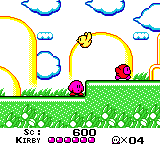
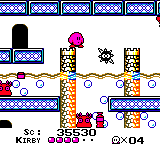
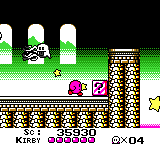
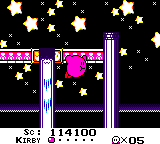
Kirby games tend to have distinctive graphics, and Dream Land is no exception even if it is monochrome. But what would they look like if they were in color? Well we don’t have to wonder any longer, because of a romhack constructed by GreenAndACat. It ports the game to the Gameboy Color hardware, and it looks pretty darn great! They resisted the urge to make it too fancy, instead giving background elements broad swaths of primary color that look great when applied to the game’s simple yet iconic graphics. Have a look:
Green Greens is looking pretty sharp!
The water may look slightly glitchy, but its clarity is really appealing!
Image borrowed from Arcade Heroes-so that I can promote the post it came from!
It’s a great article! It starts out covering the classic-era games everyone remembers, Donkey Kong, Donkey Kong Jr. and Mario Bros., and then slowly gets less and less well-known. It even mentions the two Gottlieb pinball games!
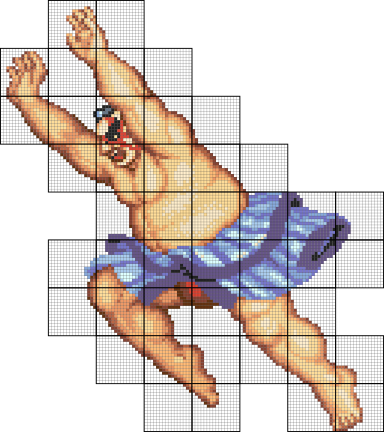
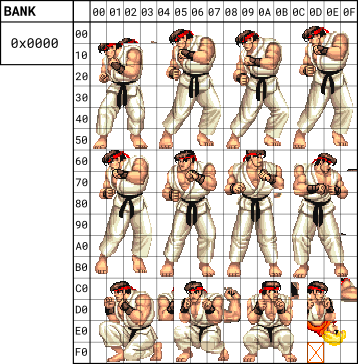
Street Fighter II has some really complex spritework! Its characters don’t actually use traditional sprites, but more what amounts to custom tile layers for each one. This helped unlock characters from being mostly rectangular, and allow them to have poses with radically different shapes.
Fabian Sanglard has a great article about how character art was created for that system that’s well worth your time to have a look at. Well, maybe it’s worth it? I don’t know you. For all I know you’re looking for sewing advice. This is probably the wrong site for that. No offense to all you clothes-makers out there.
ROMs were expensive, and Street Fighter II required a lot of them, so it was important to make the most out of each one. A big rectangular shape around Edmond Honda would contain a lot of empty, wasted space. Imagine how much space they would have wasted with Dhalsim’s long stretchy legs! With this system, they only had to include the graphics data that would actually contain pixels.
This was in 1991, mind you. More recent development practices would probably have the data be compressed in storage, which would take care of all those empty pixels, or at least they could make a tool to handle figuring out which tiles should contain data. What the Street Fighter II artists had to do was create physical representations of each character on a physical board, chop that up into squares, and figure out what each tile had to contain, a laborious process.
Fabian reckons this system was used for other CPS-1 games, going back to at least Forgotten Worlds. Looking at the tile layouts of CPS-2 titles, it seems a lot more evident that they used a packing tool to handle fitting their characters into the memory space. For more info, please go check out the article!
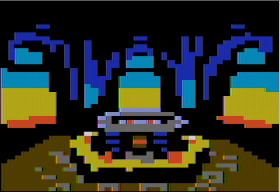
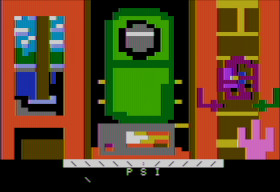
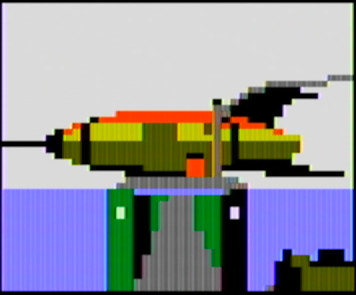
How much of Myst can you fit onto an Apple II with three 5 1/4” floppy disks? As it turns out, if you don’t really care about screen resolution, nearly all of it.
On Romhack Thursdays, we bring you interesting finds from the world of game modifications.
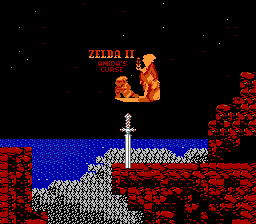
For a game notorious for its difficulty, Zelda II: The Adventure of Link has a lot of romhacks, most of which up the challenge level still more. Amida’s Curse is more of a difficulty level in keeping with the original, which is nice, and has some interesting ideas in it.
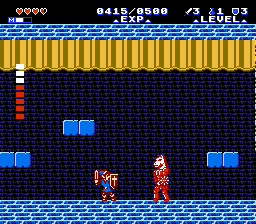
The Zelda II bosses are used mostly without change, although their new environments throw in some wrinkles.
Due to controller issues (PowerA’s cheaper wired version of the Switch Pro Controller has decided to mess up in frustrating ways) I have yet to play through the whole thing, but what I’ve seen has some interesting decisions. Amida’s Curse throws out the wandering monster encounters completely; there is no reason I can see to not wander around the landscape wherever you want. In fact you definitely should try to wander around a fair bit, for the game has bunches of secret areas waiting to be found throughout the landscape, hiding heart and magic containers, experience gems (which are a reskinned version of the original game’s P-bags) and sometimes required things.
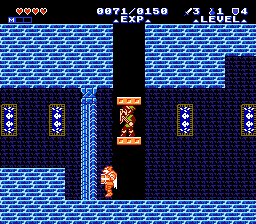
Fall off the elevator before descending to the ground and you might have to reset the room to go back up.
Amida’s Curse has a bit more terrain to cover than stock Zelda II. It’s got more towns (which are much smaller, a good change) and dungeons, and is split up more by item gating than before. In the first town you have to find a key, this lets you get the candle out of a cave, this lets you see in a cave leading to the next area, which has a dungeon with a Power Bracelet that lets you break blocks, that allows you to go through the next cave, and so on. It feels a bit like you’re being led by the nose, but that is often the style with these kinds of games, and it’s not like Zelda II itself didn’t have a fair amount of it.
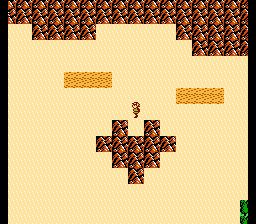
If you find interesting spots in the overworld, it’s worth it to check them out!
The overworld map takes a cue from the Famicom Disk System version of the game and has animated tiles, but instead of just animating the water, most of the tiles in the overworld are animated now. Towns have smoke coming up from them, and grass blows around. The combat scene graphics have been upgraded a little bit too.
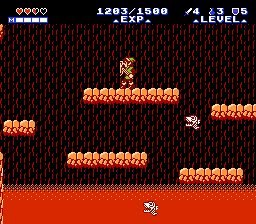
The difficulty balancing is pretty good. Romhacks that resist the urge to make you fight through gauntlets of enemies every step of the way should be lauded. It’s not perfect, I would say, there are places like where you have to jump over a skeleton on a collapsing passage, or make a big jump while being harassed by birds. And there are places where the design could use a little more work: it’s easy to get stranded in some rooms by falling off an elevator, requiring you to reset it, or in one notable case purposely die, to get yourself unstuck. And if you’re jumping water or lava that comes right up to the landing platform, make sure you clear it by a fair margin, as the game loves to kill you if your foot even grazes the perilous liquid.
Usefully, extra lives found don’t give you a one-time extra try, but increase the number you start each session with, which is a handy little improvement. I think a non-obsessive player can make it through, or at least from what I’ve managed to see. I look forward to trying to get further into this, when my controller isn’t fighting me every step of the way.
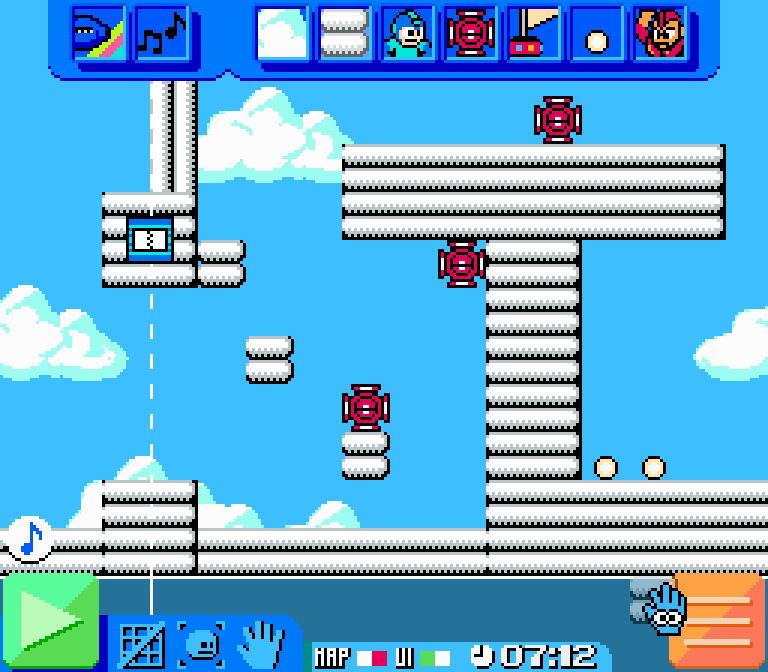
Mega Man Maker (available for PC, Mac and Linux) is a fan project to do for Mega Man what Super Mario Maker does for Mario games, and it’s very well-made! It has a huge variety of levels available on its website to play, although what seems to be an account creation bug makes it difficult to tell you about them from experience. In addition to Mega Man (a.k.a. Rock), it allows Proto Man, Beat, or fan-favorite character Roll to be included in levels, each with their own special abilities.
It has a pretty cool tutorial as well, in which Dr. Wily and Dr. Light explain how the editor works. Their pixel artist really nailed that air of playful malevolence in Dr. Wily, who seems like he’d be fun to know if it weren’t for constantly trying to take over the world. Have a look:
I feel I should mention that it doesn’t contain all of the classic Mega Man series’ enemies and bosses, nor does it allow you to string levels together into a Mega Man adventure itself. As did Super Mario Maker, and SMM2 before its world creator update, it’s focused on designing single levels, although you can make them quite large, even big enough to be a whole adventure in itself.
Version 1.8 is due to come out in a few weeks, with a whole bunch of new features, and its creators have been busy hyping it up. We look forward to trying out the new version!
It’s Halloween, so let’s review a slightly spooky European computer game that got remade as a Gameboy title with an awesome soundtrack: Bubble Ghost!
It’s kind of a riff on Marble Madness, in that you’re controlling a round object with momentum-based movement through a perilous made of obstacles. But you don’t control it directly: instead, you play the part of an incorporeal spirit that imparts motion to the object, a fragile soap bubble, by applying its ghostly breath. This whimsical concept backs a wonderful little action game. All the versions are pretty much the same game, and they’re all pretty short, with just 36 single-screen levels, but it takes a lot of skill to guide your wobbly ward through the whole maze.
The ghost can pass harmlessly through objects, and the amount of motion applied to the bubble by your breath depends on how close you are to it, which gives you a fine amount of control over its passage if you’re skillful enough.
The Commodore 64 version (below) has jerkier motion for the bubble than other versions, but has atmospheric sound:
The Amiga version is pretty representative of most of the 16-bit versions:
The Gameboy version was implemented by Japanese programmers, has a cuter protagonist and graphics all around, has great music, and an actual ending (though it’s still really brief), but it’s still the same game:
Protomagicalgirl did a speedrun of Gameboy Bubble Ghost at SGDQ2016:
There’s also versions for Atari ST (has an option to play its music out the MIDI port!), MS-DOS, Amstrad (some funky screen trasitions in this one), Apple II GS (not a complete play) and Windows (from 2003, also not a complete play, and has the flair of a bootleg clone). It’s also on Steam, released there in 2018, although that seems to be a direct recreation, maybe even emulation of the DOS version, which is one of the worse versions, with terrible sound.
According to Mobygames, Infogrammes remade the game as Bubble+ on some platforms, and didn’t pay the creators for sales of those versions! I don’t know if the creators get anything from the Steam port.
On Romhack Thursdays, we bring you interesting finds from the world of game modifications.
The early days of JRPGs contain many games that are kind of difficult to play today. The genre was just getting formulated, and while there was a lot of ingenuity and interesting ideas being played with, there were also many games where difficulty, and grind, were the entire point. When a game as simple as Dragon Quest, known first in the US by its localized title Dragon Warrior, had to justify its sale price, it had to present players with an experience that would be as long as a challenging NES platformer, or longer, within its limited memory space, and it did so with grind, asking players to accept fighting hundreds of monsters one-on-one in a basic menu-based combat simulation as fun enough to make up for most of the game.
At the time, in Japan, it worked, but it’s telling that Dragon Quest II has much deeper combat, and many more kinds of monsters, than its predecessor had. Dragon Warrior had a tough time breaking into the US market because of its simple gameplay, enough so that eventually Nintendo, who published the game in North America, resorted to giving away copies as a subscription premium for Nintendo Power.
What was a tough sell to Western players even then is much more difficult to enjoy now. Compare it to the much deeper, not to mention longer and better animated, titles made later in the series. It’s mostly enjoyable only for nostalgia factor and historical interest.
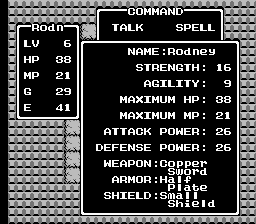
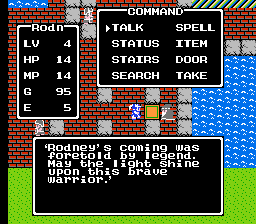
I’m not going to claim it fixes everything the game, but this hack improves its play a lot by decreasing gold prices and experience requirements ten-fold. It decreases costs: changing the earn rate of these quantities would very quickly hit Dragon Warrior’s fairly low variable caps, since the game stores both in 16-bit values. You can take the 120 gold you get from the King’s chest, buy an 18 gold Copper Sword in Brecconary, then run to the north-west to Garinham and buy the sturdy Half Plate armor for 100! With these items, even at low levels, you should be able to vanquish all of the enemies in this section of the map, except perhaps Magicians, whose Hurt spells bypass armor. But it only takes defeating one Slime to reach Level 2, two more for Level 3, and two more than that for Level 4. Slimes won’t suffice for long, but by that point you can munch on much stronger foes. This greatly reduces the number of fights a player must win to complete the game, and makes it possible to finish in less than two hours.
You can very quickly rise to decent levels of power in the starting area! You’ll still be humbled if you try to rush late-game enemies, but you don’t have to spend long building your character at all.
This guy is the Magic Refill Wizard. Don’t pay those exorbitant Inn prices, use your Heal spell repeatedly and talk to him!
Preserving some modest amount of challenge, the gold costs of Inns are left the same, making them effectively ten times more expensive. Inns were never very expensive in the unmodified game, so this makes staying the night to restore your HP and MP more of a strategic choice. A tip: remember there’s a guy in Tantegel Castle who will restore all your MP for free!
If even a two-hour Dragon Warrior is too much effort for you, you could watch this playthrough of the hack on Youtube, which is about an hour and a half in length:
‘@Play‘ is a frequently-appearing column which discusses the history, present, and future of the roguelike dungeon exploring genre.
I’ve been lagging behind a bit with @Play, which I apologize for. There are a lot of Angband variants, and even just covering important ones, there’s a lot to go over, and I’ve suffered from many distractions lately. So I figured I’d just take a more leisurely pace for a bit, which works out because many variants have quite a bit to say about them. So let’s start out with what’s probably the most important Angband variant of them all:
Zangband
Lineage: PC Angband 1.3 > Angband– > Zangband
First released in 1994. Last update 4/2003
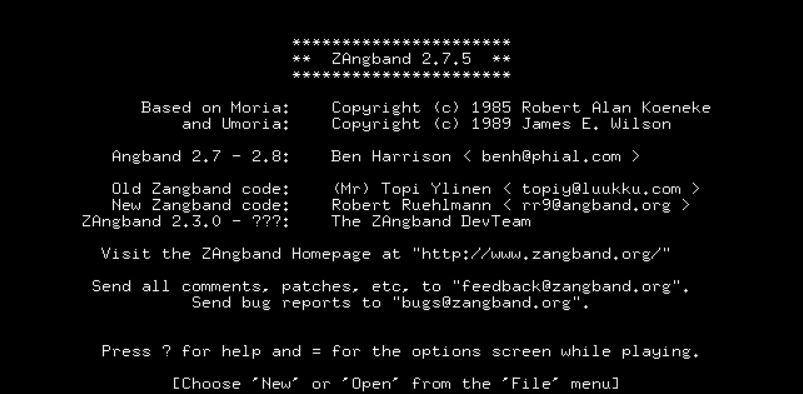
We could consider Zangband to be the first major Angband variant. It forked directly off of frogknows, but contains modifications to Angband dating after that. Its list of maintainers includes Angband maintainers Ben Harrison, and Robert Rühlmann, who took over as lead maintainer Zangband from Topi Ylinen. Of note is that he stopped being the maintainer of Angband at around the same time that Zangband entered stasis, and previous Angband fansite Thangorodrim went dark. Maybe Morgoth finally got him.
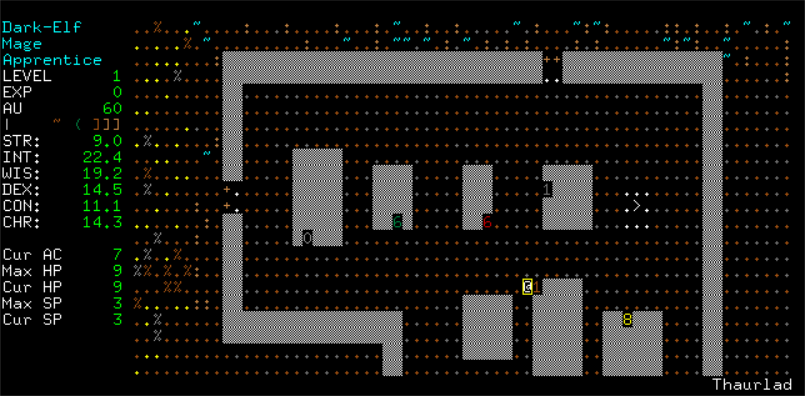
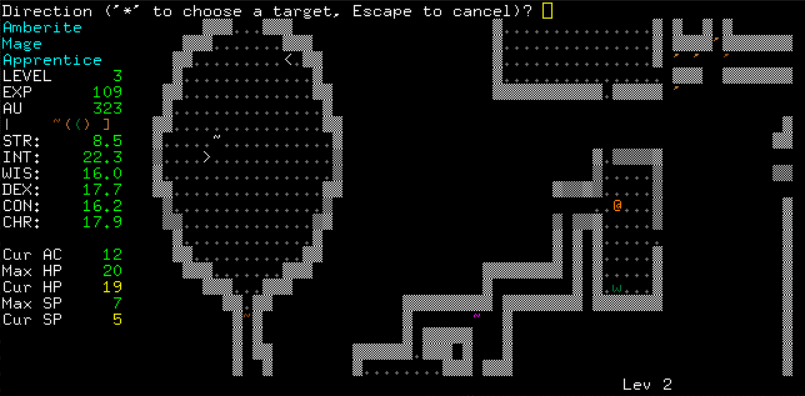
The standard Angband starting town can be shapes other than rectangular, have a wilderness outside its walls, and if you go far enough you can find other towns, with other kinds of shops.
It’s a tradition to name Angband variants with some variation upon its name. The Z in Zangband stands for Roger Zelazny, the author of the Chronicles of Amber series, and contains monsters and items from that series. Cribbing from fantasy literature has long been a way that roguelike authors have paid homage to their favorite stories.
An interesting aspect of Zangband is its version of the Angband character auto-roller. Instead of going until it hits minimum stats that you specify, asks you to “weight” various stats on a scale of 1-100, and then rolls 500 characters and picks the best one rolled as judged by those weights. This means you can’t just set your character to roll dice indefinitely until you get the perfect character–or at least, you can’t do that automatically. Nothing stops you from killing the process if you don’t get a character with stats you like and trying again, as many times as you like. Statistical cheese has, after all, long been part of the flavor of rolling up character stats, dating back to all those D&D house rules groups used to make characters more powerful/interesting than typically produced by the old roll-3D6-six-times-then-assign system.
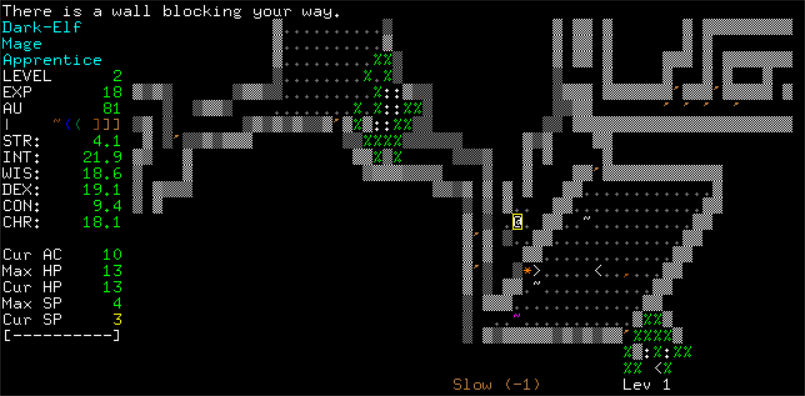
Standard dungeon levels look like classic Angband for the most part.
In addition to adding a lot of new character classes and monsters based on the Amber books, and other sources as well because why not, Zangband opens up the world outside the starter town. You can step past the walls of Angband’s town and see the outside world! That world works rather like a horizontal dungeon: instead of diving down into the earth, you can explore outward in all directions through the wilderness, which is filled with varied terrain kind of in the style of Minecraft. A new character can die very quickly that way, however; unexpectedly, the first levels of the main dungeon are rather easier to survive than just outside the town’s gates. If you have a means of defeating strong monsters, though, it’s possible to gain levels very rapidly without traveling too far from the starting town.
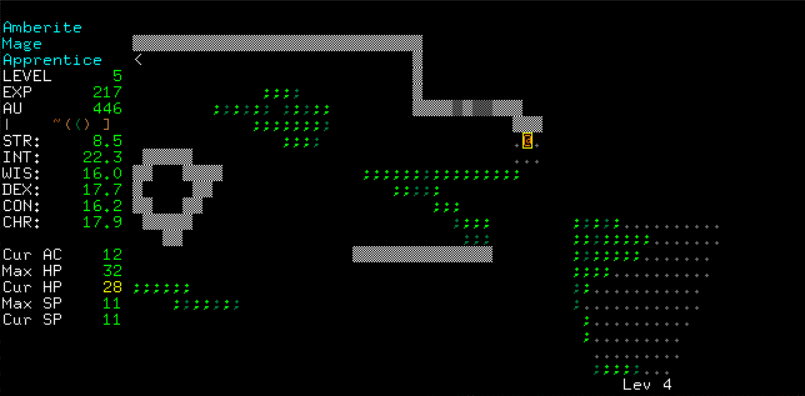
Some of the overworld terrain elements can also appear in dungeons. These green marsh plants do damage if you wade through them.
Out in the wilderness there are other towns to find, some of them with their own entrances into the dungeon (which work just as if you had entered it from the main town). As you progress out further from what we might call Point Zero, the monsters found in the wilderness get more dangerous. Some towns have special kinds of shops that are not to be found in the starting shop. The game’s bosses, which have been changed to the Amber-flavored Oberon on Level 99 and the Serpent of Chaos on level 100, are only found down in the dungeon.
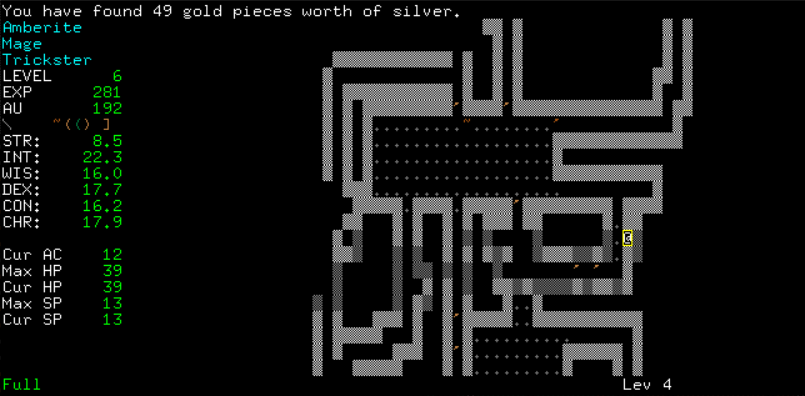
In addition to various kinds of room template designs, sometimes you find a whole themed level, like this huge swamp area.
While it did pick up some of Angband’s later advancements, it still halted development nearly two decades ago. Angband has changed a fair bit in the time since Zangband became frozen, so to speak, in Amber. Playing it requires getting used to the many little things that Angband has abandoned in more recent years, like having to actively search for secret doors and traps. If you’re playing a magic-using class, it’s possible for your starting spellbooks to get incinerated by a fire attack, then for you to head back to town and find that it’s not for sale. Once you’re alert to the danger of this, you’ll know to buy extras when you can and keep them in your house. It’s the kind of affliction that affects most players exactly once, which is a common enough experience in the world of classic roguelikes.
We’re back to classic Angband rules here, so selling things you find in the dungeon is an important source of money.
Zangband is notable for itself inspiring a bunch of variants, in fact a lot of Angband variants get those genes through Zangband as an intermediate parent. Its inclusionist philosophy of adding a whole bunch of monsters and things, and its inclusion of a persistent overworld (which it originally borrowed from Kangband) might explain the attraction.
While Zangband hasn’t been updated in nearly twenty years, its website persisted doggedly until just earlier this year, at zangband.org. Sadly, it has finally succumbed to linkrot, and now can only be found through the graces of the Internet Archive. Its Sourceforge repository still exists however, meaning you can still obtain the game through a living site, at: https://sourceforge.net/projects/zangband
The above abbreviation stands for “the Game Eating She Monster,” but that’s a lot to put in a post title! Kimimi has a great blog, with a great post from 2021, about the construction and requirements of a game FAQ, of the type that were (and sometimes still are) posted on GameFAQs, unless/until recent buyer Fandom.com kills it. It covers the basics you need to know if you wish to help keep this ancient and revered art alive, including this:
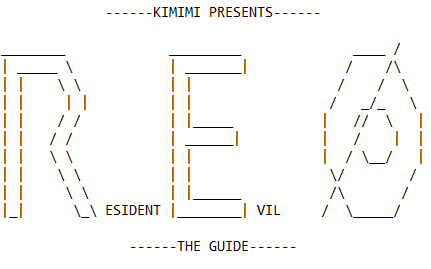
First things first: ASCII art. Everyone knows no amount of text, helpful or otherwise, is a proper guide unless the top of the page is decorated with ASCII art. This is an unbreakable universal law, on a par with gravity and cats being whatever furry shape suits them best at the time.
Kimimi
Title art looking good! Made by Kimimi herself, as should be obvious.
On Romhack Thursdays, we bring you interesting finds from the world of game modifications.
Castlevania II is an infamous entry in the series. While it’s the first Castlevania game to use the “Metroidvania” structure that would be more solidly associated with it after Symphony of the Night, there were a lot of… controversial elements? Townsfolk often lied to the player (in all versions of the game), and sometimes their hints were badly translated. A few places required the player to do arbitrary things without much prompting to proceed. And there were the timed scene transitions, between day and night, which some people have (rather unfairly I think) fixated upon as a major flaw.
There’s more. The Japanese version of the game came with a map of the countryside that was left out of the U.S. release, meaning, some locations in the game were not even given names that a player could discover in the game, which in a couple of places required them to guess which location was meant by a clue.
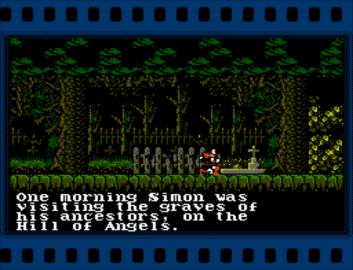
Part of the new prologue
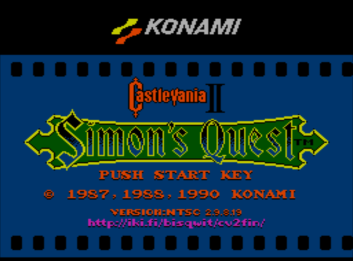
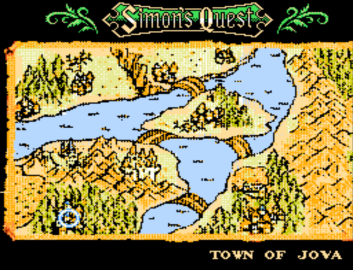
To the rescue of a player trying to appreciate this game now comes Bisqwit, a.k.a. Joel Yliluoma, and his Castlevania II Retranslation project. It doesn’t remove the townspeople telling incorrect things (which was intended by the developers-why should a random villager happen to know for certain anything to do with destroying Dracula?), but it does make their hints more comprehensible, remove the reliance on guidebooks and FAQs that have interfered with the efforts of many to enjoy the game, and it greatly speeds the transitions between day and night. It even offers an animated prologue (wait from the title screen) and an in-game map, based on the one in the Japanese manual, to lend context to the player’s explorations.
The map. Pretty nice!
There are plenty of other new features too, such as an end-game report that gives your win time and SRAM-based (battery-backed) save games. Some of the new features require better hardware than the original game had, which may limit what devices can run it, so Bisqwit thoughtfully provides a website that allows the player to customize the modification to their liking. Go there, choose the options you want (which includes language – if the site isn’t in English click the button to the left) then click the Download button to get a version with features set to your requirements and/or liking.
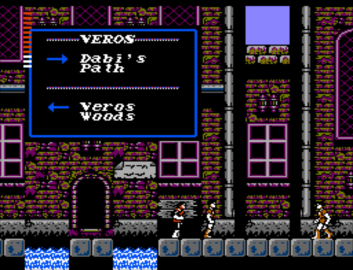
Towns get more helpful signposts!
Lots of romhacks seem superfluous relative to the original game, but Bisqwit’s translation patches substantively improve upon the original game in many ways. It really is the best way to experience Castlevania II. If you’ve played it before you should give it a try; if you haven’t, I strongly suggest playing this version, instead of having to suffering through the original’s quirks. At the very least you it’ll mean won’t end up having to resort hunting up a thirty-five-year-old FAQ before the end.
And if you like the patch, why not have a look at Bisqwit’s Youtube channel, which has a lot of interesting technical content on it, much of it unrelated to video games?
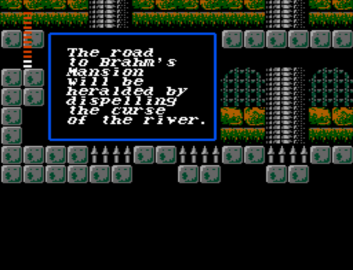
The hidden clubeooks get more useful advice, and you can even enable a hint viewer that records the books you’ve found during the game!