A highlight of the Games Done Quick speedrunning marathons at roughly six months apart each year is AGDQ’s “Awful Block,” of memorably bad games, and SGDQ’s “Silly Block,” of extremely weird, mostly-indie games. SGDQ has just wrapped up, so let’s take a look back at Silly Block this year.
The plot hangs together slightly better than DEEEER Simulator, but it’s largely the same kind of thing, bizarre settings and happenings within a physics engine, only this time you’re a drunken Italian man instead of a “deer.”
This one is actually a race between two players, in a cart racing game made with silly carts, in a mode where half the racers are driving one way around the track, and the rest drive the other way. (The race isn’t directly between them on the same tracks; they’re both playing their own systems. They’re racing in more of a speedrun fashion.)
A side-scrolling brawler where you beat up weird thugs and robots that drop food, which you then make meals with. The ingredients you choose determines which stat boosts you receive! It’s less zany than the previous games, if that’s the way your tastes (heh) lead.
“Imagine a game in the Baywatch extended universe where there’s a talking boat and Hulk Hogan is deus ex machina.” Actually the last episode of the 1994 TV show Thunder in Paradise converted, kind of, into a game for the Phillips CD-i. Most of the run is just video footage, but it was a really goofy TV show.
Ah, this one is, somehow, not an indie title! Published by Titus for the original PlayStation, and with music from the Tokyo Ska Paradise Orchestra, Incredible Crisis is a minigame collection where success at the games helps to avert ridiculous dangers to one of four members of a family.
Friday night at SGDQ 2022 the TAS Block show demonstrated something special. After a recording of a Portal 2 run that predictably demolished that game, they moved on to a rather more esoteric show.
In past shows, TAS Bot has some off some pretty ridiculous sights, using something called Arbitrary Code Execution (ACE). Essentially, using certain well-understood exploits, the runner (usually, but not always, a set of scripted inputs) writes a sequence of instructions into the machine’s RAM, and then transfers the code execution to that sequence, allowing for “arbitrary behavior,” meaning, almost anything that can be written into that RAM. TAS Bot at AGDQ 2014 wrote Pong into memory during a run of Super Mario World and ran it (6 minutes):
This technique has also been used to run a variant of Flappy Bird, and even a bona fide hex editor into the save RAM of Super Mario World, without even needing scripts, entirely by a human player. But this is beside the point.
There’s several of these videos, which I leave it to you to search out. They’re pretty easy to find on YouTube with the search terms “games done quick” and “tasbot”.
The point of this post is to bring you news of how players finally “obtained” the Triforce in Ocarina of Time after 23 years. The video of the show has yet to be uploaded to YouTube (it has been since I wrote this! scroll to the end), but until it shows up, Retro Game Mechanics EX has a video explaining how it was done (34 minutes):
It has been 15 years since Kaizo Mario World introduced gamers to the notion of extreme difficulty. Since then, the rise of Kaizo games, Kaizo-likes, and of course speed running, can all be seen as a way of giving retro games new light.
By now, I’m sure all of you have either heard or seen a Kaizo Mario platformer, but this well runs far deeper than that. For today, I want to share some of the other games and trends that have given retro games a new, more challenging light.
Explaining Kaizo Difficulty
For those new to the concept, Kaizo is loosely translated from Japan to mean “remodel” and has since been defined by modders and level creators to describe brutally difficult remixed versions of games, particularly retro games. Super Mario World was the first game to get popular, and thanks to third-party editing tools and emulation (which of course I’m not going to link to here), has opened up the doors to people working on their own takes. And believe me, there are a lot of them out there.
I’ll be discussing the appeal of these games more in length further down, but for Mario specifically, we have seen developers who take the classic game and up the challenge to extreme lengths. We have also seen developers create original content and mechanics never before seen from the Nintendo classics, and design levels around them.
While I have certainly talked about Kaizo Mario at length before, let’s talk about some of the other examples.
Kaizo Metroid
You may not think that there are ways of extending the seminal Super Metroid, but it has also grown to have its own niche of custom versions and Kaizo design. The big difference between Metroid and Mario is the difference in movement tech and the technicality of the gameplay. In the Mario games, Mario’s move set is so tight that it has allowed developers a huge range of designing content to exploit it.
With Super Metroid, the tech is far more complicated with the added elements of ranged combat and boss fights thrown in. There have been speed runners who have done low% runs and sequence breaks thanks to advanced tech. For the harder Kaizo examples, these options are oftentimes required to stand any chance of winning. Since the game is open-ended, it also means that progress is a lot harder to define compared to the stage-based progression of Mario. Some examples completely redo rooms and the order, others may literally build a completely new world for players to explore.
Kaizo Super Metroid was ran at a GDQ (Games Done Quick) event and looks like an ordeal of challenging death traps and finger-destroying movement tech in order to play it.
Randomizers
One of the downsides of playing many retro games was the fact that random and procedural generation was not really known to the mainstream back then. Once a game was done, there was very little reason to play again if you knew where everything was. Thanks to modders of not just retro games, but some modern ones, we now have randomizer mode.
many of the resident evil games in the past have a bevy of mods for them now
Randomizers will literally alter the item placements of major and minor items in a game. While the locations of items remain fixed, what actually shows up at those points is completely random. For games that are built on item progression: Soulslikes, metroidvanias, horror, action-adventure, etc., a randomizer gives these games a whole new life.
Because your actual progress and major challenge spots remain fixed through the game, the challenge becomes remembering where all the item placements are, adapting to what you find, and using them to chart a path towards the other item spots. Attempting to do a Link to the Past randomizer, I realized just how poor my memory was of all the item spots. One of the craziest things I’ve seen in this space is a Super Metroid/Link to the Past duo randomizer — tasking you to play both games at the same time, switching between the two, and finding randomly placed items for both. For games that randomize enemy placements, you are going to have to juggle the randomly given items with the fact that you could get bosses all over the place and enemy encounters that were never suited for specific areas.
In the modern space, there are mods for randomizers in Soulslikes for weapons, enemies, items, or all the above. Personally, I think this is a fantastic addition and transforms linear games into infinitely replayable ones. With so many classic games having randomizers available, I’m starting to think that this could be an interesting feature to make standard for modern-retro or linear titles.
Extreme Retro
And now for the game that gave me the inspiration to write this piece. Super Mario RPG Legend of the Seven Stars is one of my all-time favorite games. Up until recently, it was one that provided a simple taste of action commands and was the perfect game for people who didn’t like traditional JRPGs. Over the last few years, however, there have been modders working on making this classic game into something else. A mod thatcompletely rebalances and reworks the entire game.
This mod adds in additional action command timings, adjusts the stats of every character in the game, adds new skills and weapons for everyone, and also adds something that the original game never really had: a post-game. Sure, there was that one fight from a Final Fantasy boss, but here, the modders have put in bosses from as many Square Enix games as they could fit (being a free mod for a rom does have some advantages in avoiding copyright issues).
With the improvements of engines and the ingenuity of modders, even not-so-retro games have started to see mods like this. There have been content mods for the Souls games, and surprisingly enough — difficulty mods and original stories for the original Resident Evil trilogy. Some of these mods are arguably on the weird side: such as having Kendo run all over the place. Others take the difficulty to levels no one ever considered back in the day or do something completely original for the game. In some cases, modders are fixing some of the imbalances and problems in these games and give something back to the games we remember fondly.
Why the Appeal?
It may be easy to think that the modders could be spending their time doing something more productive or working on a game of their own, but there is something deeper here in terms of the “why” of creating content like this.
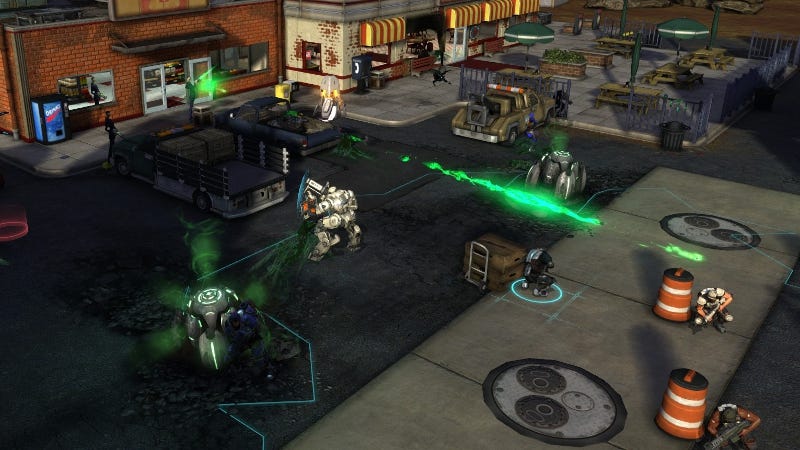
For the past 30 years, the ease of which games could be modded ranged from “easy” with games that came with SDKs (software development kit), to impossible for console games with no PC version. One of the more famous mods of the last decade: The Long War for XCOM Enemy Unknown was built by a team who had to create their own toolset along with the mod as XCOM had no SDK. For The Long War, the desire was to take a game that the creator loved and go even further to create their dream version of it.
The Long War mod is an example of modders wanting to make their favorite game even better
I’ve been wanting more non-programming-based ways of working in games for years now, and why Super Mario Maker was such a big deal. However, being limited by both being on the Switch and Nintendo’s general lack of wanting to continue supporting it has hurt its longevity. There are “unofficial” modding tools for several classic games that if you know about the game, you know where to find them.
Being able to use classic games as a metaphorical canvas to then work on is a great way to give these games more life. For a lot of these games, the original creators are either no longer able to work on them, or there might not even be a way to play them normally. I could go on a huge rant right now about game preservation and emulation, but everyone knows my thoughts on this already. While not every mod is a winner, the ones that stand out could easily sit side-by-side with the greatness of the original games.
Much like how some of the most popular mods get integrated into their PC games, I would love to see creators acknowledge and celebrate these mods without fear of a lawsuit or takedown. And maybe someday, someone will create the ultimate 2D action game and call it “Streets of Josh,” or “Super Josh Deluxe” or Devil May Josh” but one can dream, right?
Owner of Game Wisdom with more than a decade of experience writing and talking about game design and the industry. I’m also the author of the “Game Design Deep Dive” series and “20 Essential Games to Study”
Scattered throughout the World Wide Web (which, I remind you, is not the same thing as “the internet”) is a wealth of game information, although as old sites die out increasing this info is really hosted on the Wayback Machine. I previously presented the Bubble Bobble Info Pages, which are among my favorite game sites of all.
Image from hardcoregaming101
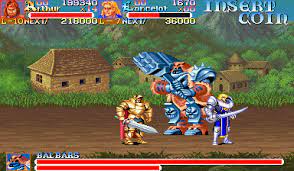
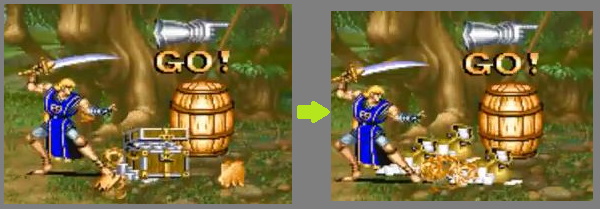
A relatively recent addition is this description of the great nuance in Capcom’s 1991 fantasy brawler Knights of the Round by Sebastian Mihai. It should be remembered that at that time Street Fighter II was already out and making it harder for games that weren’t one-on-one fighters to succeed. Capcom had a lot of experience with belt scrollers at that time, having made Final Fight and Dynasty Wars by then. A few years after they’d make the (IMO) even better Dungeons & Dragons brawlers Tower of Doom and Shadow Over Mystara, which I think are probably the pinnacle of the genre.
Image from site
As just one example of the thought that went into Knights of the Round, most of the pickups in the game can be struck with your character’s weapon, and this splits them up into multiple smaller treasures, that are both usually worth slightly more than the original, and if desired can be shared with other players. It’s the only brawler I know of that does this!
If you’ve followed the speedrunning scene for a while, you’re probably familiar with fcoughlin‘s Zelda Randomizer. It’s a program that can take a rom file of The Legend of Zelda and “scramble” it, in ways that the user can specify, in order to make it playable afresh, even for people who have played through it dozens of times already. It can move dungeon entrances, dungeon layouts, item locations, enemy placements and much more. And its changes can be encapsulated into a seed value so multiple people can be guaranteed of playing the same version of the game.
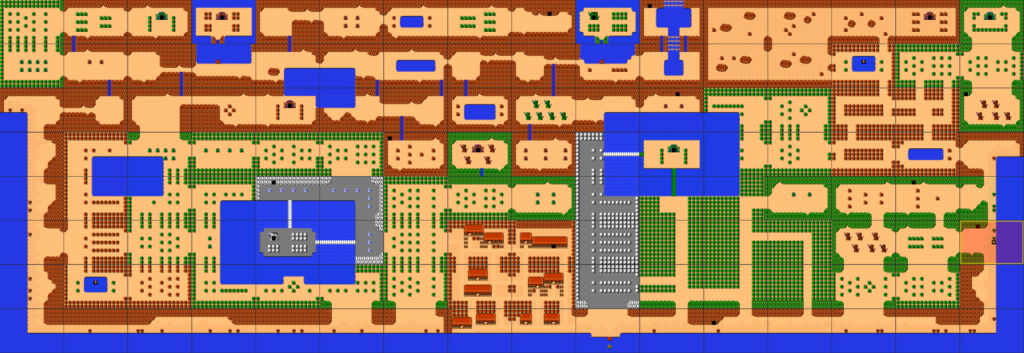
But for everything Zelda Randomizer can do, one thing it cannot do is change the game’s overworld. All of the familiar Zelda landmarks, the Central Lake, the Lost Woods, Spectacle Rock, and the rest, will be present and in the same places. That is where Infinite Hyrule (forum post, BitBucket) comes in. It’s a program whose purpose is to randomly create new overworlds for The Legend of Zelda, and to insert those into a rom file.
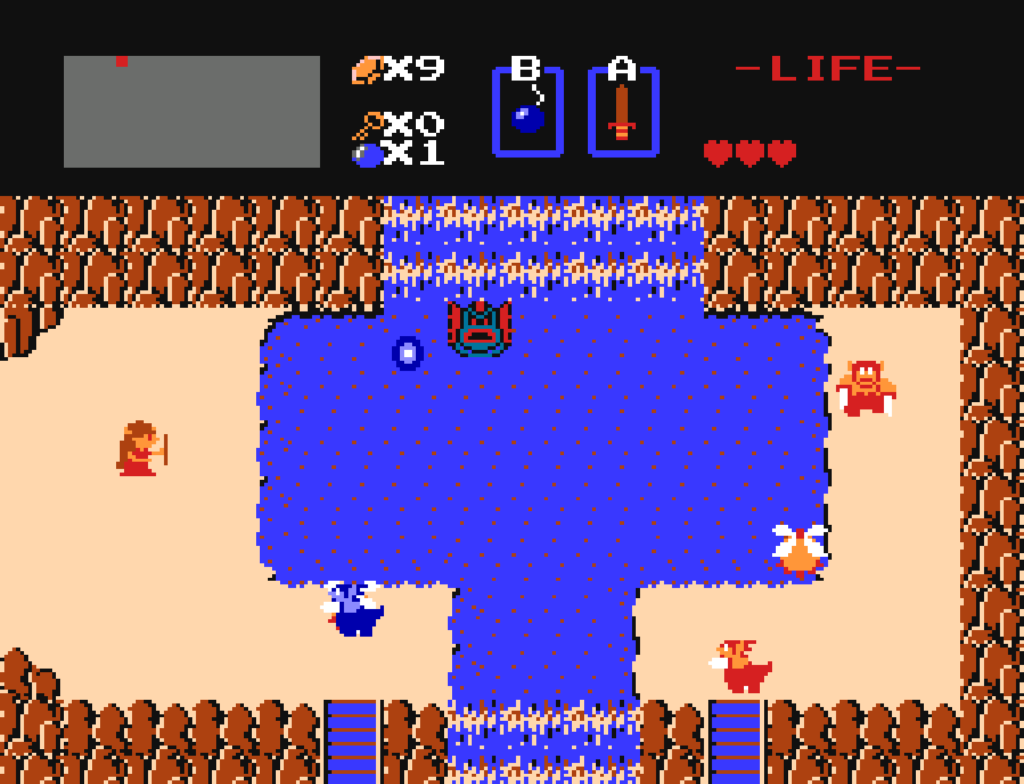
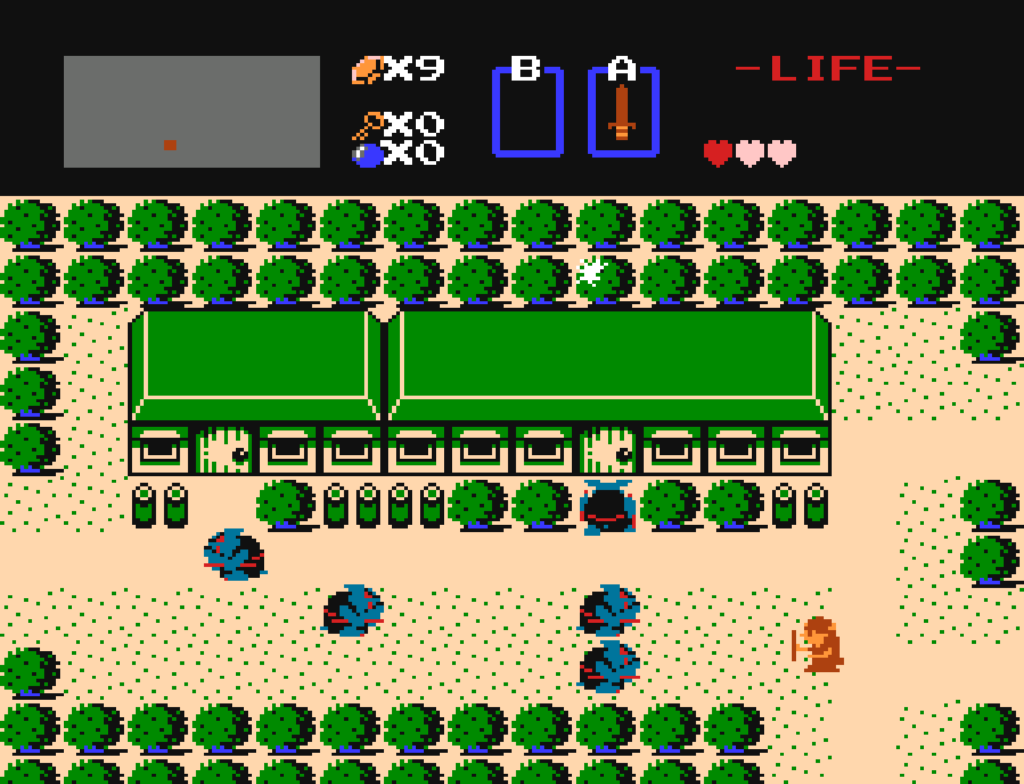
Gah, Lynels! Nice waterfall though.
I should take a moment to impress upon you how difficult that job is. There’s a good reason fcoughlin never built an overworld randomizer himself. The Legend of Zelda doesn’t store its game world in an obvious format. To get around this, Infinite Hyrule actually expands the rom file, so it can avoid the original game’s convoluted system, which stores each overworld screen as a set of links to vertical sets of tiles.
This partially explains the unusual structure of Zelda’s landscape, and why a number of structures, like the round boulders of Spectacle Rock and the dungeon entrances, are reused in multiple places: there is only room for so many vertical strips of surface tiles in the game’s ROM chips. To create a program capable of generating new overworld, a programmer must not only keep this limitation in mind, and work within its stricture, but must also follow the usual checks to ensure the game is still winnable.
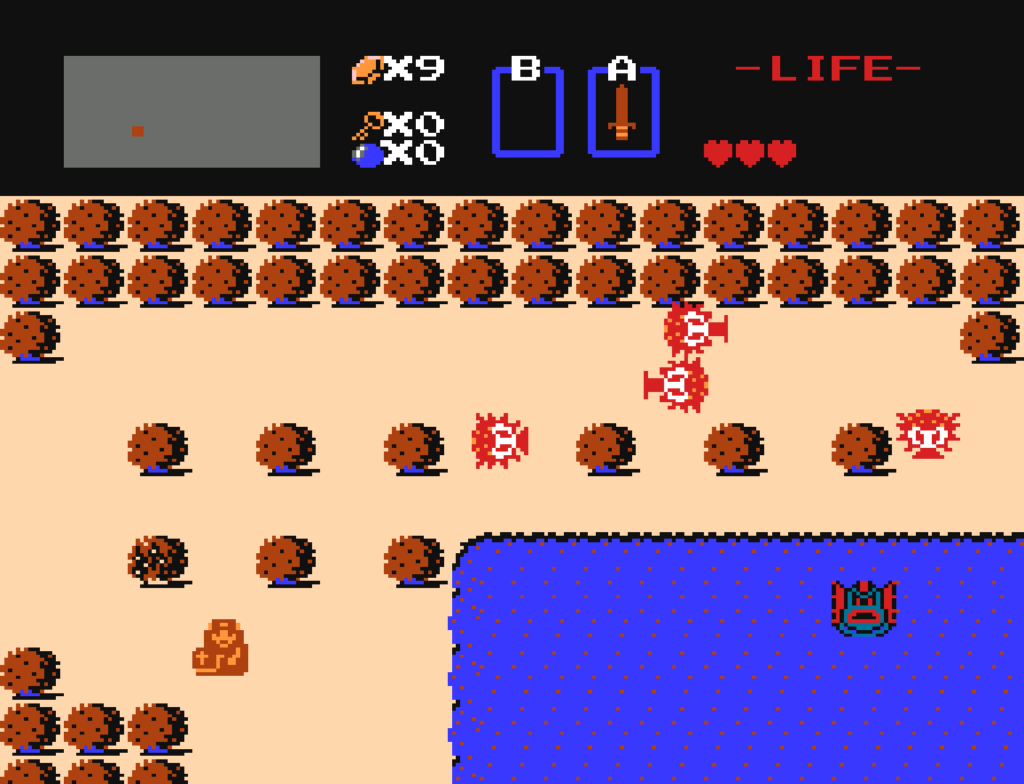
Note that tree in the bottom-left
But it’s not even necessary to combine the two tools into one, for Infinite Hyrule can work work with Zelda Randomizer! You just have to make sure you use Zelda Randomizer first, and that you restrict yourself to only using certain flags. I personally find the flag string cHBRDMIhioEeNCb14OPhBo useful for mixing things up acceptably.
In addition to mixing up the overworld and maintaining the unique feel of The Legend of Zelda‘s map, it implements a few new kinds of screens, including a village with houses, and can produce a map of the generated world too. That should keep you going for quite a while. And, if you’re not 14 any more, it can even be set to reveal LoZ‘s infamous secret caves with graphical tells of their location. That’s such a nice feature if you want to explore a map in a reasonable time frame, instead of resorting to the original game’s technique of testing every square. Since, after all, none of us are 14 anymore.
Showing off the new village biome
If for some reason you want a similar treatment for Zelda II: The Adventure of Link, you sadist, there is no need. The randomizer for that game can generate new overworlds without need of a separate utility. I’ve played quite a bit of that, and will tell you, if you thought the original game was hard, the randomized version can be ludicrous.
Chrontendo’s back! Dr. Sparkle’s long-running journey through the entire library of the Famicom and NES continues. He’s been doing this for at least 15 years! Chrontendo got its start as a blog, then moved to a YouTube format, although every episode is also uploaded to the Internet Archive. Dr. Sparkle tries to complete the games he covers, meaning, sometimes it takes a very long time to construct an episode, especially when it contains a lengthy JRPG.
In addition to being generally watchable by anyone with even a passing interest in video gaming history, Chrontendo is a good series just to have on in the background while you do other things. What I’m saying is that it’s comfortable. Like Comfortable Doug! (warning: earworm)
Chrontendo 60 is subtitled “The Most Perverted Episode,” covers April through May of 1990, and features:
horse racing sim Kurogane Hiroshi No Yosou Daisuki! Kachiuma Densetsu,
a long section the original Fire Emblem and the series in general,
Rare’s PinBot, a very unique and interesting simulation of a real Williams pinball table with some unique video extras,
GameTek’s home version of the Nickelodeon game show Double Dare, which was also made by Rare,
the ludicrously-titled Dinowarz: The Destruction of Spondylus,
Imagineering’s Ghostbusters II,
Ivan “Ironman” Stewart’s Super Off Road, by Rare,
a very long section on the epic Final Fantasy III, from and by Square, which Dr. Sparkle proclaims to be the best JRPG on the system,
Kagerou Densetsu, a “sorta action RPG thing” published by “Pixel,” but we’re not sure who exactly that is, and may have been intended, it is speculated, to be a kind of RPG-ish sequel to The Legend of Kage, and
Nintendo World Cup (forgive me for not typing out the entire Japanese title), that weird Kunio soccer game that Nintendo published under their own banner, just with all the story and setting removed. It’s a decent soccer game even so.
With this episode, Dr. Sparkle is declaring a dividing point for the series. Up until now has been the rise of the Famicom; the rest covers its fall, what he calls the “Byzantine Empire” phase of the system’s life. This doesn’t mean the series is almost over though. Far, far from it.
‘@Play‘ is a frequently-appearing column which discusses the history, present, and future of the roguelike dungeon exploring genre.
So let us talk about what is probably the worst thing about Omega: it’s capriciousness.
If you read the experiences of the CRPG Addict you might be given to thinking that Omega is actually pretty easy. Judging by the title screen on his review, he was playing 0.71, a version I don’t have access too, and may actually no longer be available anywhere on the vast World Wide Web.
My version is 0.80, which it seems like it must be harder than his. Also, he backed up his save games, which, while the instructions specifically suggest it if you’re having trouble, is still cheating. All of my games have been played traditionally. And let’s be clear as to why: because I’m a snob. A roguelike snob.
Of course most classic roguelikes have a degree of deadly capriciousness, but for some reason it’s especially bad in Omega. I don’t think I’ve seen a game with as many ways for a game to go from terrific to dead instantly, often without warning and in a single turn.
Here’s a list of ways this can happen, most of which I’ve personally seen.
To get it out of the way: you can be struck by a cosmic at nearly any time above-ground (and even underground? I don’t think so). That does 10 damage purely from random chance, with no way to avoid or reduce it. If you have less than 10 HP, your game is just over. Some characters don’t even start with 10 maximum HP. Cosmic rays are triggered at two different places in the code, on tables for indoor events and outdoor events. My reading of the code indicates that indoors, a check that can produce a cosmic ray happens every ten game minutes, and outdoors it’s every game hour. However, depending on the terrain, multiple hourly checks can be made per move. Cosmic ray hits are far from the only bad things that can happen per hour, so it’s best to go by road if you can, and with other travel aids if possible.
The hedge maze in Rampart is a terrific source of deaths. Traps in there can absolutely wipe you out, or else make the game unplayable. Traps exist elsewhere, but the hedge maze both has a higher density than elsewhere (it always seems to have at least one, and probably has several), and is right there in Rampart. There are a small number of possible layouts for the maze, and traps tend to appear in the same kinds of places, so eventually you figure out where you should search. Specifically: fire traps and scythe traps do a lot of damage, an abyss trap can bestow a bunch of falling damage arbitrarily and effectively teleport you, acid traps do damage can destroy multiple pieces of equipment, a disintegration trap can destroy equipment or kill you outright, and an alarm trap won’t do any damage, but it will make all the guards in Rampart permanently hostile, dooming your character unless you can take them, which is unlikely at the point in the game when you’ll be exploring the hedge maze.
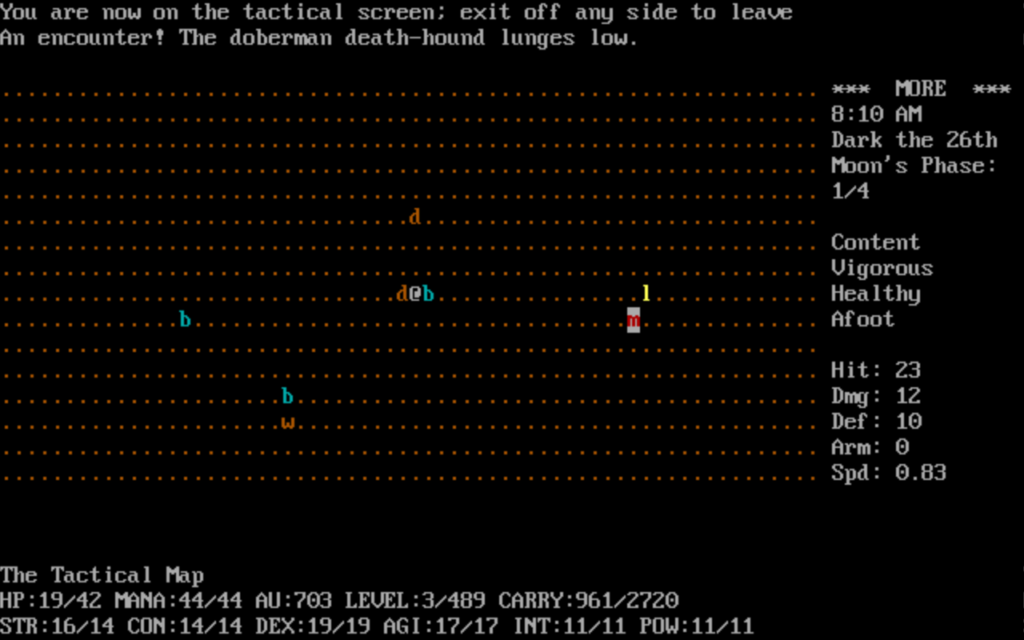
Once you step out of the starting city of Rampart there’s the countryside, a whimsically deadly region where you can have “encounters,” during which you may be killed (I can attest) by bandits, goblin shamans, lions, bears, bog haunts, mirrorshades, liches, or even “doberman death-hounds,” who are both fast and get lots of attacks. Encounters can generate a monster right beside you, and in that case the game even gives it the first turn. Many times my games have consisted of spending the 15 minutes or so getting all my chores in Rampart done to get my character started, leaving town, getting an encounter on the way to the Archdruid’s temple, and getting wiped out literally before I could do anything. The only thing you really can do about these situations is decrease the amount of time you spend outside.
What did Lawrence Brothers have against dobermans?
I’ve died to random encounters three games in a row before: #1: Upon exiting the Archdruid’s temple, immediately, a random encounter. Then, in the tactical map, they got a turn before me and I died. I don’t even know what it was; it was invisible and killed me with a missile. #2: Upon exiting the city of Rampart, again before I got a turn, a random encounter. This time it was a goblin shaman casting spells. One was an area effect spell that killed the caster and awarded me an experience level, but then also killed me. #3: I got some steps towards the Archdruid’s temple before I got a random encounter that completely surrounded me with hedges. Trying to wade through them poisoned me to poison death.
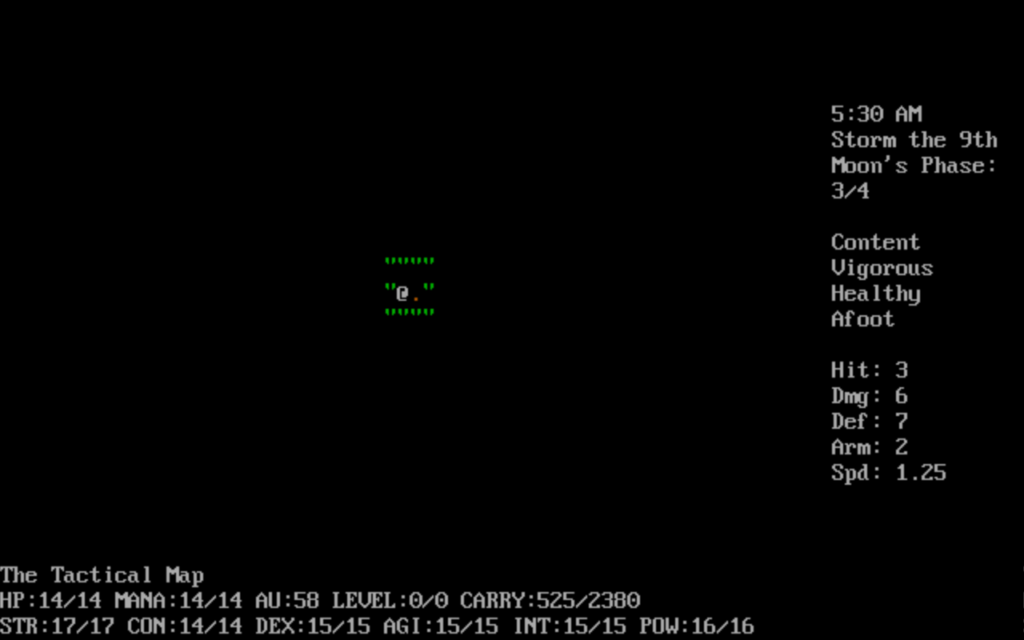
How did I even wander into this situation?
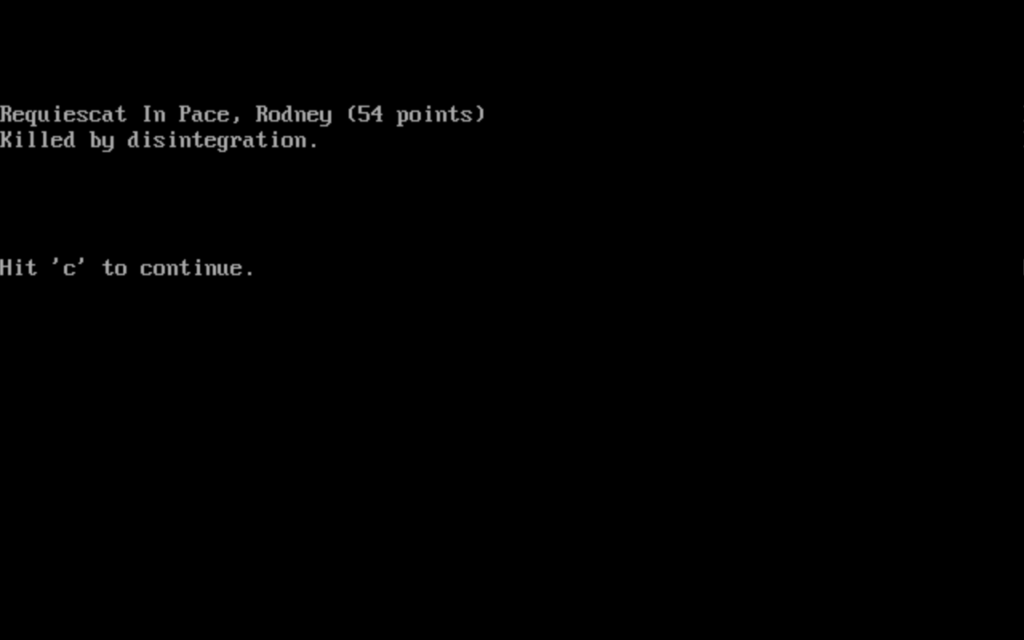
Disintegration traps deserve special mention. I have again checked the game’s code and discovered the logic is: when you activate one, if you’re wearing a cloak, it’ll get disintegrated, no checks, no save, it’s just gone no matter what it is. If no cloak, it’s your armor that gets disintegrated. If no armor, it’s you. Traps in Omega are not common in the Goblin Caves, but can be anywhere there, and there’s lots of space for them.
Back to the hedge maze. Monsters can get generated there too, sometimes out-of-level ones, like lions, bears, “were-swarms,” frost demons, or pterodactyls. It’s right by the cemetery too, and sometimes it gets incorporeal visitors from there.
The hedges themselves can easily kill you. The game always asks if you’re sure when you accidentally miskey into one, thankfully. If you answer ‘Y,’ you open yourself to be stuck to the brambles for a not-insignificant number of turns, getting poisoned (easily deadly if you’re still at level 0), have your cloak ripped apart, or, if your luck is particularly bad, walking straight into the waiting tentacles of a trifid. Moral: YOU SHOULD ANSWER ‘N.’
Then there are the monsters who have unusually deadly attacks. Salamanders can breathe fire for high damage and from a distance unless you have fire resistance from a ring. Bog things can outright frighten you to death in melee. Until you learn that you should wear heavy armor to survive the Goblin Caves you’ll frequently get missiled to death by goblin chieftains, which are a prominent early source of fatality.
Learn to handle them, and later in the Goblin Caves your bane becomes goblin shamans, who can do a variety of awful things to you. The worst of these is sleep. If you get put to sleep, they’ll be able to get off several spells after. While somehow you can block their attacks, and even counterspell their continued enchantments, automatically while asleep, you’ll still often get slowed, snowballed, cursed, diseased, or poisoned. Entering a new level there is a particularly tense moment once these guys start showing up.
Oh here’s a good one. Fighting tooth and nail against goblin chieftains got my hit points down, but I was resting between fights and not doing too badly. Then not seeing any monsters around I walked across the room, happened to step next to a ‘1’ character, a statue. It came to life immediately as a salamander and promptly roasted my ass. I prefer my ass uncooked.
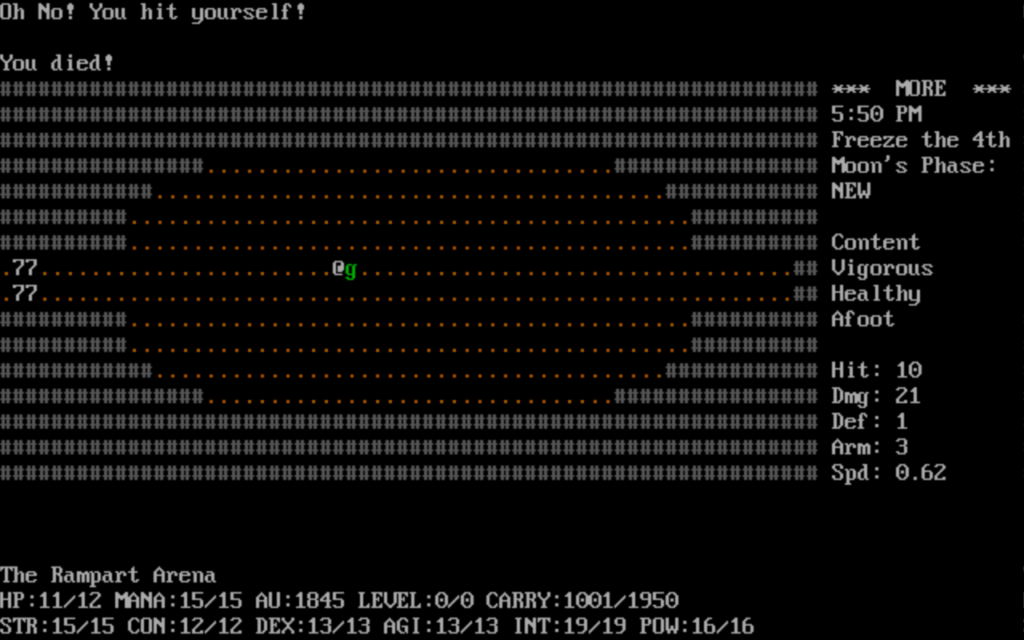
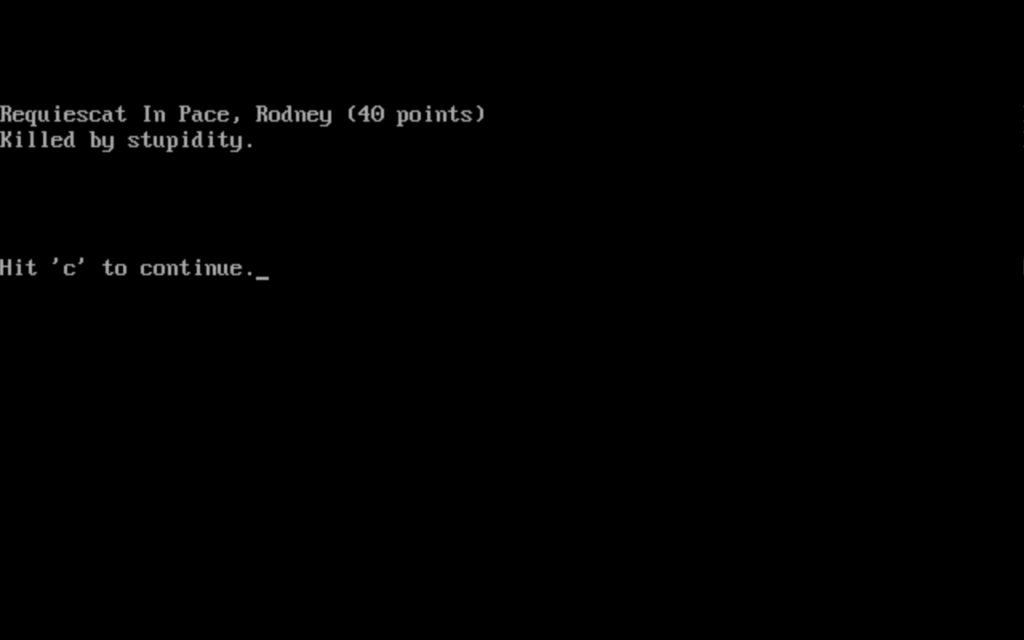
Get a load of this. Rolled stats until I got a character who had an Intelligence of 18, so they could join the Collegium Magii for free right away, and also could join the Gladiators. Did both those things. Bought ten buckets of Lyzzard Partes for early rations. Tripped over a hoplon, a good shield, and found both ring mail +1 and a war-hammer + 2 in the pawn shop. Found the Thieves’ Guild by dint of checking nearly every door in town. Joined the college but failed at the roll for learning a random spell. Went to the Arena and chose to fight the first opponent, a lowly goblin. Set combat tactics to Block Low then Lunge Center. On my first attack against the puny green foe, I take one hit point of damage from them, then: “Oh no! You hit yourself! You died!” Eleven points of damage from a fumble at level 0. That’s like having a fatal accident at after-school martial arts practice.
“Stop hitting yourself!”
At INT 18: “Killed by stupidity.”
It’s not just death that particularly bad luck can cause.
Weapons can shatter if you roll particularly badly in a fight. In general, you should consider your equipment in Omega as ultimately temporary.
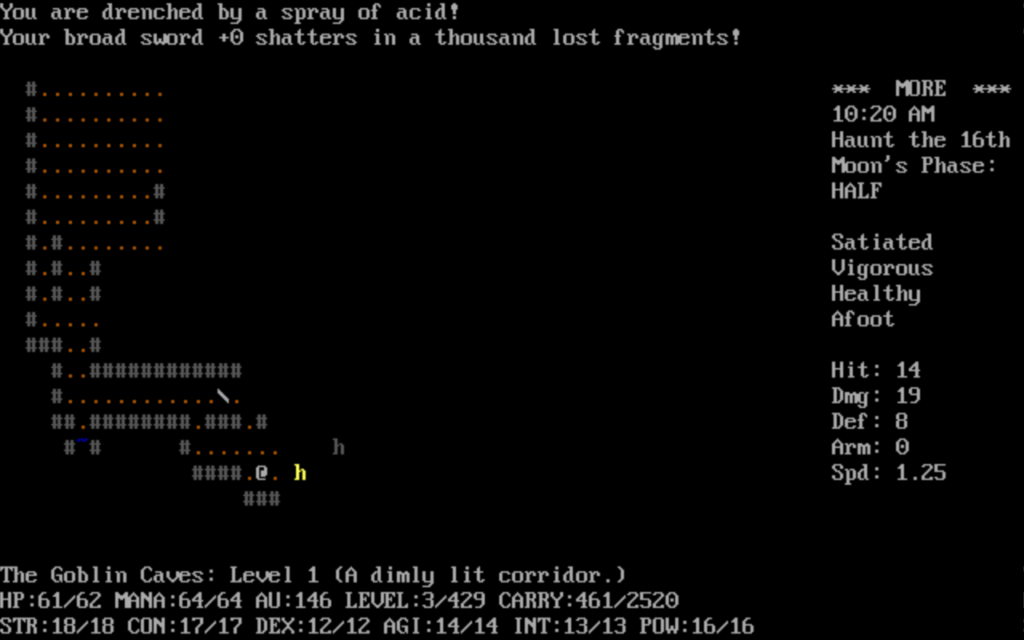
Punching is of little use against strong enemies, so I bought a broad sword for 180 gold. Ventured into the wilderness. Got a random encounter involving a freaking lich. I managed to get away, but not before it destroyed my broad sword from a distance with a spell of Destructo Weaponum. I headed back to town and bought another one, then went to the Goblin Caves. Saw some money, stepped to pick it up, but surprise, there was an acid trap there! It destroyed my thieves’ picks, a bucket of Lyzzard Partes, and my broad sword again! Grawlix grawlix.
How does corrosive acid shatter a sword?
If an item gets cursed, you don’t have many recourses. I’ve never seen a scroll of blessing work on them; reading the source code suggests they’re just not strong enough. The most practical thing to do is break the weapon to bits with your bare hands: use the ‘z’ key.
Corporal Phantom guards the entrance.
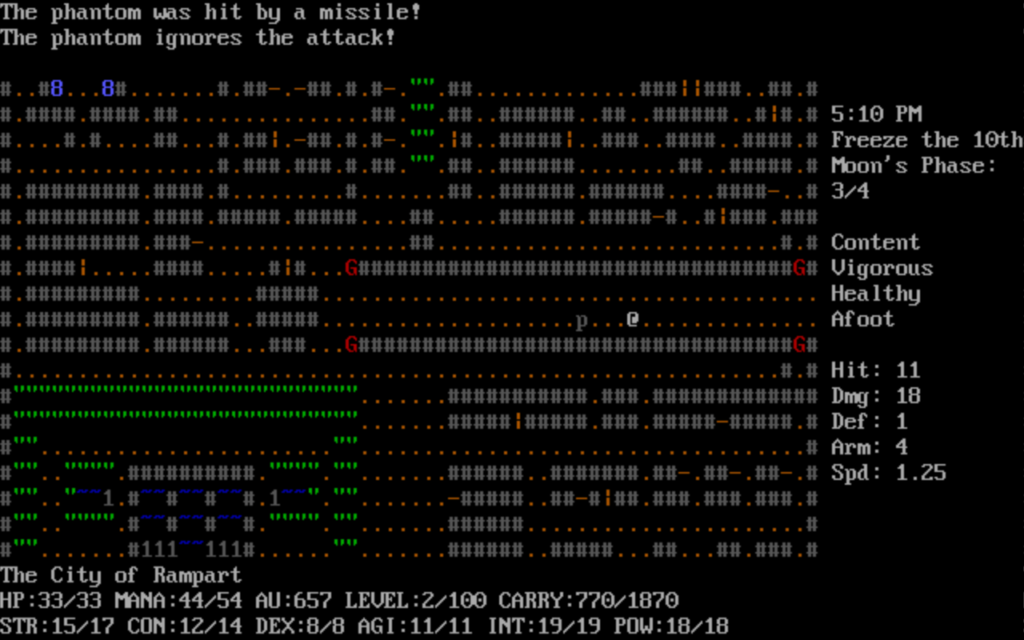
Phantoms that appear in the hedge maze can level drain you; the main defense against that is a Cloak of Negimmunity, which you probably won’t have at that stage. If you just walk near the hedge maze, it’s possible to awaken a phantom sleeping inside. Phantoms are incorporeal, so weapon attacks don’t work on them, and once they’re awake they can chase you, floating right through buildings, throughout the whole city. The entrance to the city is a long passage with walls on both sides; if you don’t have a way of dealing with the phantom (use magic if you can), it’ll block the passage when you leave town, and get a few free hits on you when you return.
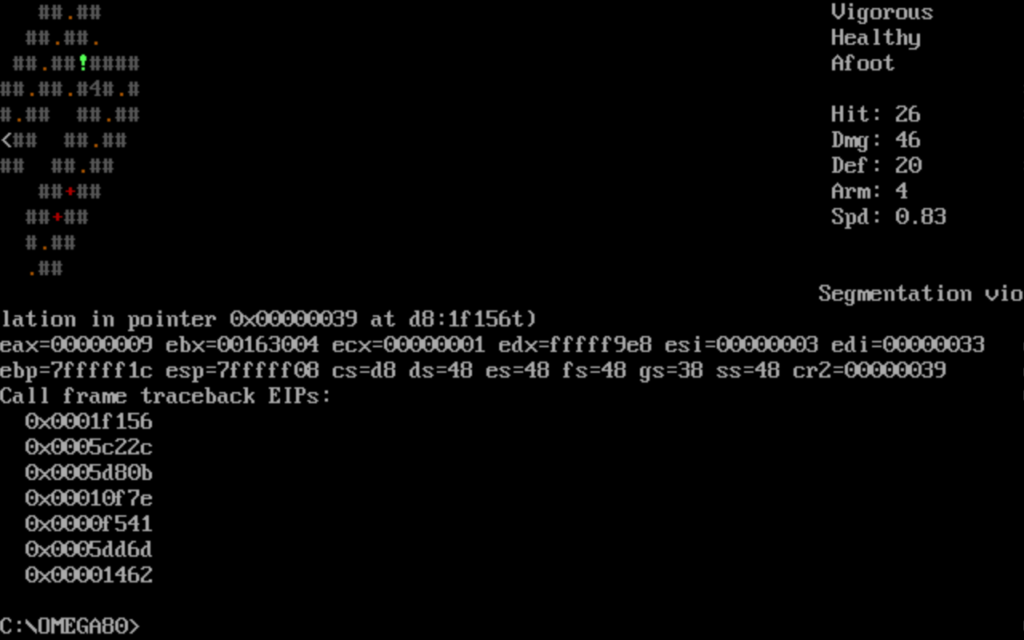
And then there’s the worst death of all, an attack by the dread monster Segmentation Violation:
Omega still has some decades-old bugs in it.
So what is my point? It’s not that you shouldn’t play Omega. It’s that you have to expect that your game could end at almost any time. Your game is not yours to have. Your character lives on borrowed time, so do as much with it as you can while you’ve got them.
These are a few things you can’t completely prevent, but what you can do is reduce their frequency. You can reduce the number of spaces you walk through in dungeons. You can try not to be slow when traveling the wilderness. If you encounter a trap, it might not be fair to it, but riding a horse will mean its effects are more likely to happen to it than to you. And good armor is almost always helpful, if you can afford it.
But sometimes, you just die. That’s just the kind of game it is. As you get better at Omega, you still suffer from them, but as you learn to play more effectively, you do find you get farther much more often.
How best to do that will be the subject of the next, and last for now, column on Omega.
Dylan Mansfield at site-favorite Gaming Alexandria tells us that there is now preserved an unreleased Famicom port of Taito classic arcade game The Fairyland Story! Fairies are rife around our offices, I have to tell you, they’re everywhere, getting underfoot and in the way of closing doors. Oh? This game is more to do with a more generic kind of fantasy world? I knew that.
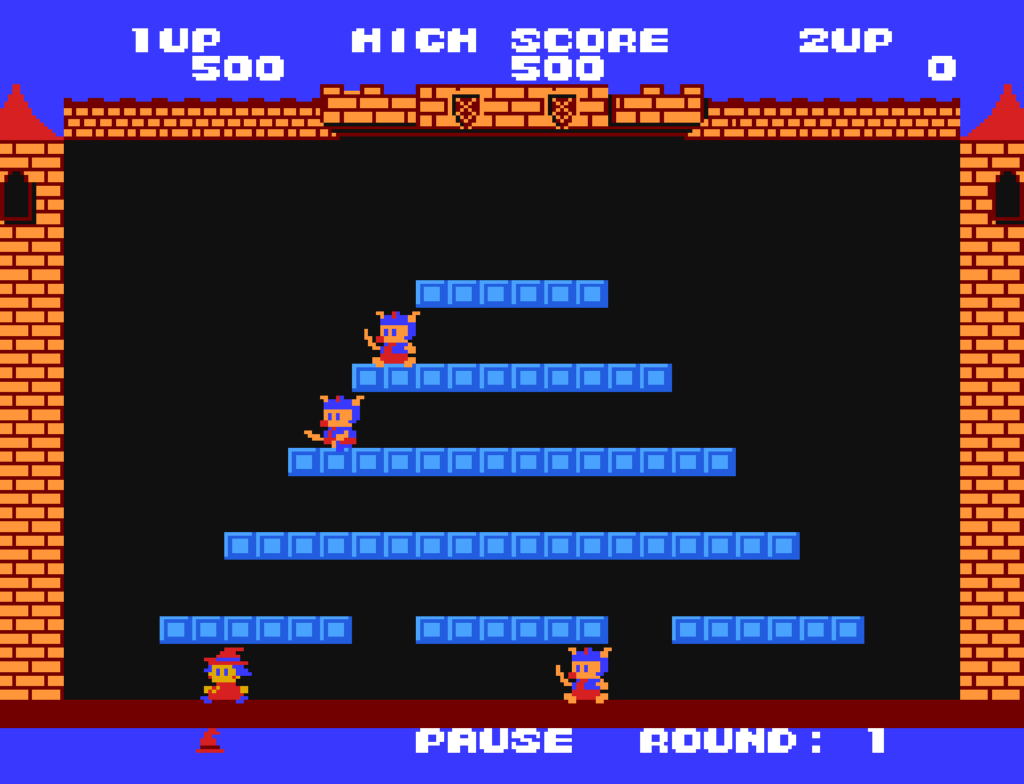
Young witch protagonist Ptolomy clears a number of successive screens of enemies using her magic that can turn them into cakes! Released to arcades in 1985, it’s kind of an intermediate game between 1984’s Chak’n Pop and classic 1986 arcade hit Bubble Bobble. If you’re a fan of the arcade game you should check into this one, as many of the level layouts are different! The announcement post and rom is at Forest of Illusion. Unfortunately-named YouTube channel Hard4Games has a short video about the find:
You want to know a great game that, statistically speaking, you’ve probably never played? Konami’s Maze of Galious for the MSX. It’s an early example of that genre we all now call Metroidvanias (Jeremy Parish, your royalty check is in the mail), and in Japan it was hugely inspirational. More recently, it was a direct inspiration for the La-Mulana games.
Well, more-recently-than-that, some romhackers have updated it to take advantage of the much more powerful MSX2 hardware. This results in much more detailed and colorful graphics and a number of other game improvements.
Playing it requires a rom of the original game (which you much seek out yourself), the patch file (here’s it’s GitHub site), and a patcher like Floating IPS. Or do you? Indie Retro News found a site that’s serving up the game and patch together, all ready to play!
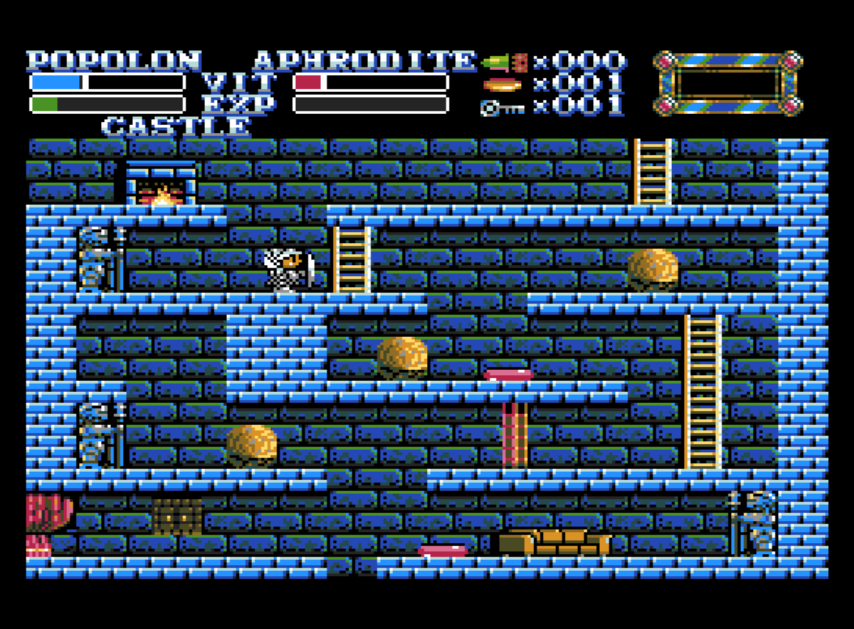
Look at that murderous dungeon room. Now that’s what you call a video game.
If you’re prepared to patch the rom yourself and name it correctly (it’s explained on the project’s GitHub page), it can also be played in the online MSX emulator at webmsx.org.
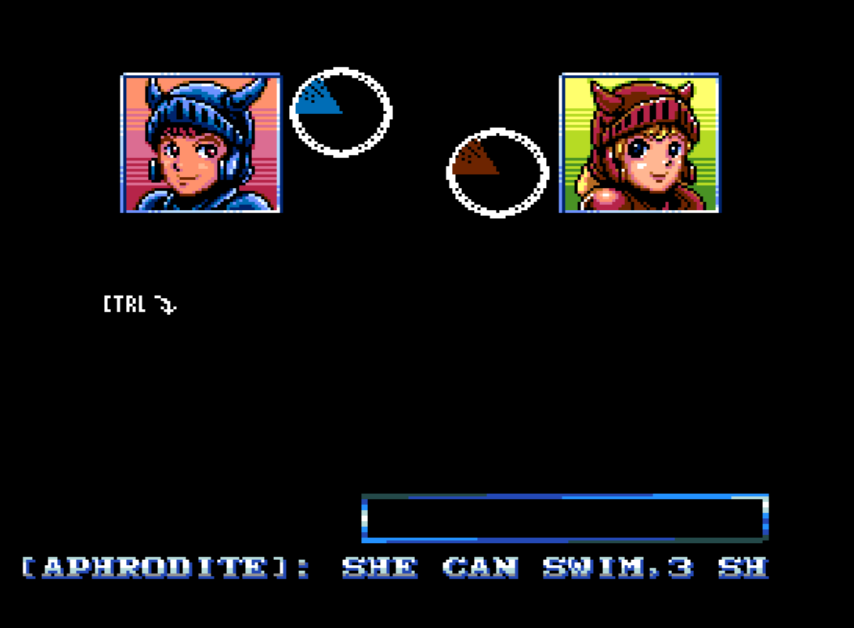
So, what’s playing it like? Challenging! You have two characters, Popolon and Aphrodite, who have separate health and experience meters. Filling up your experience bar doesn’t actually improve your stats at all; it just heals that character up to full. And your characters’ jumps, while not as stiff as Simon Belmont’s, are not fully controllable in mid-air.
The two characters have subtly different abilities. Popolon’s attacks do more damage, he can jump higher, and his jump height varies according to how long the button is held. He’s also the only one who can push open doors. Aphrodite’s jumps are of constant height, but she’s also the only one who can survive in water! If one character runs out of health, the other can soldier on alone, but reviving the other is a difficult process.
Aww, they’re wearing matching armor!
In fact, the whole game is a difficult process! This is from that thankfully-brief time in the history of video gaming where developers seemed to revel in putting in secret features and hidden passages. Beating the final boss requires you find a very well-hidden item, the Cross, which is in a very secret passage. If you no longer have months to devote to finishing a game, you’re probably going to want to find at least a good FAQ for this one.
It’s nine years old, but I’m amazed by how few seem to know of these old projects that litter the internet, and this is one that’s definitely worth revisiting.
When people talk about reasons for the Great Game Crash of 1983 (which, it should be remembered, was mostly a crash in the U.S., other countries didn’t suffer much loss in popularity), one reason sometimes given was the lack of quality of one specific game: Howard Scott Warshaw’s E.T. The Extra-Terrestrial, for the Atari VCS/2600. (That’s not really the point of this post. For more of this, seen the Addendum, below.)
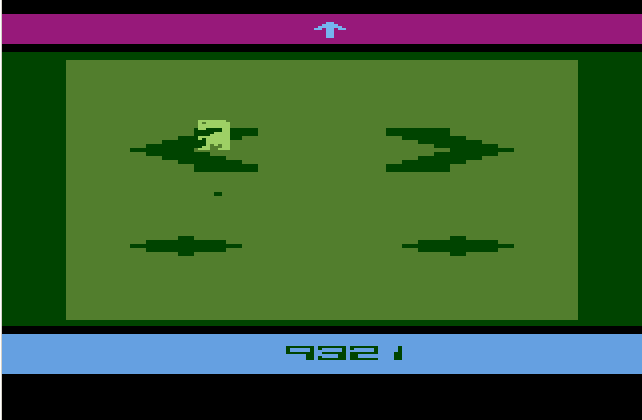
I should emphasize that it was easy to get frustrated by E.T. Its development was rushed so that it could be in stores in time for the 1982 Christmas season. Warshaw’s previous work Yars’ Revenge was a huge hit for Atari, but its successor, Raiders of the Lost Ark, is possibly a bit too experimental. I think E.T. is a better game than Raiders, it’s easier to learn certainly, but it has some definite issues that make it very frustrating to play.
There were a number of issues, but the biggest by far was that it was extremely easy to fall into the many pits that dotted the landscape of the game’s version of Earth, and after floating up out of one, it was just as easy to immediately fall back into one again. You could fall into a pit merely from changing screens in the wrong location.
Back in 2013, a user in the AtariAge forums using the handle recompile produced a hack to fix the game’s problems, including this one. They made a page that the hack from which could be downloaded, and explained, in great technical detail, how it had been made. The result has slightly worse graphics than the original, but is much more playable, and reveals that there is a very interesting game hidden beneath the rushed product mandated by Atari’s managers. Not only is the page and his work still up now, nine years later, but so is the AtariAge thread he made.
Remember: a delayed game is eventually good, but a bad game is bad until someone with enough time, energy and technical know-how takes it upon themselves to fix it, which in E.T.‘s case was about 31 years from its release.
Addendum
Was E.T. the real reason for the U.S. crash? Honestly, I’m dubious. It’s likely a contributing factor, but a slight one. But the fact that it can’t be ruled out, and probably helped a little, makes it something that many writers can point to without much fear of contradiction. It’s the way many narratives are built.
But there were plenty of good games, by the standards of the time, to offset the fortunes of any single title. A more likely explanation was a deluge of bad games, and a market oversaturated by them produced by companies looking for a quick buck, so that unless a consumer had done their research, it was difficult to separate the worthwhile purchases from the cash grabs.
Video games had, almost overnight, turned into a billion-dollar business. For a few years, specifically 1978 to 1982, the success of arcades, and of the Atari VCS and a number of excellent games for it, tantalized a nation. For a brief period, almost everyone sold game cartridges. I remember seeing them on the racks of drug stores during that time.
Then, almost as suddenly as it had risen, it collapsed. No one knew which games were good and which were bad. Even the good ones were pretty expensive: a $30 game in 1982 was nearly $90 in today’s (2022) money. All of those stores that had jumped on the bandwagon were left with piles of unsold inventory. Console gaming died out almost completely for a few years, until the arrival of the NES, and some canny moves by Nintendo of America, resurrected the industry in the land of its birth.
Hackaday’s Matthew Carlson points to an effort to make the graphics in old Sierra On-Line Adventure games better. The graphics in the games in question weren’t stores as raster images, but rather drawn with vector commands, so theoretically it should be easy. But as the video demonstrates, the resolution of their coordinate system didn’t take into account the possibility that someone might come in later and draw the art into a canvas with higher resolution, which causes some weird glitches that had to be accounted for.
I’m a bit fuzzy on all this and open to correction, but….
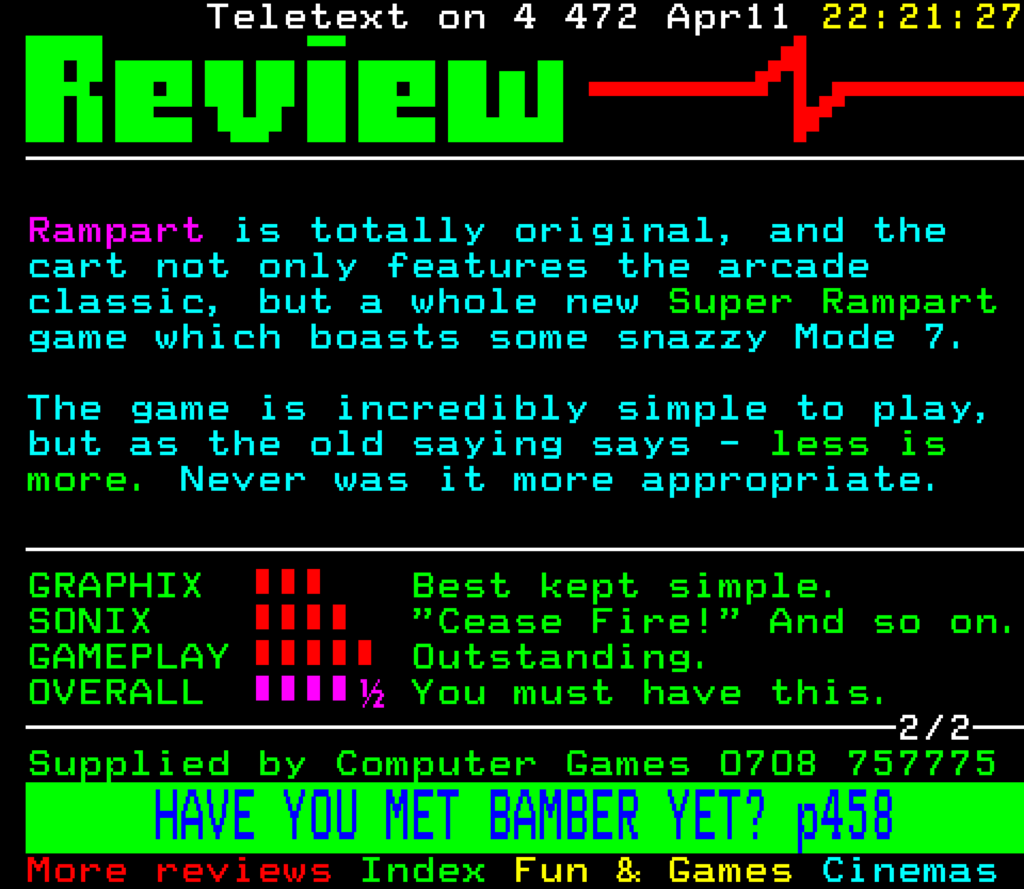
In the UK, as far back is 1978, there was an electronic text service called Oracle, of no relation to the current-day owner of Java, OpenOffice, and VirtualBox. It was launched as a competitor to the even-older BBC service Ceefax that launched in 1974. In 1993 Oracle turned into Teletext, Inc. Teletext lasted for a good long while, up until 2009.
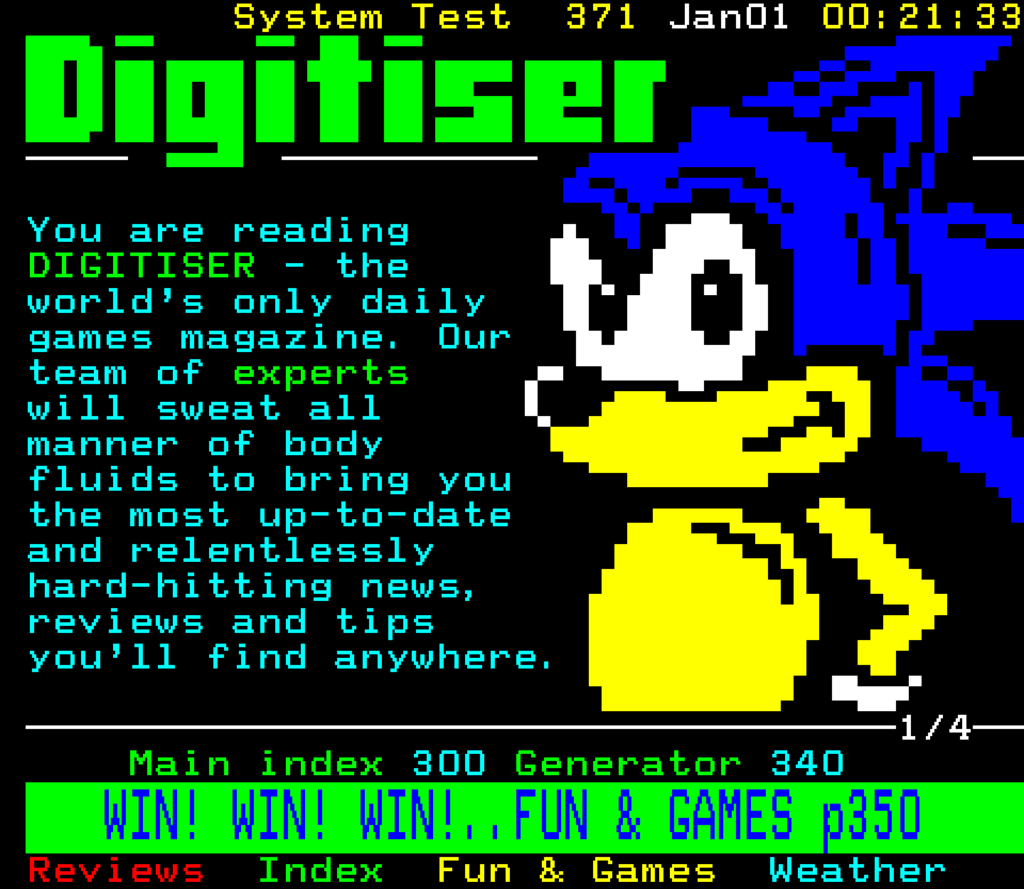
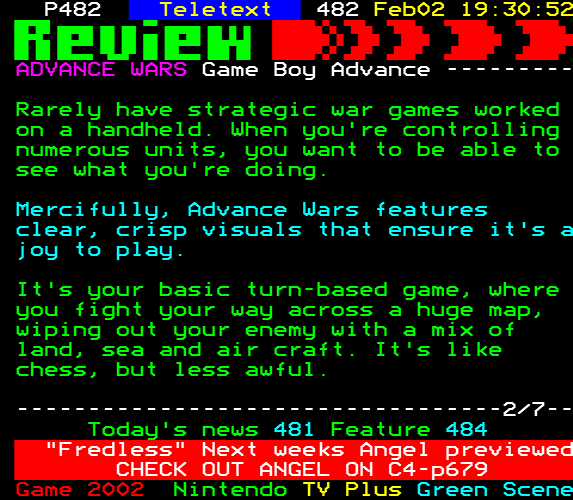
There is much more to that story, but we’re getting into the weeds. Our subject is the early teletype video game magazine Digitizer, a service provided on Teletext. Digitizer lasted from 1993 to 2003, a solid ten years full of typically cheeky 90’s British video game news content, delivered through the medium of ASCII text and artwork.
It’s a whole world of gaming enthusiasm from a lost era, and in it one can see the birth of a whole subculture. Some of these people are still writing today over on the site digitizer2000, although sporadically it seems. The site Super Page 58 has worked hard to archive as much of their content as they can, including a voluminous, yet still incomplete, listing of reviews.
And they liked the SNES port of Atari’s Rampart almost as much as I did!