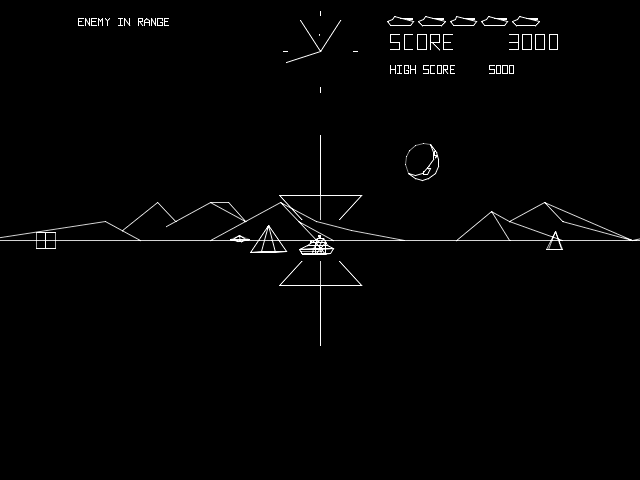
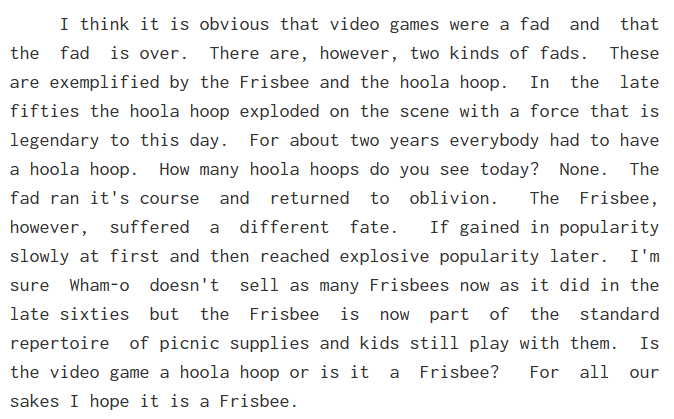
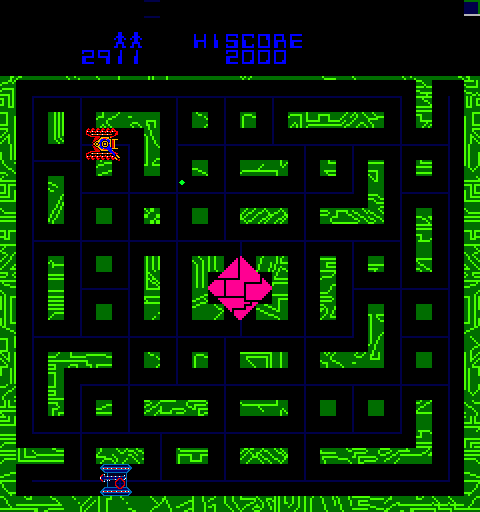
The podcast Arcade Attack interviews former Atari designer and programmer Ed Rotberg, creator of Battlezone! His introduction identifies him as the creator of the first FPS. Is he? I do not know for sure, but it seems awfully plausible. I think it’s a little distasteful identifying him by his connection to a genre that, when he created Battlezone in 1980, wouldn’t even exist for a decade yet. Rotberg’s accomplishment feels more profound than that, but Battlezone is definitely foundational!
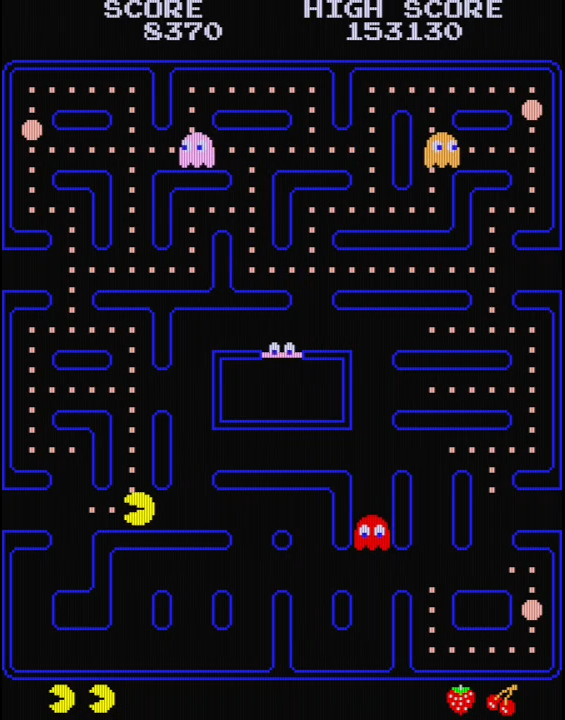
Pac-Man is rightly heralded as a classic, not just the best-selling arcade game of all time at over 100,000 units (even more when you consider every Ms. Pac-Man arcade machine has the elements of a Pac-Man machine inside it), but it’s solidly well-designed. All of its elements come together to produce a solid test of skill and strategy.
It’s not perfect though. The game possesses two major flaws that, in retrospect, made it a little less interesting to play now. The ghosts behave deterministically when they’re not vulnerable, meaning that patterns work against them and turning the game into a test of memorization and execution. And, every level’s maze is the same, which gets kind of monotonous. Tellingly, while Pac-Man was extremely popular for its time, its GCC-made follow-up Ms. Pac-Man had a much longer life in arcades, and it addressed both of these issues with the first game: ghost movement at the beginning of boards is randomized, and it had four mazes, instead of the original’s one.
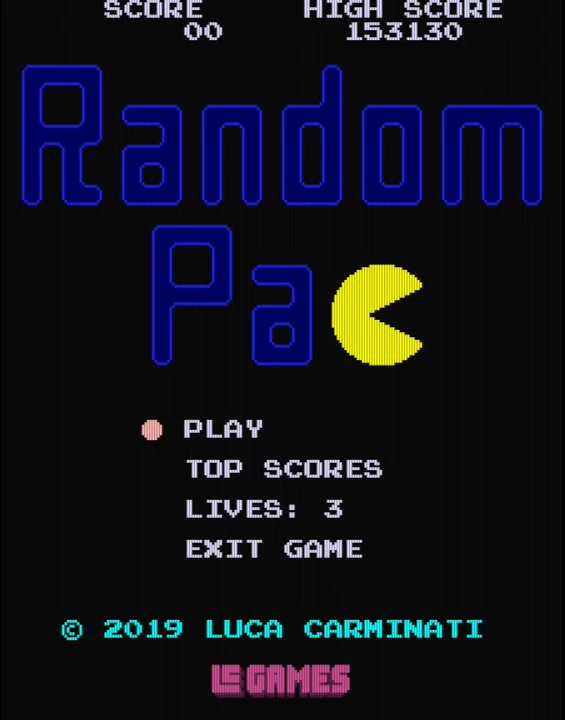
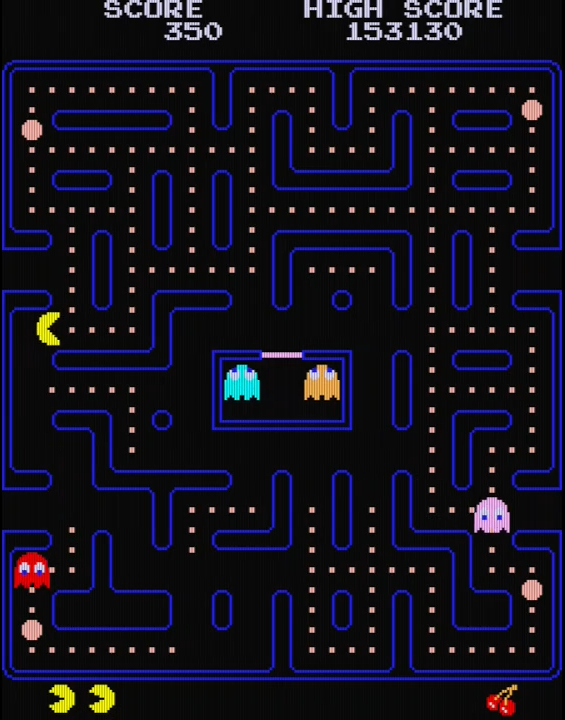
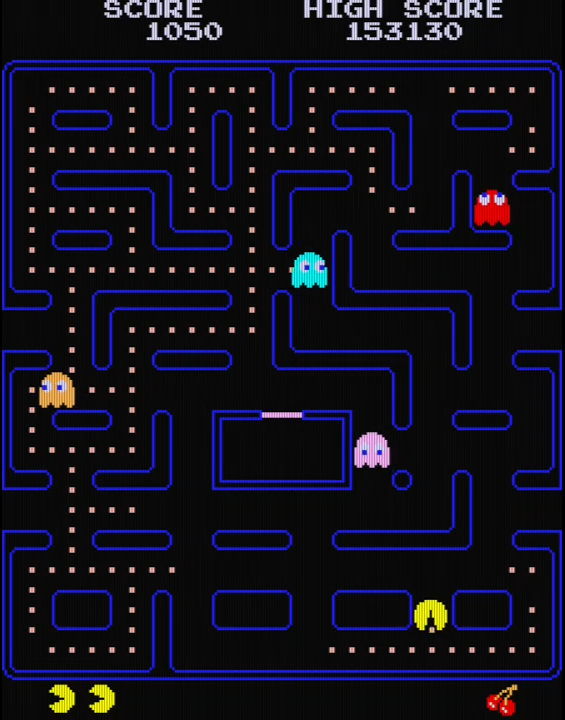
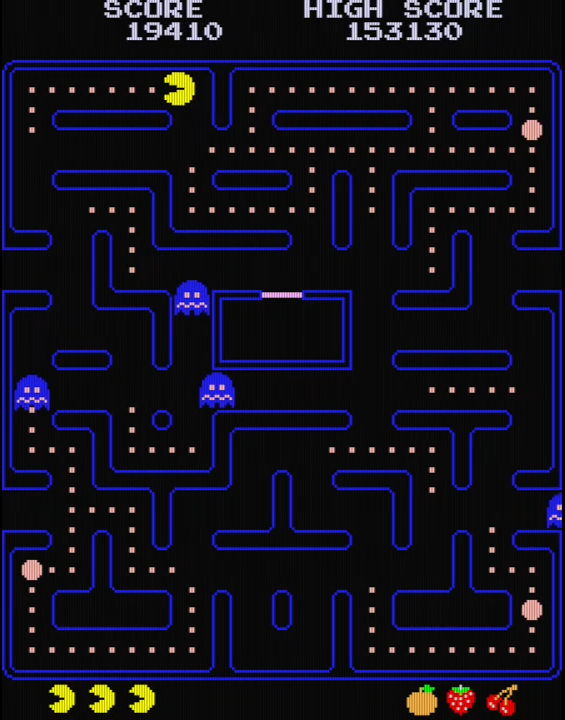
Random Pac is a fan game, available on itch.io and made by Luca Carminati, that also solves the issues, and a bit more simply: it randomizes the maze for each level. This one change makes the game immune to memorization, and makes each level a kind of situational puzzle, as the player must use the maze layout as best they can to avoid being caught.
It’s not the only change made, but the others are, for the most part, in line with that one. Since the game is much less likely to extend endlessly, extra lives are awarded multiple times, first at 10K then every 50K points, instead of the once, by default, of the original. There are bonus levels in place of the intermissions that can be worth a considerable number of points.
The fruit bonus items that showed up twice during each level of the original game may now appear up to four times per level, which can be worth the majority of the player’s score if they can get up to the 5,000-point Key boards. Getting all four Keys is 20,000 points, which is two-fifths the way to an extra life by itself.
The game increases in difficulty a bit more slowly than classic Pac-Man. I’ve been to the 7th Key level; in the original, on the the 5th Key board, and from the 7th Key on, ghosts no longer become vulnerable when eating an Energizer (a.k.a., a power pill). Vulnerable times kept decreasing in my 7th Key game, but hadn’t cut out completely yet.
Another difference, and I’ll be going into some deep Pac-Man internals here. In classic Pac-Man, ghosts have three states, Scatter, Chase and Vulnerable. If Pac-Man doesn’t eat an Energizer, ghosts periodically enter Scatter state for a few seconds, then change back to Chase. You can tell when ghosts change between these states because they all reverse direction.
In most boards there are two Scatter periods, and the timers, both for entering Chase and Scatter, freeze while an Energizer is active on any ghost. In Random Pac, the timers don’t freeze; Chase and Scatter periods continue even when the ghosts are vulnerable. This makes Energizer timing very useful for decreasing the amount of danger you face: a short way into a Chase period, eat an Energizer and disrupt their pursuit! By the time they catch back up to you after it wears off they may be time for them to Scatter!
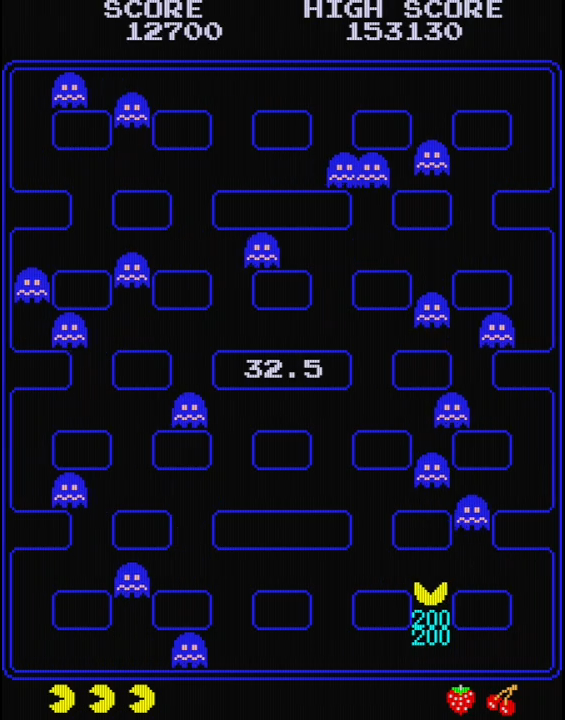
In place of intermissions there’s a bonus round that asks you to eat as many randomly moving targets as you can in 35 seconds
Ghost AI seems to be mostly the same, although unlike classic Pac-Man, each ghost doesn’t seem to have a set “home” location. They don’t intend to chase Pac-Man during Scatter, but instead fixate elsewhere on the board. The Orange Ghost’s Chase AI also makes use of its home location, making its behavior much less predictable, although it’s still easily the least threatening ghost.
Random Pac was Luca Carminati‘s first classic game remake. Since then, they’ve made many others, including Tutankham Returns, which we’ve linked to before. They’re terrific!
“We scour the Earth web for indie, retro, and niche gaming news so you don’t have to, drebnar!” – your faithful reporter
Quite a bit to get through today! Pull up a florb and moop for a bit!
Luke Plunkett at Kotaku informs us of Nintendo pulling support from the third-party tournament Smash World Tour, leaving them in a gigantic financial hole. This will severely harm tournaments’ willingness to trust Nintendo in the future, and the esports scene around future Nintendo products. Nintendo’s response at the end is especially frustrating, claiming they did not request any events be cancelled while still denying SWT a license, forcing them to cancel anyway.
After our initial post, I’ve purposely been trying not to talk up the Super Mario Bros. movie, but I do think this post from Ryan Leson at IGN is of interest, about Shigeru Miyamoto noting that Donkey Kong’s been a bit redesigned for the movie, still recognizably the Rare-made version of the character, but with some adjustments to more resemble the original version.
Here’s Rich Stanton at PC Gamer on the effort to preserve a Ridge Racer Full Scale, a version of the arcade game that featured an actual car chassis the player would sit it, had triple ultra-wide display, and cost operators $250,000. Very few were sold, and it’s possible only one survives, which was in Blackpool. After an arcade museum sought to purchase it, but refused when they learned of damage to the frame, it was thought lost, but although the physical structure of the unit has not been salvageable, the car portion and the hardware have been saved, and its code dumped. More can be read at Arcade Blogger.
And at Engadget, I. Bonifacic remarks upon Pong turning 50 years old. Yeah, that number isn’t getting any smaller. It’s a useful retrospective, although I take issue with them saying that without Pong Nintendo would not exist. Nintendo is over a century old, originally making playing cards. What is more likely is they wouldn’t exist as we know them today-they may not have gotten into video games at all. (By the way, they make traditional Japanese game playing equipment too, like go boards!)
Have no fear, we’ve not forgotten about Arcade Mermaid, our regular classic arcade feature. I don’t think this post is quite the right material for it, but it’s still very interesting.
People who played the Atari VCS, later renamed the Atari 2600, will no doubt remember David Crane’s seminal Pitfall!, one of the greatest, and certainly one of the best-selling, games for the system.
Pitfall’s huge success spurred the creation of a sequel, Pitfall II: Lost Caverns, which is certainly among the most technically brilliant games for the VCS. We recently covered how one of its best tricks was how it managed to get music out of the Atari’s TIA chip that few other games were capable of. That’s not all it did. Pitfall! was one of the very first exploratory platformers, and Pitfall II expanded its focus greatly. Some might call it the first Metroidvania, although it doesn’t have the item-based progression gating usually associated with that genre.
It does have great design ingenuity though. It gets its challenge not through limited lives but its huge and complex system of caverns. In fact, it abandons lives entirely, replacing them with a checkpoint system, another possible first. Getting “killed” never ends the game, instead, it just costs points and returns the player’s surrogate Pitfall Harry to the last cross he touched. So anyone, given enough time and effort, can finish the game; they might not have a good score when they do it though, which still leaves room for players to improve.
Pitfall II, with its huge world and great music on a system not known to be able to support either, powered by a custom microchip that Crane himself designed, called the DPC, would undoubtedly have been a giant hit if it had been released a year before. Sadly, it came out right at the end of the VCS/2600’s life. Crane had hopes that the DPC would help revive the system but, sadly, it became the only game to utilize it.
But that wasn’t the end of Pitfall II. While it was designed around the limitations of the VCS, it received ports for several other systems, including the Apple II, the Atari 5200 and Atari’s 8-bit computers (which both had a secret second world to explore after finishing the first!), the Commodore 64 of course, Colecovision, MSX, SG-1000 and ZX Spectrum. It even got a kind of NES port, called Super Pitfall, which was programmed by anonymous NES contractor Micronics and is widely regarded as terrible. And then, there was the arcade version.
Sega’s arcade version of Pitfall II is more of a recreation than a port! It’s divided into levels and goes back to the standard arcade paradigm of limited lives. Its first level resembles a condensed version of the first game, with some extra hazards built it. The game world is both smaller and harder than the original, to make it harder to master and thus entice players to put in more money. You can see for yourself in the below playthrough, a deathless run up on the Replay Burners channel. Videos on Replay Burners are done cheatless and without tool-assist, so you can be assured that an actual player performed this run and not a control script. The video is about 27 minutes long.
According to the people at Rice Digital, many of Namco’s games set in the future, including Galaxian, Galaga, Gaplus, Bosconian, Baraduke, Burning Force, and many more, are all part of a common timeline! Namco calls it the UGSF History. Due to the inclusion of Kissy from Baraduke, which was named to be Susumu “Mr. Driller” Hori’s mother, it also drags in the Mr. Driller games, and even Dig Dug! You can read about it on their site here. Namco’s own site concerning it is here.
Hiromi Tengenji of burning force (image from ricedigital.co.uk)
According to their timeline, the earliest game chronologically is Ace Combat 3 (which is not an arcade game), and the latest is Galaga ’88!
Posted to Metafilter by Going to Maine, it’s definitely the kind of thing of interest to me and probably our readers. A link is a link, no matter where it came from. This site is an archive of messages made by Jed Margolin from the Atari Games corporate email server, from July 11, 1983 to when he left the company on September 15, 1992.
Note: we saw the Nintendo Direct with the trailer for the (newer) Super Mario Bros. movie, but there’s not really to comment on? Maybe we’ll talk about it later, when we’ve learned more.
The Arcade Blogger recently spotlighted some documents related to the design process of the classic 1983 arcade game Tron, including information on some dropped minigames for it. Tron is such an interesting production. It is of course based on the movie of the same name, which has become a cultural landmark despite not actually doing that well in theaters upon its release. One of the interesting facts revealed in the article is that the arcade game actually outperformed the movie, despite being released while interest in US arcade gaming was falling.
The Museum Monster presents: a WEIRD MOMENT IN VIDEO GAMES.
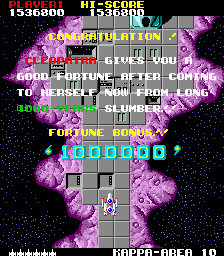
About halfway through the arcade version of Star Force, a prominent early shooter made by Tehkan (later renamed Tecmo, and now half of Tecmo-Koei) something weird happens.
Whatever could it mean??
Shooters were in a kind of odd phase right then. The enormously influential Xevious was fresh in memory, and it presented, as a striking and memorable background element, the Nazca lines from Peru. It lent the game an air of mystery that impressed many Japanese players.
Perhaps inspired by that, Tehkan’s developers put something similarly bizarre in Star Force, but it’s a lot better hidden. First, you have to get about halfway through the game. Once there, on the ground of the weird space continents that float by serenely beneath your craft, you can spot a coelacanth, a whopping-great space fish.
You don’t see that every day Chauncy.
Then, if you aim your ship’s guns at the spot at the right side of the screen that it’s looking at, and fire your guns a whole bunch of times, you’ll make the golden head you can see in the above screenshot appear. Then, fire at it a whole bunch more. If you’re relying on autofire it won’t do, you must actually pound away at the fire button yourself to have any hope of unloading as much firepower as needed to destroy it. If you do, this happens:
CONGRATULATION!
Here is a recording I made of this being done in gameplay. Note, I had an invincibility cheat on, because not only is the game extremely hard at this point, but unloading enough shots into it requires you to stay in one place for a while. In a real gameplay situation your only hope is to encounter Cleo during the lull between enemy waves.
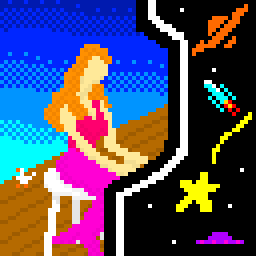
Huh. So, what is that about anyway? It like triples your score! There is no mention of Cleopatra anywhere else in the game, and no hint as to what she’s doing sleeping on a big purple island floating out in deep space. This doesn’t occur anywhere else. It just a thing that happens.
Arcade Mermaid is our classic arcade weirdness and obscurity column! Frequently (no promises) we aim to bring you an interesting and odd arcade game to wonder at.
You are reading the words of a Castlevania fanatic. Your standard fan who came into the series with the Igavanias will tell you its pinnacles are Symphony of the Night or, if they’re really trying to impress, Rondo of Blood. Truthfully, both of those are fine games. But I am of the opinion that the best the series has ever been was the first and third Famicom/NES games, and that series creator Hitoshi Akamatsu got a raw deal. The first game particularly is an especially brilliant gem among the jewels of the early Famicom’s library. Every moment of it shows care and attention to detail.
Just a few examples. While many people curse the stream of Medusa Heads that harry Simon Belmont at several places in the game, the game is actually quite sparing with their use, easing up with them at certain telling moments. One particular place this happens is climbing the staircases in the second stage of Block 3: while you’re on the staircases there, interestingly, the Medusa Heads don’t attack.
Also, the Fish Men in the first and fourth blocks, on the first loop, are kind enough never to jump from beneath the player’s location. And while on the second and later loops through the game they will happily emerge right beneath your feet and bump you into the water, there is a tell even for this: except for a brief section where there are no candles, Fish Men only emerge from the water directly beneath candle locations. (I gained a small amount of internet notoriety when an online friend pointed out where I had observed this fact in a Metafilter thread.)
I could go on, and will for a few more sentences, even though this kind of stuff makes for boring writing. The subweapons are very precisely designed, each filling a specific role in the game. All of the game’s platforms are supported by background elements, and when the player climbs stairs to a new area, background pillars in the upper area mostly line up with those from the lower area. You can see the crumbling spire that’s the site of the Dracula fight far in the background in block 3, half of the game before you get to climb up there yourself, and it’s such an iconic piece of level design that almost every Castlevania game that follows includes it. Much of its brilliance is recounted by Jeremy Parish in his book on the NES Castlevania games. (An earlier version of the Castlevania material can be seen linked here on the Internet Archive, but please consider his book if you are able to buy it.)
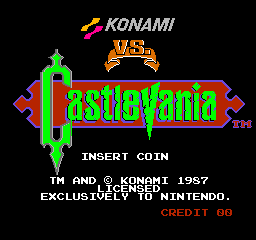
All of this is just preamble though, to the true subject of this post: the port for Nintendo’s Unisystem arcade hardware, Vs. Castlevania.
Castlevania is renowned as a tough game. While it only has six “blocks,” broken down into 19 stages, the game ramps up in difficulty pretty quickly through that thin territory. I’ve played through it all dozens of times. I’ve completed the game on one life before, but I still find the last level challenging. Even so, I’ve rolled both the score counter and stage counter. I’m good at Castlevania, not speedrunner-level, but, no offense intended to those who are, I have other things that I have to do. I cannot devote huge blocks of time to mastering individual games like I could as a teenager.
If you enjoy the original Castlevania, you might want to have a look at the Vs. variant, which is available via the Arcade Archives series for current consoles. Especially if you count yourself a master at it, this version will probably put you in your place.
In terms of hardware, the Unisystem is very close to a NES, and Vs. Castlevania doesn’t use any tricks that its home version doesn’t. Here is video of me playing through the first level:
The first block of Vs. Castlevania (Stages 00-03)
People familiar with the original will notice that the game looks slightly different. The colors are different, which is something that was frequently the case of the arcade versions of NES software. It’s likely that the Unisystem’s hardware is responsible for this: as a protection against bootlegging, which was rife in the arcade industry, each Unisystem arcade board had, in addition to the ROMs with the code for each game, a specific, custom PPU chip with the palette for that game embedded within it. People who copied the ROM chips into EPROMs in order to run a game without buying it from Nintendo would have something that could technically run, but the palette would be for the original game, not the copied one, and make the colors look funny. While I don’t know if this is true for Vs. Castlevania, it might explain the difference if the whole game had to use a single palette set.
Two major differences between Vs. Castlevania and its home version are immediately evident. One, in the first level enemies do four bars of damage on each hit to protagonist Simon Belmont. The first couple of levels of NES Castlevania are mostly just a warmup. Enemies in both blocks only do two bars of damage, meaning even without health powerups Simon can take seven hits without dying. The increased damage is the same as on the game’s second loop, after finishing the whole thing and starting from the beginning. The arcade sensibility, to keep players putting in money in order to learn the game and see its later stages, means it doesn’t have time to let the player acclimate themselves to its heated waters. The fire is lit; the soup is boiling.
Block 4 (Stages 10-12)
Even worse though is that, for each of the first three blocks of the game, the player only has 170 seconds to finish. It’s quite a shock if you’re used to the original, where time is practically never an issue! Even if you’ve mastered the levels on the NES, you’ll find, if you don’t constantly work towards reaching the door of each stage, you will easily run out of time. Expect the warning alarm to be ringing through the boss fights until you get used to the constant progress the game demands.
I don’t know what it is about the later blocks, but they have much more generous time limits, along the lines of the NES version. For these levels, the challenge goes back to surviving enemy attacks. Starting with Block 3, the game increases the damage done by enemies to levels never seen in the NES game even at its hardest: six bars, enough to kill Simon in just three hits. This makes Dracula at the end of the game quite a challenge.
If you manage to loop the game, you get to see something quite amazing. Desperate to end the player’s credit now, the game increases the damage done by enemies to eight bars, killing Simon Belmont in just two hits. More than that, the game pulls off the stops with nuisance enemies. You even have to face bats in the outside area before entering the castle! Take a look at this:
Block 1 revisited and the beginning of Block 2 (Stages 19-23)
The extra nuisance enemies are an especially interesting addition, since NES Castlevania never uses so many, even on the second loop and beyond. It’s exactly the kind of ludicrous challenge that people who have mastered the original game should seek out!
Castlevania is not the only Vs. game with substantial differences from the arcade version. Vs. Excitebike has many niceties over the home version, including some clever bonus stages. Vs. Balloon Fight in the arcade is a vertically-scrolling game, that played with two players gives each its own monitor. There’s lots mot to say about these games, but I’ve got to save some material for later.
The news about this broke some time ago, but Set Side B is only a few months old at the moment and we weren’t around then. It’s still worth mentioning though!
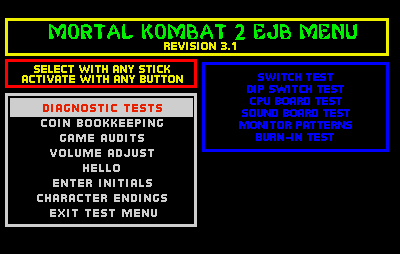
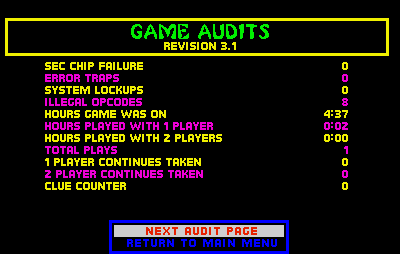
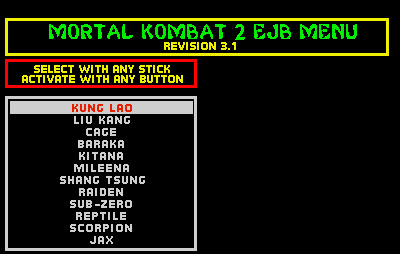
Ed Boon put secret codes in a number of his games to allow him to check on individual machines while out in the public. He revealed his code for Mortal Kombat II some time back, which is listed on The Cutting Room Floor. The code is entered entirely with the 1P and 2P Block buttons: P1 Block 5 times, P2 Block 10 times, P1 Block 2 times, P2 Block 8 times, and P1 Block 2 times. The timing is tight, so keep trying.
All image credits for this post: The Cutting Room Floor
One way to remember part of the code is in the menu’s name, the EJB Menu. The E and B of that stand for Ed Boon. E is the 5th letter of the alphabet, J is the 10th, and B is the second, and those are the number of button pressed needed for the first three parts of the code.. The whole code would thus be EJBHB. Using initials as part of a code seems to have been part of the culture at Bally and Williams at the time. A number of pinball games have hidden displays that can be called up from attract mode if you press buttons as if you were entering a developer’s initials in the high score screen.
The EJB menu offers a lot of information on how a machine has been performing on location! It’s much like the operator’s menu, but with even more options! You can even call up the ending for any character, would certainly would have made any kid who knew that code back then the star of the arcade.
Of particular note is, a couple of the items in the menus are red herrings. The developers loved taunting kids by putting fake hidden features in the operator menus. “Shawn Attacks” is one of them (there is no character called Shawn in the game); “Kano Transformations” is another (Kano is not playable in MKII).
Other EJB menu codes:
Mortal Kombat 1, it’s 1PB x 5, 2PB x`10, 1PB x 2, 2PB once, 1PB x 2, 2 PB x 3, then 1 PB x 4. The page notes that, converted to letters, this code would be EJBABCD.
In Mortal Kombat 3, it’s 1PB x 5, 2PB x 10, 1PB x 3 (it’s EJC this time!), then 2PB once, 1PB x 2, 2PB x 2, 1PB x 3, and 2PB x 3. EJCABBCC. This code also works in Mortal Kombat 3 Ultimate.
The Cutting Room Floor does not list a EJB code for Mortal Kombat 4. Smash T.V. does have a code for a developer’s menu.
There was once a time where game information was really hard to find on the internet.
Before Fandom née Wikia started automatically generating wikis for everything in existence, before even GameFAQs, which started in 1995 and is still chugging away after all these years, became sorta-big, there were the shrines sites. Some enthusiast (obsessive?) would build a website to document literally everything about the game they could find. Early free hosting site Geocities was a haven for that kind of thing.
Not all of these sites were on Geocities, or other host short-lived free host. Some of them survive today. I personally think these sites are an essential part of the soul of the World Wide Web (yes, I’m old enough to call it that), and proudly link to some of them from our hard-wrought Links page.
One of my favorite of these shrines is the Bubble Bobble Info Pages, created back in 1998, and its companion site the Rainbow Islands Info Pages. It’s not just their old-school web design that I love, although that’s hugely charming to me. It’s that it’s the source of a great quantity of information on a couple of extremely opaque games.
The arcade game Bubble Bobble is absolutely filled with mysteries, most of which are practically undiscoverable without diving into the game’s code, and it’s known that even its manufacturer Taito lost its source code many years ago. This leaves BBIP as nearly the sole source for a lot of important game data.
My favorite of these facts is the information on how Bubble Bobble decides which special item to generate each game. These are not random but chaotic, influenced by unseen patterns, that gives a kind of sense of them. Some items tend to be generated on certain levels, but they’re not hard-coded that way, so that the player’s actions can influence them without relying on them.
The game keeps count of a huge array of things that the players can do or cause during the game. The number of times they jump, the number of times they shoot bubbles, the number of times the pop bubbles, the number of times they jump on bubbles, the number of steps they take, the number of times they wrap the screen, and so on.
At the start of each level, the game goes down the list, finds the first value that exceeds a certain limit (which generally increases with the game’s difficulty, both explicitly-set and dynamically-rising), will set that item to generate during that level, and resets the counter. Some of these things can only happen in certain levels, like screen-wrapping or popping water bubbles, and that gives the history of generated powerups throughout a game a shape, that the players can influence, even without knowing exactly how. These counters are not even reset when the game ends! They carry on to the next, and in fact a few of the counters probably won’t trigger for several games.
It’s a significant factor in what makes Bubble Bobble so much fun, but interestingly, it means it’s more fun when played in an arcade setting, where the actions of past players contribute to add uncertainty to the powerup schedule. This is a terrific design pattern that I don’t think nearly enough developers know about, and one of the few places in the world where you can find out about it now is the Bubble Bubble Info Pages.
The YouTube channel Classic Game Repairs fixes and restores old arcade units, especially those from the classic age and before. There’s a number of such things out there, but this is a whole channel of nothing but! Many of the units are really old too, like from the 70s. Those are a whole slew of games that are much in need of current-day love.
The video linked above is of Universal’s Mr. Do!, which is kind of like more-awesome Dig Dug. Most of these videos, I should make it clear, are not of gameplay footage, but of circuit boards and soldering irons, but that kind of thing is like ASMR to me. Maybe it will be to you too?