Lists are severely worked content delivery methods, but darn it if TheZZAZZGlitch’s video lists aren’t actually really interesting. These are all early Pokemon game glitches and their application, and usually go quite deep into their code.
In the most recent of these (the ninth, 10 minutes long) one of the examples has to do with exploring glitched, out-of-bounds Pokemon boxes. These can cause writes to unexpected regions of memory, and very strange glitches indeed. But one in particular, if it happens, causes a write to a region of memory that causes an unexpected bankswitch, meaning, suddenly a whole swath of the game ROM isn’t what the code expects. In 99% of cases this would cause a sudden game crash end of story, but in THIS case the code that ends up executing doesn’t immediately crash the game, and not only that later in the code path, the bank gets switched back, and the code path is in such a place that it actually recovers, and the primary effect is just some glitched graphics, all completely by chance. Huh!
Here is that video, and if it’s interesting, the others (9 video playlist link) might be to your liking too.
And we’re off! Let’s start 2026 off with Flandrew’s look at the weirdest Star Wars game, the Famicom-only one Namco made. (11 minutes) It’s kind of a meme at this point, but gosh it’s even weirder than the Star Wars Holiday Special.
Bluesky only released their Saved Posts feature about three months ago, but I’m such a link packrat that there’s plenty there to fill a multilink post for 2025. I hope you find some interesting things in here!
@thinkygames gave us a talk by Patrick Traynor, creator of the mindtwisting puzzle game Patrick’s Parabox, and how that game was programmed. Hey, I kind of know him!
videogameesoterica.bsky.social notes that a fan translation of SEGAGAGA, one of the last official Dreamcast games and a weird and hilarious museum of Sega content, is nearing completion.
fluffcopter.bsky.social, on a weird interaction in Caves of Qud that I’m not sure if they’re kidding about or not. They “poured warm static on my dog, it turned into a dromad trader that comes with guards and items. They are all my dog, the whole trade party and merchandise. I convinced my dog to sell me my dog for free while my dog, my dog, my dog and my dog were standing guard.”
And, most recently, almondsquirrel.bsky.social reminds us that Disney Solitaire, a game with dark patterns, real money transactions and lootboxes, is PEGI rated 3+, while Balatro has none of that, but is rated 18+ because of its nebulous Poker theming.
“Zelda Day” is a random thing over at Metafilter. One day long ago, on December 26th, there was a day in which three Legend-Of-Zelda-themed posts were made in one day. Since then I’ve commemorated the event by making another Legend of Zelda post on the same day each following year.
Here is this year’s post, but you don’t have to follow it because I’ve included the links in this post too.
They’re all videos this year. These first links are to videos by Skawo:
I think I mentioned this one before, but again, in Ocarina of Time, if you go back the way you came during the event in Kakariko Village, the world will become a glitchy mess (7 minutes):
Capsyst Animations made three fake commercials for early Zelda games, in the style of the evocative illustrations from the manual. There’s the original Zelda, Zelda II and Link to the Past (all 1 minute long):
The Amiga has hardware sprites, but they’re fairly limited. Most programmers prefer to use its powerful blitter hardware to simulate sprites, drawing them to screen memory much more rapidly than non-blitter hardware can. For more information, I refer you to the video.
That’s it for today, but there be something more substantial tomorrow….
Slowly making headway against a year’s worth of accumulated links. Please enjoy whatever takes your interest.
1. Sega’s One-Sided History, from The History of How We Play, about the tensions between Sega’s Japanese and American management.
2. From Mugen Gaming, working on a translation of Japanese TTRPG Sword World, with a crowdfunding campaign to begin in 2026. Included here because Sword World is soaked in video game influences. It really is a case of back-and-forth around the world: Wizardry and Ultima inspired Dragon Quest, Dragon Quest inspired other JRPGs, and then those JRPGs influenced Sword World. And to go with it, a nearly-complete fan translation of a Super Famicom Sword World game.
4. At Retroevolve, Mandy Odoerfer describes the charm of bootleg Pokemon games, games like 2003 Pocket Monster Carbuncle and Pokemon Vietnamese Crystal.
Image from the article, up on Retroevolve
5. The Splatterhouse Homepage, an oldschool webshrine, is still updating, and has a new page on the recent dumping of an unreleased sequel to Splatterhouse Wanpaku Graffiti, called Splatterworld, although I notice that one of its downloads is actually dated to 1993. Hmm, curious!
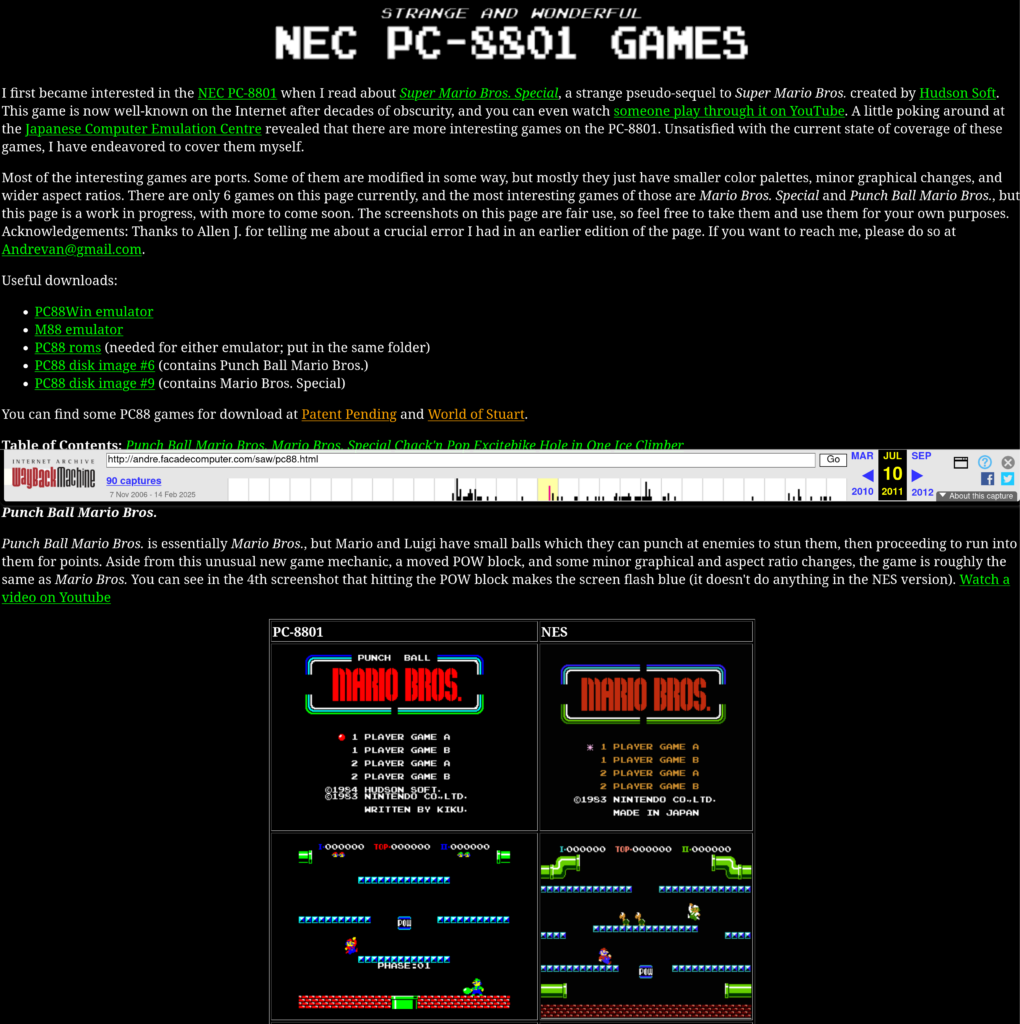
It was a weird time. Around the time as the Famicom was just getting started, Hudson Soft struck a deal with Nintendo to release some of their games for the PC-88 Japanese personal computer platform.
Many of these games had weird differences from Nintendo’s originals. The best known of them is probably Super Mario Bros. Special, a very weird version with paged scrolling, which is to say, no scrolling at all, but just flipping forward one screen at a time. Super Mario Bros. Special isn’t on the subject page of this post, which is old enough that it’s only available on the Wayback Machine, but it is on the website World Of Stewart, and wonder of wonders that page is available on the living internet! Playthroughs of the whole game, in its clunky miscolored XOR-sprite glory, can also be seen on Youtube, here, for instance. (51 minutes)
You can tell the page is old because it has a Digg social media button. (Wait, what’s that? They’re trying to revive Digg?) Please excuse the Wayback Machine banner stuck in the middle of the screenshot, it’s an artifact of Firefox’s screenshot tool.
There was also Punch Ball Mario Bros., which took the basic premise of Mario Bros. and just, well threw it away, just tossed it right in the trash, and replaced it with punching a ball around to attack enemies. Gameplay of that is also on Youtube. (5½ minutes)
Another version of Mario Bros., Mario Bros. Special (which isn’t Super Mario Bros. Special but something else) It’s harder to find Youtube video of that because Google assumes you must be looking for the Super version, but it can be found. (8½ minutes) If you recognize the title screen music from that then you are really a supergeek! (I did recognize it, so yes, that includes me.) And the game, wow… it really doesn’t look fun to play.
Some other games listed include Excitebike (11 minute video), Ice Climber (7½ minute video), the (only slightly Nintendo and with janky music) HAL Hole-In-One Golf (15 minute video), and (the very non-Nintendo) Chack’n Pop (4 minute video). Hole-In-One is a predecessor of Nintendo’s Golf, if you’re looking for that Nintendo connection.
One thing all of these games, except maybe Hole-In-One, have in common is they look like they’re excruciating to play now! They either have way too fast or slow controls, or ear-tearing scratchy music, or both. But they are interesting as curiosities, so here they are. Curious!
Wow, Ocarina of Time has some bizarre glitches. There is one where if you talk to a character with a specific object in hand, you get absolutely the wrong item in return. I need to pin down the details so I’ll talk about that one later.
In the meantime, here’s another ridiculous glitch, explained by Skawo. (7 minutes) Skawo’s style is to use onscreen text to do the talking, which I can appreciate since I usually have subtitles on anyway.
In brief, due to the way the game handles weather, if you enter Kakariko Village during a certain story event, then leave it immediately, it starts raining heavily, then doesn’t have the chance to stop. The game handles lighting separately for each time of day and each kind of weather. Kakariko has a table for the specific kind of weather for that event, HEAVY_RAIN, but most places don’t, so the game refers to a table of garbage data to provide lighting for places. That causes Hyrule Field to take on a bright purple hue, among other places. Have a look!
3. Read Only Memo on a recompilation of Dinosaur Planet, Rare’s N64 game that got reconfigured into Star Fox Adventures on Gamecube, their last game made for Nintendo before Microsoft bought them. (They did make some portable games after that, like It’s Mr Pants for Gameboy Advance and a port of Diddy Kong Racing for the DS.)
Jamey Pittman is the creator of the foremost document on the workings of Pac-Man ever created, the Pac-Man Dossier. If you’ve never read it, but have any interest in playing classic Pac-Man, then you should go read it immediately. It will make so many things make sense to you.
Pac-Man has a reputation as a game of patterns, and seems designed in such a way as to enable patterns to work. The only randomness is in the behavior of the ghosts when they’re vulnerable, and even then, if the player has performed the same moves at the same times up to that point in the level, even their vulnerable behavior will be consistent. Its GCC-developed follow-up, Ms. Pac-Man, has the red and pink ghosts move randomly at the start of each board specifically to foil patterns.
But you don’t have to play Pac-Man as a pattern game. It is possible to play it “freestyle,” like a naive player would, reacting to the ghosts’ movements. You’re unlikely to make it to Pac-Man’s famous kill screen at board 256 that way, but you can still make it pretty far.
Key to doing that is keeping the ghosts as close to each other as you can. The ghosts are much more dangerous when they’re scattered around you, because they can block off all of your escape routes. Four ghosts piled up on the same spot not only can’t block off other corridors, but their AIs tend to continue to keep them together, at least when they’re far away from Pac-Man. Red and Orange behave identically when they’re at a distance, and Pink’s behavior appear to be more like Red’s the further away from Pac-Man it us. Blue has the most chance of diverging, but often moves the same way anyway.
Not only does keeping the ghosts clustered make survival easier, but it makes it much easier to eat all of them with a single Energizer. The ghosts only turn blue up to around the 4/6th Key board, but up to that point it’s basically impossible to get the maximum score from every Energizer if one hasn’t managed to herd the ghosts into a single, easy-to-gobble blob.
That’s where Jamey’s tutorial comes through. It presents a series of situations and techniques for getting the ghosts near each other and moving as one unit, whether it’s for avoiding them or getting the maximum points from an Energizer. It’s a bit much for casual play, but it can be very interesting to see how a true expert goes about doing it. Here, then, is the tutorial (27 minutes):
Falcom’s Popful Mail is one of those games that takes after classic anime. It’s almost the perfect anime-styled light RPG, with appealing and fun characters on a quest that doesn’t take itself too seriously. It got a good number of ports, and they all have something a bit different about them. In the US we only got the Sega CD version, ported by the prolific-but-controversial Working Designs, but in Japan there was a PC-88 original, and ports to the PC-98, PC Engine CD and Super Famicom. Hardcore Gaming wrote them up here.
I could go on about its very light RPG elements (there’s no experience system at all), its comedic story, its characters and music, and I will someday. But until then, please be content with what the Basement Brothers had to say about the original PC-88 version of Popful Mail, which is the version for the weakest machine, but still fun. (39 minutes)
Falcom had developed a reputation for making hardcore, unique and system-heavy RPGs like Dragon Slayer and Xanadu, so Popful Mail was a departure. It was designed to be an early multimedia game, with animations and even voice acting in some versions. This version, however, was distributed on floppy disk, and for a underpowered system, so it couldn’t rely on audio-visual splendor. It still did pretty well for itself, as the Brothers demonstrate.
It’s always saddened me that Popful Mail was a one-off. It’s a property that seems ripe for sequels and animation, but to my knowledge it never happened. Maybe Falcom will ease their stream of Ys sequels someday and look at updating more of the other games in their history, and maybe then they’ll return to Mail and her cartoony comrades. Here’s hoping.
The latest installment in my eternal quest to reduce the size of my notes file! Also because a lot of my day yesterday was spent in preparing for a TPUG World of Commodore demonstration of Loadstar Compleat, which I hope to show all of you soon, but meaning that I need something relatively low-effort for today.
2. NESbag, a system for wrapping NES homebrew for immediate play by others without having to set up an emulator yourself, announces two-player support.
5. He uses AI-generated images to provide visual interest, which is usually a strike against a link for me, but I know he means well so I’ll give him a pass this time. Youtuber Lupe Darksnout presents a series on getting video to play on a Commodore 64. (playlist link, 48 videos averaging about 17 minutes each, about 10½ hours in all)