“We scour the Earth web for indie, retro, and niche gaming news so you don’t have to, drebnar!” – your faithful reporter
News posts has been light lately. I’ve been worried I’ve been starting to congeal. Even alien blob creatures get older. Well let’s go with what we have–
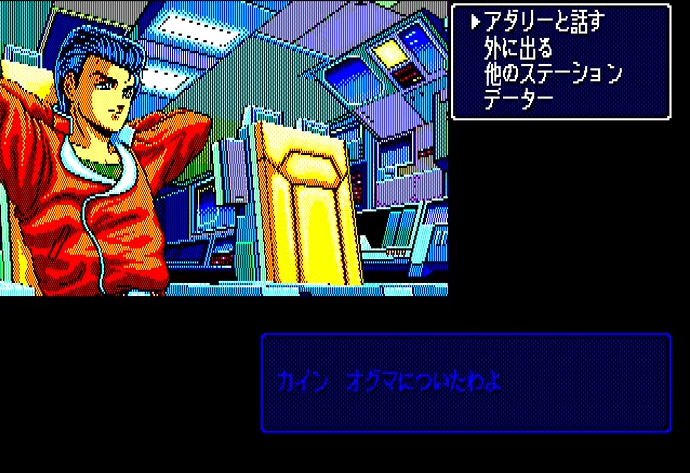
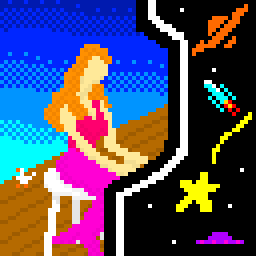
Kerry Brunskill at PC Gamer breaks the news about Startrader, a shmup made by Falcom for the PC 98. Falcom was mostly known for its classic and unique RPGs, while the PC 98 was mostly known for its erotic anime-styled games that could somehow make full-color pictures (yes, often of naked women) often with only 16 colors and a whole lot of dithering. Startrader went against both the RPG and eroge trends, but still managed to host some amazing artwork.
How did they do that in 16 colors?
At NintendoLife, Kate Gray suggests 3DS and Wii U DLC you should get, if you can, before their eShops shut down. Games discussed include Fantasy Life, Xenoblade Chronicles X, Phoenix Wright: Ace Attorney Spirit of Justice and Dual Destinies, the many songs of Threatrhythm Final Fantasy and its Curtain Call sequel, and Fire Emblem Fates.
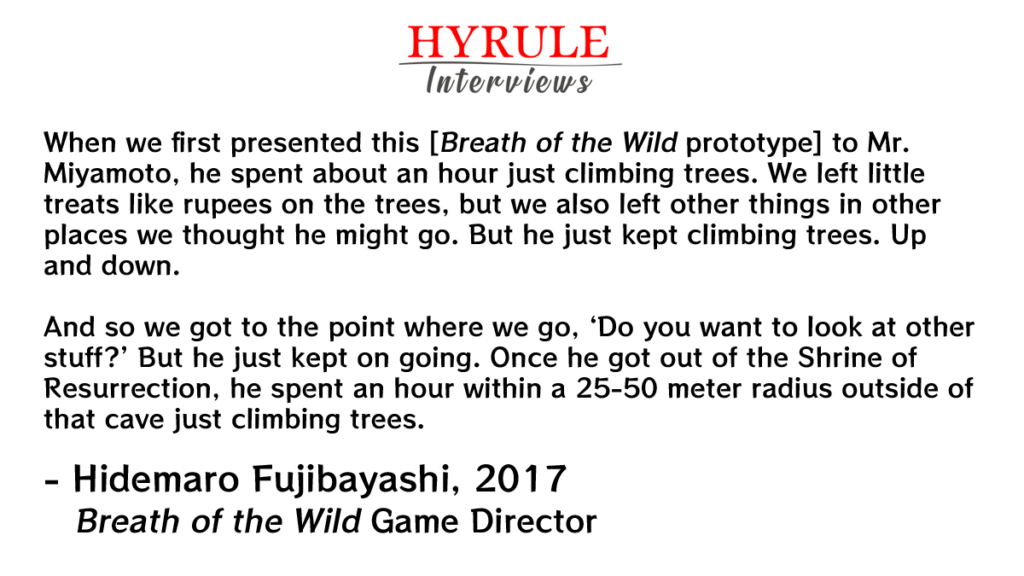
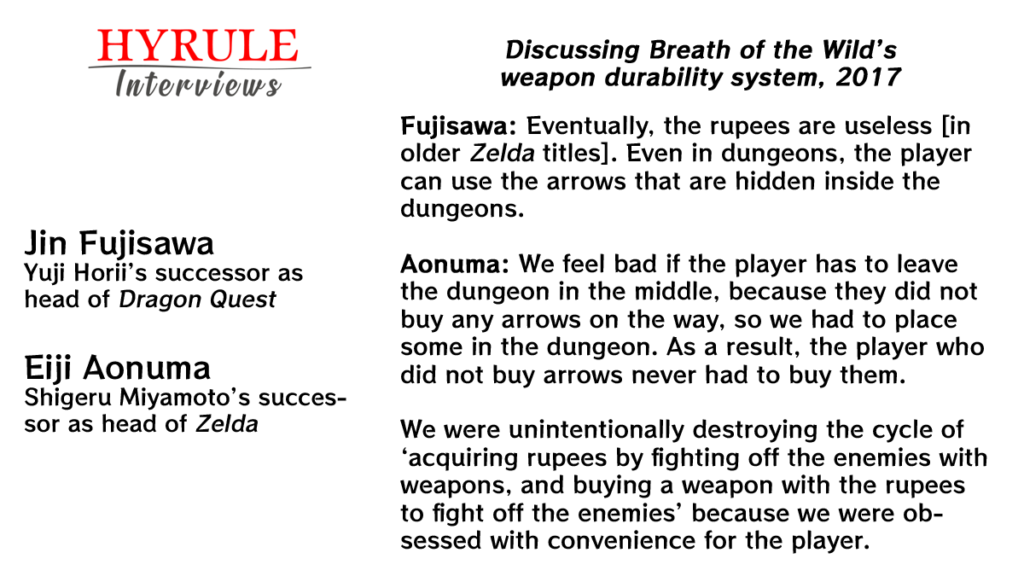
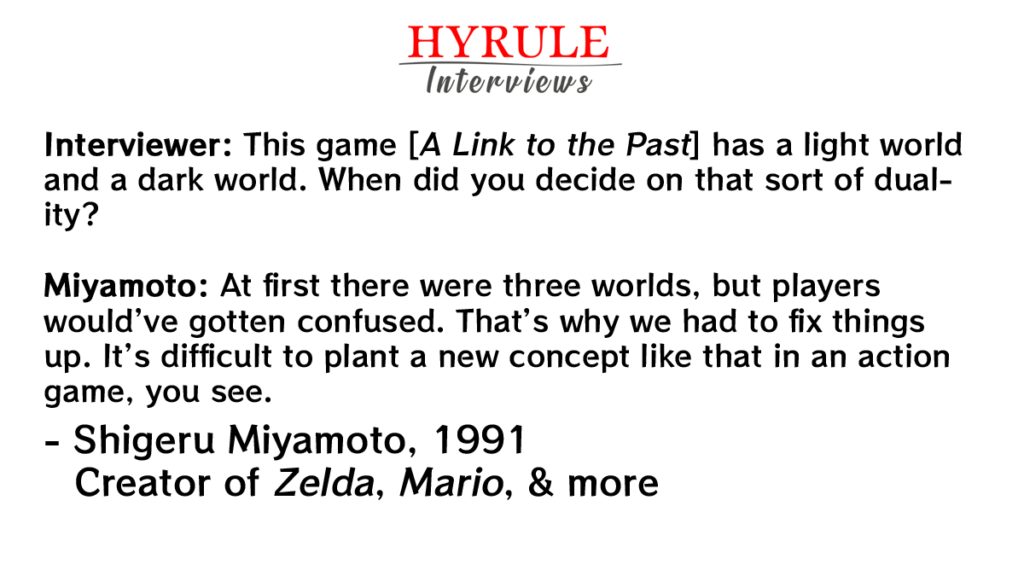
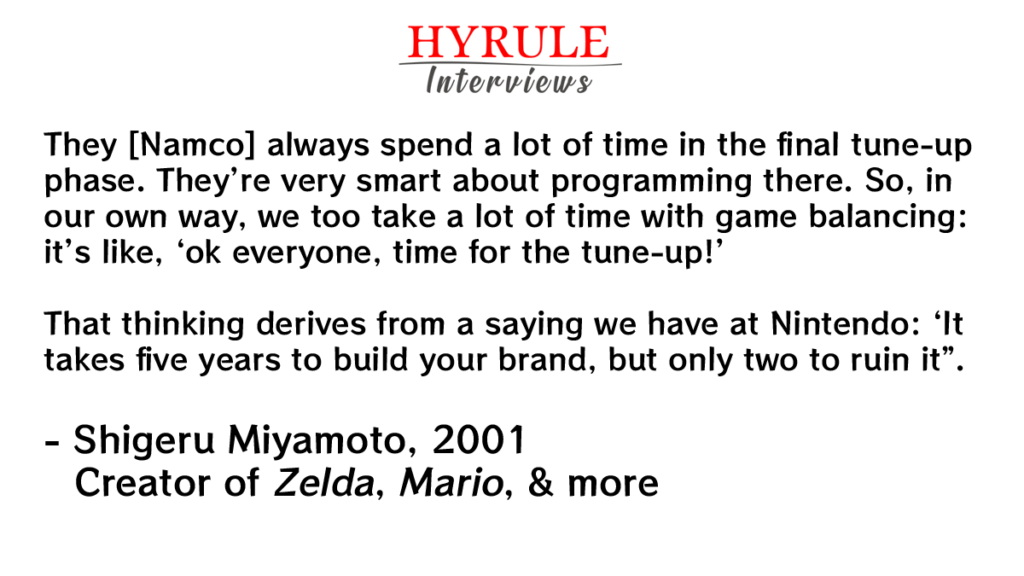
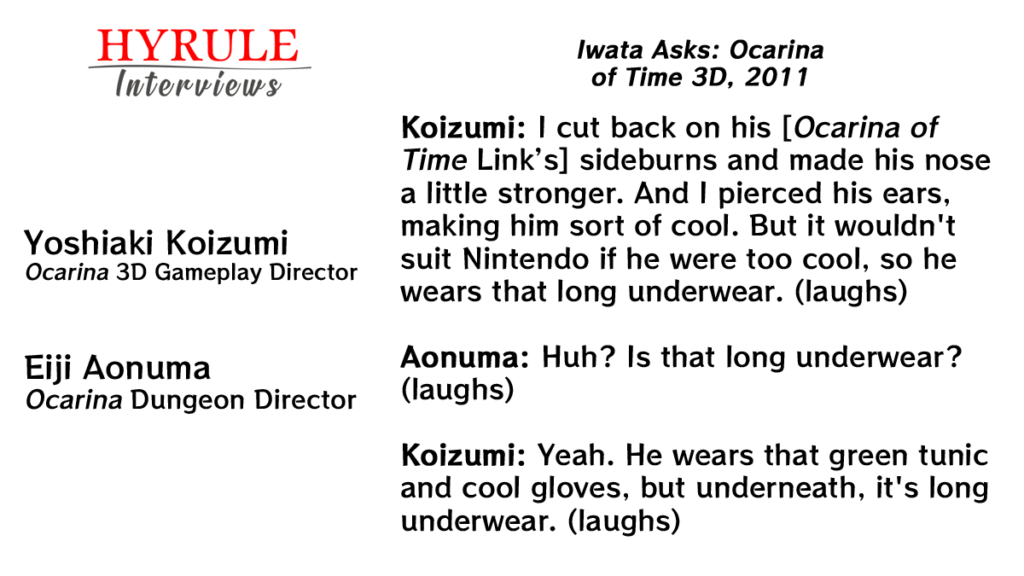
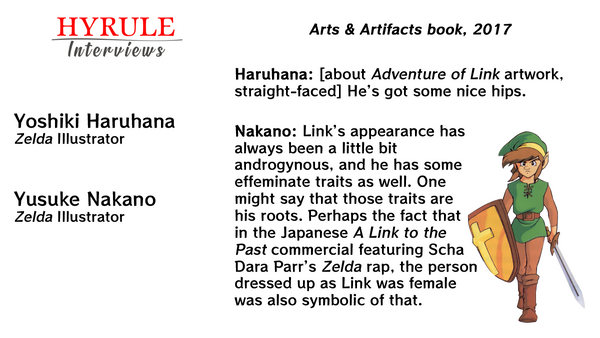
It’s a big searchable database of a lot of interviews the people who have made Legend of Zelda games! You can browse by selections of quotes, by game, by publication, by interview topic, or by job rule. It’s a pretty plain site to look at, but there’s a lot of gold to find there if you’re at all curious about this long-running and immensely popular series.
One useful feature the site offers is pre-made images of some quotes (sadly, not all) suitable for including in Twitter posts! Here’s a few:
Arcade Mermaid is our classic arcade weirdness and obscurity column! Frequently (no promises) we aim to bring you an interesting and odd arcade game to wonder at.
You are reading the words of a Castlevania fanatic. Your standard fan who came into the series with the Igavanias will tell you its pinnacles are Symphony of the Night or, if they’re really trying to impress, Rondo of Blood. Truthfully, both of those are fine games. But I am of the opinion that the best the series has ever been was the first and third Famicom/NES games, and that series creator Hitoshi Akamatsu got a raw deal. The first game particularly is an especially brilliant gem among the jewels of the early Famicom’s library. Every moment of it shows care and attention to detail.
Just a few examples. While many people curse the stream of Medusa Heads that harry Simon Belmont at several places in the game, the game is actually quite sparing with their use, easing up with them at certain telling moments. One particular place this happens is climbing the staircases in the second stage of Block 3: while you’re on the staircases there, interestingly, the Medusa Heads don’t attack.
Also, the Fish Men in the first and fourth blocks, on the first loop, are kind enough never to jump from beneath the player’s location. And while on the second and later loops through the game they will happily emerge right beneath your feet and bump you into the water, there is a tell even for this: except for a brief section where there are no candles, Fish Men only emerge from the water directly beneath candle locations. (I gained a small amount of internet notoriety when an online friend pointed out where I had observed this fact in a Metafilter thread.)
I could go on, and will for a few more sentences, even though this kind of stuff makes for boring writing. The subweapons are very precisely designed, each filling a specific role in the game. All of the game’s platforms are supported by background elements, and when the player climbs stairs to a new area, background pillars in the upper area mostly line up with those from the lower area. You can see the crumbling spire that’s the site of the Dracula fight far in the background in block 3, half of the game before you get to climb up there yourself, and it’s such an iconic piece of level design that almost every Castlevania game that follows includes it. Much of its brilliance is recounted by Jeremy Parish in his book on the NES Castlevania games. (An earlier version of the Castlevania material can be seen linked here on the Internet Archive, but please consider his book if you are able to buy it.)
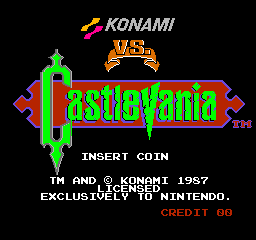
All of this is just preamble though, to the true subject of this post: the port for Nintendo’s Unisystem arcade hardware, Vs. Castlevania.
Castlevania is renowned as a tough game. While it only has six “blocks,” broken down into 19 stages, the game ramps up in difficulty pretty quickly through that thin territory. I’ve played through it all dozens of times. I’ve completed the game on one life before, but I still find the last level challenging. Even so, I’ve rolled both the score counter and stage counter. I’m good at Castlevania, not speedrunner-level, but, no offense intended to those who are, I have other things that I have to do. I cannot devote huge blocks of time to mastering individual games like I could as a teenager.
If you enjoy the original Castlevania, you might want to have a look at the Vs. variant, which is available via the Arcade Archives series for current consoles. Especially if you count yourself a master at it, this version will probably put you in your place.
In terms of hardware, the Unisystem is very close to a NES, and Vs. Castlevania doesn’t use any tricks that its home version doesn’t. Here is video of me playing through the first level:
The first block of Vs. Castlevania (Stages 00-03)
People familiar with the original will notice that the game looks slightly different. The colors are different, which is something that was frequently the case of the arcade versions of NES software. It’s likely that the Unisystem’s hardware is responsible for this: as a protection against bootlegging, which was rife in the arcade industry, each Unisystem arcade board had, in addition to the ROMs with the code for each game, a specific, custom PPU chip with the palette for that game embedded within it. People who copied the ROM chips into EPROMs in order to run a game without buying it from Nintendo would have something that could technically run, but the palette would be for the original game, not the copied one, and make the colors look funny. While I don’t know if this is true for Vs. Castlevania, it might explain the difference if the whole game had to use a single palette set.
Two major differences between Vs. Castlevania and its home version are immediately evident. One, in the first level enemies do four bars of damage on each hit to protagonist Simon Belmont. The first couple of levels of NES Castlevania are mostly just a warmup. Enemies in both blocks only do two bars of damage, meaning even without health powerups Simon can take seven hits without dying. The increased damage is the same as on the game’s second loop, after finishing the whole thing and starting from the beginning. The arcade sensibility, to keep players putting in money in order to learn the game and see its later stages, means it doesn’t have time to let the player acclimate themselves to its heated waters. The fire is lit; the soup is boiling.
Block 4 (Stages 10-12)
Even worse though is that, for each of the first three blocks of the game, the player only has 170 seconds to finish. It’s quite a shock if you’re used to the original, where time is practically never an issue! Even if you’ve mastered the levels on the NES, you’ll find, if you don’t constantly work towards reaching the door of each stage, you will easily run out of time. Expect the warning alarm to be ringing through the boss fights until you get used to the constant progress the game demands.
I don’t know what it is about the later blocks, but they have much more generous time limits, along the lines of the NES version. For these levels, the challenge goes back to surviving enemy attacks. Starting with Block 3, the game increases the damage done by enemies to levels never seen in the NES game even at its hardest: six bars, enough to kill Simon in just three hits. This makes Dracula at the end of the game quite a challenge.
If you manage to loop the game, you get to see something quite amazing. Desperate to end the player’s credit now, the game increases the damage done by enemies to eight bars, killing Simon Belmont in just two hits. More than that, the game pulls off the stops with nuisance enemies. You even have to face bats in the outside area before entering the castle! Take a look at this:
Block 1 revisited and the beginning of Block 2 (Stages 19-23)
The extra nuisance enemies are an especially interesting addition, since NES Castlevania never uses so many, even on the second loop and beyond. It’s exactly the kind of ludicrous challenge that people who have mastered the original game should seek out!
Castlevania is not the only Vs. game with substantial differences from the arcade version. Vs. Excitebike has many niceties over the home version, including some clever bonus stages. Vs. Balloon Fight in the arcade is a vertically-scrolling game, that played with two players gives each its own monitor. There’s lots mot to say about these games, but I’ve got to save some material for later.
This isn’t intended to be a big meaty article, but it’s worth noting that three online services from the 80s through early 2000s, the old Commodore 64 service QuantumLink, and both its successor America On-Line and AOL’s rival Prodigy, have experiences something of a revival in recent years.
The QuantumLink experience can be had with new servers using client software available from the QuantumLink Reloaded project. It provides software that can be used to interface with their servers running on either a real Commodore 64 (with PC software acting as an intermediary) or the VICE emulator.
Snazzy banner!
For AOL, the AOL Reloaded project (who, fittingly, has an announcement post on Livejournal) is still in the early days, but have managed to get the AOL 3.0 client interfacing with their server. And gaming and tech journalist Benj Edwards is helping with the Prodigy Reloaded project, which seeks to provide something for its old clients to talk to. If you’re interested on some of the details of how this worked, you should take a look at Prodigy Reloaded’s project page.
Image source: https://g.livejournal.com/10829.html The brutal JPEG artifacts in this screenshot edit are all part of the aesthetic.
I must emphasize that none of these services are hosted by their original companies or any rights-holders. They are all fanwork, and because of the ridiculous extents of copyright in this era could easily be wiped off the map without even a lawsuit, with a simple Cease and Desist. But until that happens (if ever), please enjoy.
Sadly, there is no word of a similar revival for former online leader CompuServe, which was my own early online hangout. AOL bought them in the late 90s, and, bizarrely, still puppets a compuserve.com site, which it loads with generic news for people who have yet to figure out that a much wider internet exists.
Their About page reads, “CompuServe: The Value Leader in Cyberspace.” I feel deeply sorry for whoever still loads this page on the regular.
In any event, none of these projects or sites can hold a candle to cyber1, which seeks to recreate the experience and the software of the old PLATO systems from the 1970s.
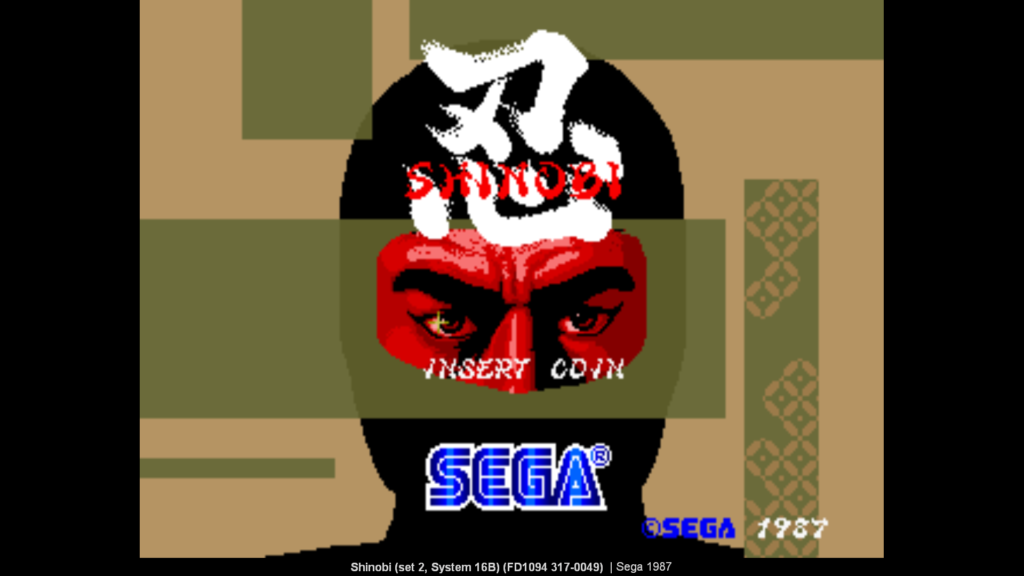
Did you ever look at your collection of legally-acquiredof course MAME roms and thought to yourself, I wish I could turn the attract modes of these arcade games into a screensaver? I thought that, and then thought, I should try to create one!
Then I stopped myself, and thought once more: before creating one, let’s use Google to try to find out if someone’s already done it first, save myself a lot of work, wot wot.
As it turns out, someone has made one! Currently it’s only for Windows, sadly, and it requires the NET runtime. It also needs you to have a stock version of MAME already installed. But if MAME is set up so it knows your rompath, it’s smart enough to ask it where to find them. You can even determine the command-line options that MAME receives. It’s nice! Which is why I mention it here! You’re welcome!
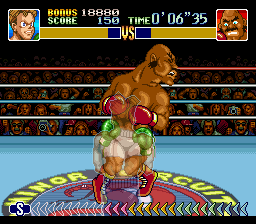
Bald Bull is one of those memorable characters who’s been in several games, but doesn’t get the respect he deserves. The crowd loves the Turkish Titan! And now you can play as him! (Image credit: Mobygames)
(Note, for clarity, you have to say the SNES game Super Punch-Out!!, because Nintendo made a different arcade game that they also called Super Punch-Out!! Also, the exclamation points are part of the name. I’m not just really excited.)
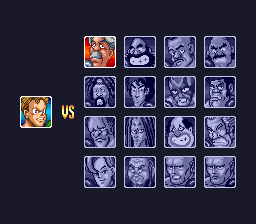
To do it, Y+R must be held on controller 2, and Start pressed on controller 1. This loads a screen where any opponent may be selected
The opponent select screen. (Image credit: Unlisted Cheats)
Then, on the character info screen, hold B+Y, again on controller 2, and press Start on controller 1 to allow player 2 to control the opposing boxer.
The code even works on the version of the game on Nintendo Switch Online, so if you have an account there you can try it out without setting up an emulator or digging up an old cartridge.
It’s interesting to note the times that the big gaming sites reported on this. As of this writing (yesterday) and according to Google, Ars Technica reported on it 18 hours ago, followed by IGN (16 hours), Kotaku (15 hours), and then Eurogamer. Reddit says the post went up there 19 hours ago, and Unlisted Cheats posted it 20 hours ago. News travels fast in the videoscape.
The phenomenon of the cheat code has gone kind of out of fashion these days. They still exist, but tend to be more for debugging than anything, especially since interesting features can conceivably locked behind paid DLC gates and bring in more lucre to the mothership. I know of a particularly interesting code that news broke about some time back, but let’s give that its own moment in the sun, tomorrow….
The always terrific 8-Bit Show And Tell shows us some secret codes for old cartridge-based C64 games that reveal they were developed by Andy Finkel. These are recent finds! I had the C64 port of Lazarian growing up, and much later I was surprised to find out I prefer it to the arcade version, the C64 version feels more polished and has better music!
Along the way we’re also taught about the super-obscure Commodore product the Max Machine, which is like a severely stripped-down C64 with a bad keyboard, no ports for storage devices, and only 2K of RAM, but including the C64’s iconic VIC-II and SID chips. It was designed solely to run cartridge software. The Max is mentioned on the C64 Programmer’s Reference Guide, where I saw it long ago and had to wonder what the heck that was about. Turns out the Commodore 64 has a compatibility mode that lets it run Max Machine carts!
The Max Machine only saw release in Japan, where it was very obscure. Just think, if Commodore had put a full 64K into that, maybe it could have supplanted the MSX? Well maybe not, but it’s interesting to think about!
My favorite shooter of all time is Zanac on the NES/Famicom, with The Guardian Legend following not far behind. I have a softspot for the Gradius series, but Zanac is really something special. I think you can get a sense for how someone feels about shooters as a genre in general by what they think about Zanac, its powerup system, its adaptive difficulty, and above all its blistering speed. Zanac presents a lot of Compile’s greatest strengths as a maker of shooters unalloyed. It’s a great shame that its Playstation-only sequel ZANACxZANAC was never brought to the US.
It was just a couple of minutes into Shmup Junkie’s video that I realized that he gets it. He knows these are amazing games, hugely foundational and inspirational. Without Zanac the whole history of shooters would have gone in a different direction. Plenty of arcade shooters, especially the Raiden series, are obviously iterations on ideas first found in Zanac.
(BTW, my favorite shooters? Besides Compile shooters and the Gradius series in general, I also like Twinbee and 1943. I generally don’t like the modern ilk of bullet hell games, which seem to me to be more about responding to patterns than dynamically-arising situations. This is all just me, of course, but it is me, that means something I reckon.)
Just learned today from Jeremy Parish’s NES Works, Data East’s Cobra Command had an alternate title planned in case they ran with trouble releasing under that title, possibly due to its name’s similarity to that of the bad guys from the G.I. Joe cartoon show. According to The Cutting Room Floor, that title was, well, not so great:
We link to U Can Beat Videogames once in a while here (in fact, here), and this week has an especially interesting installment, Beam Software’s cult classic NES game Nightshade. It’s a weird point-and-click adventure game, hugely ambitious and largely successful. Sadly it was released fairly late in the life of the NES. Nowadays it looks amazingly prescient, putting the player in control of a Batman-like hero with no powers at the beginning of his career. It’s an engaging combination of gritty and comedic, offering a Batman-style dark graphical look to its city, but also full of in-jokes, and some of the weirder character art on the system.
It’s arguably better to play Nightshade now than when it was first released. It has no save or password function, but that’s not so much an issue with save states. It’s available on Steam and on the Nintendo Switch Online service.
It does have the standard point-and-click style of obtuse puzzle sometimes, but there’s an abundance of cool ideas. You don’t have “lives,” but instead, when Nightshade “dies,” he’s thrown into a James Bond-style deathtrap. The first four times this happens, there is a way out of the situation, and if you can figure it out in time you get to continue the game with full health. (The fifth time, the trap has no escape.) Each of the traps is unique and a situation that appears nowhere else in the game.
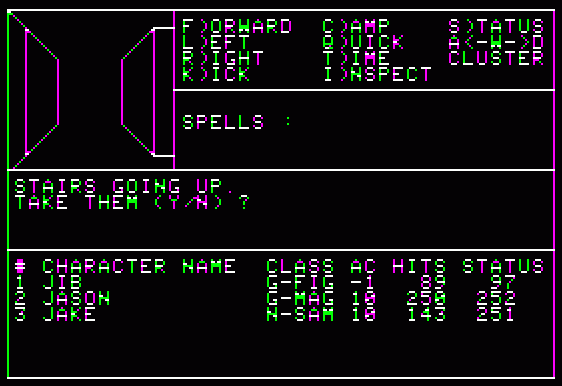
Apple II Wizardry. All images in this post are from MobyGames.
In @Play yesterday I mentioned a number of games that use Wizardry’s weird world metaphor. They’re sort of like roguelikes in that the world is divided into a grid of discrete spaces, but instead of viewing them from overhead, you are given a first-person view from the center of that space.
You don’t move with the same kind of smoothly-adjusting motion as Wolfenstein 3D would bring a while later, but movement instead jerks along one space at a time, and you turn in 90 degree increments. These games all disorient the player just enough that mapping them becomes important, but can be easily mapped on graph paper. Your more fiendish RPG dungeons of the type have tricks they play on you as you explore specifically to disorient you, like teleporting you to an identical-looking corridor without telling you, or spinning you around randomly. Wizardry and Bard’s Tale in particular delight in doing this.
It’s such a distinctive and immediately recognizable way to represent dungeon exploration that I’m surprised there isn’t a fan name for it, like “shmup” or “belt scroller.” I’ve calling them blobbers, but those actually get their name from the fact that, if you are commanding a party of characters, they’re all considered to inhabit that one space. The term doesn’t really apply to the mode of movement, only the atomicity of your group.
I gave a list of a good number of games that offer this kind of movement, but shortly after I thought of a bunch more, and they’re such a weird and varied bunch that I figured I’d take it as an excuse to catalogue as many examples as come to mind, and say some words about them in passing.
In the beginning there’s the Wizardry games, of course. I don’t actually know if it’s the first of the type, but it’s the earliest I can think of. Wizardry games using this format include, I believe, the first seven in the series; the 8th (and last in the core series) finally switched to a full 3D engine. There’s also some Japanese Wizardry games, and some of them use the style as well, but I can only personally vouch for one. That’s eight in total.
There’s some games that use Wizardry-style mazes as only a part of the experience. Some of the Ultima games do this. The Ultima predecessor Akalabeth uses them, and I know Ultima III does too for its dungeons. That’s two more.
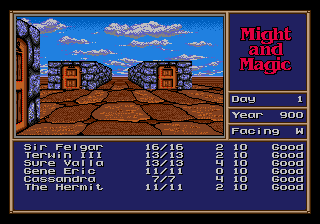
Might & Magic II for Genesis, image from MobyGames.
There’s two major series of Wizardly-inspired games. The original Bard’s Tale series were blobbers in the truest sense of the term. That’s four: I, II, III and Construction Set. The hugely underrated Might & Magic series also used them for both dungeons and their game worlds up to V. That’s nine more, for a running total of 19.
On the NES there are some surprising examples of the form. I already mentioned Interplay’s Swords & Serpents, a unique and probably doomed attempt to make a Bard’s Tale RPG on a ROM-based system. There’s multiple oodles (boodles! froodles! zoodles! poodles!) of interesting things about that game, like its character-specific password system and its four-player support, but we don’t have the time here to get into that. In fact, I could say that about nearly this entire list.
Two of the most ridiculous kinds of characters to explore 1st-person dungeons are a super spy (as in Golgo 13: Top Secret Episode) and lightbulb-tonguing uncle to a weird and macabre family (as in Fester’s Quest), both also on NES. Adding them to the pile brings us up to 22.
I mentioned Phantasy Star on Sega Master System and Arcana on SNES. There’s also Shining in the Darkness on Genesis and Double Dungeons on the TG16. There’s at least one Madou Monogatari game that uses the system, but I’m only adding games that I can remember without Googling or looking anything up, so I’m only counting it once. We’re now at 27.
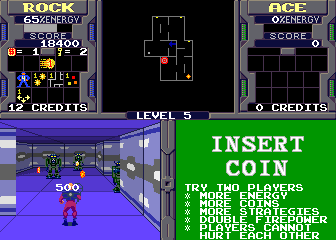
Xybots
There’s 3D Bomberman on the MSX, an early experiment in the Bomberman series where the mazes you’re in are 3D. In the arcade there’s Ed Logg’s Xybots, which was intended to be a Gauntlet sequel but the play ended up being different enough that he changed it to a sci-fi game. Xybots breaks the rules slightly because your character is visible, but it’s still that kind of grid-based, first-person maze. More recently there’s, hm… at least five Etrian Odyssey games? That brings the count up to 34.
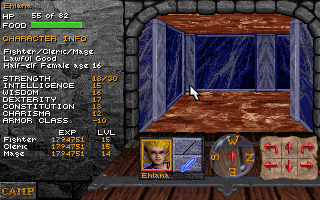
Some more miscellaneous RPGs I mentioned last time: Dragon Wars, Eye of the Beholder, and Dungeon Hack. I particularly like Dragon Wars and Dungeon Hack, although for completely different reasons.
Dungeon Hack
Oh! Let’s not forget about the D&D Gold Box series, which use 1st person grid mazes for dungeon exploration. That includes Pool of Radiance, Curse of the Azure Bonds, Secret of the Silver Blades, Pools of Darkness, Champions of Krynn, Death Knights of Krynn, Unlimited Adventures, and the Buck Rodgers game made in that style. There are other computer D&D games from the time, but they didn’t use that engine. These games also had other modes of exploration, and overhead-view combat, so they aren’t as tied to the format.
Finally there are some other miscellaneous games. Blobber-style mazes were a low-resource way of immersing the player in a labyrinth, even if there was nothing else in there of interest. My first exposure to the field was a C64 BASIC game called, natch, Labyrinth. I remember seeing a shareware DOS game called 3-Demon. The game that Strong Bad poked around in the Friendlyware video I linked last time is Killer Maze, and definitely fits the discretely granular bill.
It’s a good excuse to embed the video. (14 minutes)
So, all in all that’s 48 games completely from memory! But I’m sure there’s more; can you think of any others?
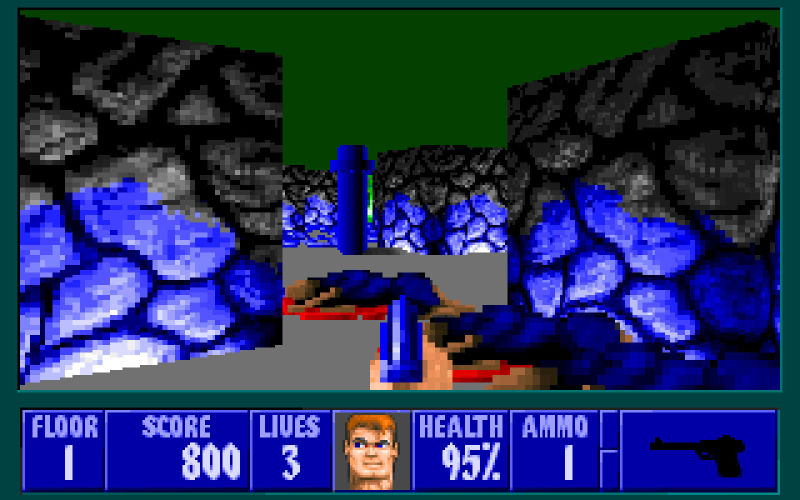
Wolfenstein 3D
When Wolfenstein 3D came out this entire style of world presentation immediately fell out of favor. Wolf 3D has very much that same kind of grid-based world, but no longer is your position locked to the center of each space. You can turn in angles of less than 90 degrees, and there’s more of a real-time immediacy to the game that’s a lot more engaging.
Wolf 3D pretty easily destroyed this genre. Almost no blobber mazes show up from that point on except for some edge cases that are explicitly calling back to the old style, like the later Japanese Wizardry games and Etrian Odyssey. It is interesting that, once computers became powerful enough to render worlds in a more fluid and immediate kind of way, it made these kinds of distinctive presentation shortcuts irrelevant. It’s kind of saddening.
EDIT: One I had intended to include but somehow left out is Dungeon Master, which xot reminded me of in comments!
Of all the @Play columns, which begin to approach 100 in number, I have only directly tackled Angband once. I admit, that’s a huge oversight. Our first treatment of Angband was on GameSetWatch, which now only exists on the Wayback Machine. A reprint of that column is in my @Play collection Exploring Roguelike Games, out in print through CRC Press, but that’s admittedly kind of expensive.
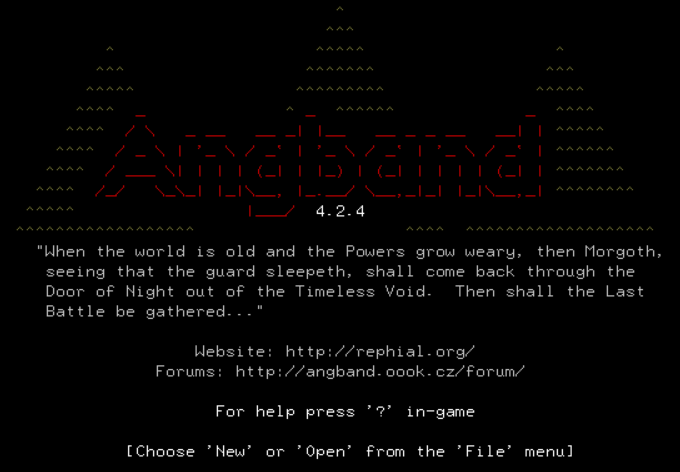
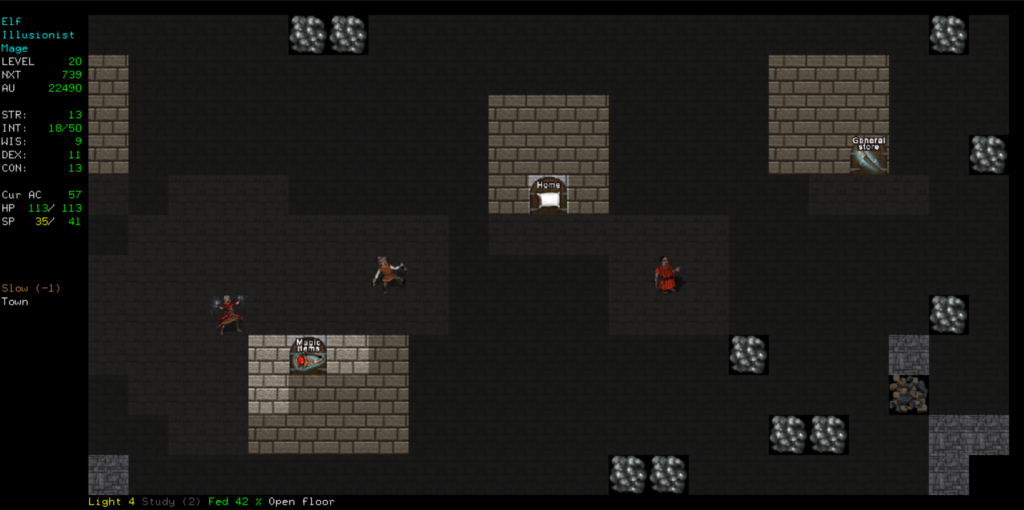
Don’t let this retro title screen fool you, these days, on Windows at least, Angband has full-color graphical tiles.
An Angle on Angband
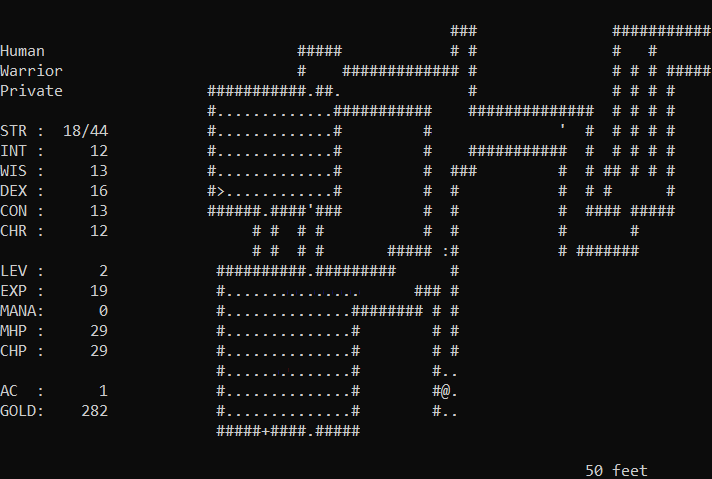
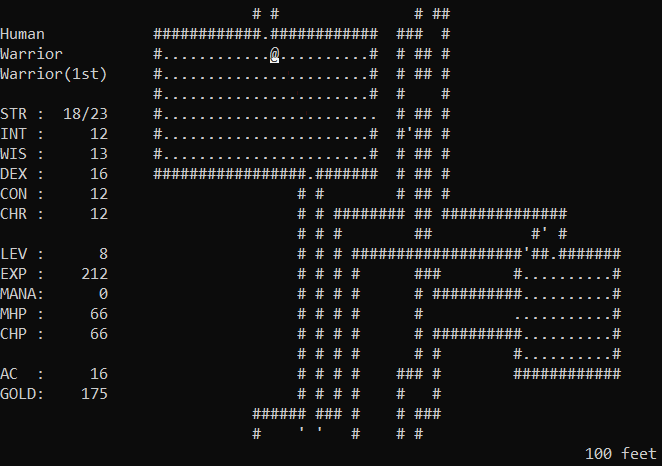
If you’ve played a Hack-like, Angband (home page) will probably look fairly similar at first. It, too, is a grid-based dungeon exploration game where you fight lots of monsters and find objects with unknown properties that you must discover as you play. Both games have randomized maps, dangerous monsters with fearsome abilities, powerful magic items to use against them, spells you can learn and cast, and traps you must look out for. Both standard-bearer for the Hack series, NetHack, and Angband now feature graphical tiles by default, although they can also be played in the old ASCII-based format.
Where the games differ is in their general philosophy of what dungeon exploration means. While NetHack has lots of strong monsters, it seems to take the view that the dungeon itself is your greatest opponent. The puzzle of figuring out item identities is a larger part of the game, and NetHack offers both more uncertainty in identification and more ways to identify. NetHack has more set locations that offer specific puzzles players must overcome, like finding the Luckstone at the bottom of the Gnomish Mines, or getting past Medusa, or crossing the moat around the Castle; Angband has only one set location, its Town, although there are lots of special areas that can be randomly found within its dungeon levels.
NetHack’s dungeon cannot be exited without giving up the game, for even once you get the Amulet and escape, you’re thrown into an End Game that functions as a coda to your adventure; in Angband, you’ll probably leave the dungeon many times in order to avail yourself of the Town’s useful services. In Angband, this Town offers shops where you can buy and identify items, but the shops are all menus. NetHack’s shops have a physicality, in that they’re rooms in the dungeons, overseen by a Shopkeeper character, which allows players to steal from shops if they can survive the shopkeeper’s eyes and wrath. And, of course, NetHack has its iconic pets that can help you explore the dungeon and provide other services, while in Angband you fight alone.
NetHack’s has a stronger sense of place than Angband, where dungeon levels are much larger but also less distinctive, and anyway are forgotten once you leave a level. If you go downstairs then right back upstairs in Angband, you’ll find a completely different map waiting for you, with new monsters and items. NetHack’s dungeons persist so long as your character survives, and you can go back to a level after a long time and find it’s largely as you left it.
It’s possible to see a kind of rivalry between NetHack and Angband, but I think this is largely an illusion. Both games know what they’re about and are content to pursue it in their own way.
While NetHack has more name recognition, lots of people like Angband! It’s spawned several popular variants all its own. One of them, ZAngband, is basically its own game by now, with a ton of variants and other notable branch-offs.
The Legacy of Moria
While Beneath Apple Manor has many aspects of a roguelike, Rogue is still at the center of the roguelike genre. Rogue inspired Hack, and then, NetHack.
But also, Rogue inspired Moria, and in fact Moria predates Hack by several years. Moria may be the first “roguelike” game, in that it’s not Rogue itself but was clearly inspired by and derived from Rogue. Even the “direct” descendants of Rogue, like URogue and SuperRogue, came along after Moria. If there is another character-based game played on university computing terminals between Rogue’s release and Moria’s, word of it has not come down to me.
UMoria
Moria was created by (the recently deceased) Richard Koeneke. First written in a dialect of BASIC, then converted to one of Pascal, he left university and, like many other roguelike authors who exited academia, appears never to have worked on their game again. But he opened the game’s source, and some other people ported it to C, and called the new version UMoria. UMoria still exists, and can be downloaded to play locally or via a web browser.
The significance of Moria and UMoria on the history of computer gaming cannot be overstated. Rogue was popular yes, and has inspired a legion of games taking one or more of its aspects and running with them. But there is something fundamental to the core of Moria that has seeped even more deeply into CRPGs. Diablo’s credits mention UMoria as a direct inspiration, but more than that, the basic sense of Moria has become pervasive.
It is easy to forget now that there used to be all freaking kinds of RPGs, and early on games in the genre looked very different from how they look today. dnd and Oublette on PLATO systems have a slightly familiar kind of overhead view, with the walls of the dungeon around you drawn in lines, but monsters don’t exist outside of your immediate interactions with them. Wizardry, what is now weirdly called a “blobber,” has a grid-based world that is experienced in first-person, and this became a very common means of presentation, inspiring… well, all of these are purely from memory: The Bard’s Tale series, the Might & Magic series, Dragon Wars, Dungeon Magic, Eye of the Beholder, Dungeon Hack, Swords & Serpents on the NES, the dungeons of Phantasty Star on the SMS, Arcana over on the SNES, a funky 3D version of the original Bomberman on MSX, and countless other games that presented the mazes without the monsters. Even Strong Bad has wrestled against one of the blobber ilk with his begloved hands. (“Who’s Strong Bad,” asks half of my audience. I know, I’m old.)
UMoria
In particular, it should be remembered that Dungeons & Dragons, which inspired this whole category, was not a solo game. Despite promises of solitaire play in the 1st Edition AD&D DM’s Guide, you really needed at least two people, a player and a referee, or “DM,” to play; most groups had multiple players, each playing one or more characters. This is still how D&D is most commonly played today. Rogue was one of the games that, by attempting to offer a solo version of the experience, put the emphasis on the solo.
But Rogue has other things going on in it. Its identification game is a work of genius by itself, and the way its systems work together make it special in ways other than just being a D&D simulation. Its descendant Moria, on the other hand, offers a more generalized RPG framework, and that is what has come to suffuse and infect nearly the entire rest of video gaming. What Moria did was generalize the solo fantasy RPG experience. Moria has multiple attack types, like fire, cold, and electricity, and resistances to them, has equipment items with add-on special properties, and has a bunch of generally plain monsters but with colors that identify their properties like they were palette-swapped.
In fact, I do not think I am being hyperbolic when I say that, due to Moria’s influence on Diablo, nearly every game now that features what they call a “loot system,” is actually offering a Moria-style loot system. It is that pervasive. And Angband, as UMoria’s direct descendant, has kept up that system and elaborated upon it for over 30 years now.
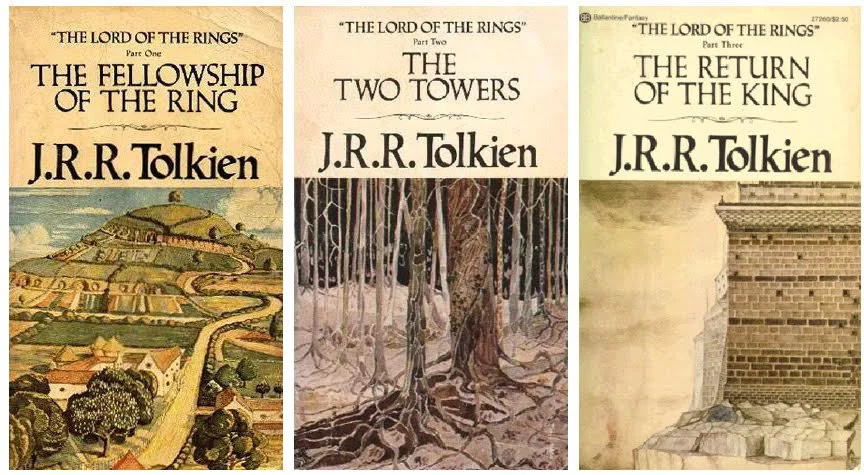
J.R.R. Tokens
Angband started out as mostly a themed version of UMoria. If the name Moria sounds familiar, like you might have heard it in a movie once, that’s because it comes right out of Tolkien. The Mines of Moria* are the dungeons of the game, and that’s why at level 50 the player fights a Balrog, trying to do a better job of it than Gandalf did.
* Off the subject. A fun game to play if you’re of a frame of mind is, when watching the relevant scenes in the movie of The Fellowship of the Ring, to refer to random things as “the Something… of Moria!” You can start from outside with “The Gates of Moria!” Say it like Gimli, with a gruff voice, and it helps if you can rouse yourself to try a Scottish accent. It’s more entertaining if it’s a bad one. Then: The Halls… of Moria! The Goblins… of Moria! The Hasty Retreat… of Moria! The Panicked Screaming… of Moria! I find that one can amuse themselves for quite some time this way.
Well you might have heard that there are other Middle Earth books than The Hobbit and the Lord of the Rings trilogy. One of these, cobbled together by John Ronald Reuel’s son Christopher Tolkien, is The Silmarillion. It’s a big collection of backstories and myths and legends of questionable canonicity.
You might remember that the Mines of Moria were not the final destination of the LotR books, but merely a stop along the way. If you read The Silmarillion, you’ll know that there were once even worse places in Middle Earth than that. One of them was a stronghold of Morgoth, called the pits of Angband.
That’s why you fight Morgoth in the game of Angband, on level 100, and his lieutenant Sauron, the same entity that was the big baddie in The Lord of the Rings, on Level 99. And what’s more, all of Angband is deeply drenched in token Tolkienness. It’s got a bunch of Tolkien monsters, both unique types, from the afore-mentioned end bosses down to Farmer Maggot and his dogs, to representatives of species like goblins, orcs, Ainur, and Maiar. A lot of the items have add-on properties like being a weapon “of Westernesse,” which in game terms means it’s quite good.
Despite how deeply it plumbs the pits, If you approach it as a full adventure in Middle Earth where you can visit the Shire, smoke a pipe with Frodo and hang out with Strider, Angband will disappoint you. It takes the wonder and beauty of The Hobbit, the Lord of the Rings series, and the Silmarillion, and uses them as basically a list of monsters and items. Some of the variants that I’ll get to later try to restore a bit of that, but for the most part Angband is a game of tactical combat, map exploration, and loot collection, and anything from the literature that doesn’t fit that purpose is left out. There’s no Land of Mordor, Where the Shadows Lie; no Gondor with its rich history, except where it involves special monsters and items; and no sad departure of the Elves to the West. (Writing about Tolkien involves capitalizing a lot of seemingly random terms.)
It’s not that Angband seeks to balderize Tolkien, but that it just has no place to use those aspects of his work. These are generic fantasy exploration and tactics games that have been given a coat of Tolkien Paint, probably by Tom Bombadil, who has had difficulty finding work lately.
What Angband gets from the Lord of the Rings and its subsidiary books is a rich lore that it can just do with as it pleases. It lends weight to the games. Instead of just making up a bunch of monsters, which often falls flat, it puts on an Elven Cloak and seems richer for it. It’s not just Angband itself; there’s a whole family of Angband variants that work by replacing (or sometimes, just supplementing) the Tolkien stuff with material from some other author, from Roger Zelazny to Anne McCaffery to H.P.Lovecraft to Terry Pratchett.
That makes a good enough introduction! Next time, in a week, we’ll offer some early playing advice, then maybe a timeline of Angband and its versions, and after that will come the Herculean task of looking at some of those many variants. See you soon-adillo!