
Sundry Sunday: What Could Possibly Go Wrong?

Sundry Sunday is our weekly feature of fun gaming culture finds and videos, from across the years and even decades.

May 22nd is the launch date of the remarkably anticipated Bubsy 4D, the most looked-forward-to Bubsy game since, well, since Bubsy 1. The franchise has been on a steady downward slope since the SNES/Genesis original, so it’s nice to see the character do good for a change, unlike literally every other original take the character had.

The original Bubsy had instant deaths, leaps of faith and gameplay so frustrating that the nine lives Bubsy started with seemed insufficient. Its designers gave Bubsy Sonic-style speed but without his spin attack. Bubsy’s only means of attack was to jump on enemies but which were often off the screen when descending from jumps. I tried playing a bit of the original Bubsy a couple of weeks ago and it turns out the game was worse than I remembered.

Bubsy wasn’t entirely a failure in the marketplace so he got four sequels, not counting the one happening later this month. One was so terrible that it became a meme.

It was on the strength of that questionable success that Bubsy got a pilot for his own cartoon show. So let’s take a moment, or 28 minutes, to look back on it: the Bubsy that once was and could have been.

It was a time when lots of properties were getting one-episode days in the sun in the hopes of landing a series on Saturday mornings. They tried it with Battletoads and it failed a deserved failure. They tried it with Earthworm Jim and succeeded to the degree that it went to series, with an effort that many agree was pretty okay! Now it was Bubsy’s turn. What could possibly go wrong?

This, this is what could go wrong. With original commercials too.

I don’t want to heap too much scorn on the back of a 30-year-old pilot for a failed cartoon show. Its flaws now should be more than evident. Jokes are fired off much too quickly and have no room to breathe, and the sound design is confusing and hyperactive. Compare the Bubsy But lots of shows had problems like those. Earthworm Jim among them, but strong writing saved it. Compare either show to some classic Looney Tunes to get a sense of how far cartoons had fallen. No one expected SatMorn cartoons to measure up to the lushness of the Termite Terrace animators, but they could have slowed themselves down and had more faith in their gags.

By that point the writing was already on the wall for Saturday morning. A decades-long television tradition was on the way out, hurried on its way by cable channels that devoted themselves to showing cartoons all the time instead of just once a week. But at least it was allowed to linger a bit; a Saturday morning Bubsy show could have just killed it outright.

Rings of Saturn

The Rings of Saturn logo, from the site itself

This post isn’t about any game specifically, but rather about an awesome Substack blog, Rings of Saturn, that examines the code of games from what they call the “32-bit era,” around the time of the Saturn to the Playstation 2, which includes the original Playstation, Dreamcast, and Gamecube, with a handful for the Nintendo 64, 3DO, Xbox and even the PSP along the way. They load them up in like Ghidra and search for unpublished codes, they look through demos and prototypes for ways to unlock features (sometimes ones that aren’t present in the finished game) and they make hacks to make unreleased features usable. All are very worthy activities that should be of interest for the kinds of people who would visit Set Side B. (You know who you are.)

A few selected items: a mod for Burning Rangers to play it two-player co-op, playing as Sonic in Christmas NiGHTS Into Dreams, enabling a secret English translation in Kingdom Grandprix, a debug mode in Grandia II, a patch to unlock the entire first Clockwork Knight game in Clockwork Knight 2, a code to unlock some extra cartoon artwork in Cotton Boomerang, extra options in Radiant Silvergun, a cheat code for Parappa the Rapper, and much more!

Really, if you’re a fan of games from this era, you’re almost bound to find something on this site of interest to you. Have a look!

Dealing With Mortal Kombat II’s CPU Players

In the past we’ve linked to Modern Vintage Gamer’s looks into how Mortal Kombat II and Street Fighter II CPU opponents utilize unfair advantages against their players. These games’ code react to player movements far faster than another human could, can activate special moves much faster than humans can because they aren’t limited by move input timing, and in the case of MKII have a random component in whether the player is allowed to do certain things to CPU fighters. It might be worth having a look at the MKII video from that post.

So then, what can the player do? Just because CPU opponents have unfair advantages no human player has doesn’t mean its AI can’t be exploited in certain specific ways. Danny Tsung06 has a 19-minute video demonstrating how to handle the various opponents:

Another thing we’ve linked in the past is instructions on how to activate Ed Boon’s secret developer menu in the first three Mortal Kombat games.

NESHacker on Basic NES Platformer Movement

A 6502 is not a bad little machine, but it does require efficient coding to get decent real-time results. NESHacker dives into basic Mario-style platformer movement in a 10-minute video

The main portion of the video goes into subpixel movement, a term you may have heard speedrunners use. Many NES platformer heroes don’t jump immediately to movement when a control is pressed, but instead increase acceleration, and that acceleration is measured, in the case of Mario, in 16ths of a pixel.

The process of conversion is pretty slick though. It doesn’t use floating point math but fixed point. Mario’s position isn’t stored just in hardware screen coordinates but in a number with four extra bits off the right side. This larger number is what acceleration math is performed on, and when it comes time to position Mario’s sprite matrix (he’s not properly a sprite because he’s made of several), the code divides by 16 by just rolling the bits to the right, which is a very time performant operation on a 6502.

Other useful tricks are explicated, like storing controller states in a single byte (easily done since NES controllers have precisely eight buttons) and jumping. It’s not a general guide into general platformer implementation, but that’s okay, as there already exists a terrific example of that.

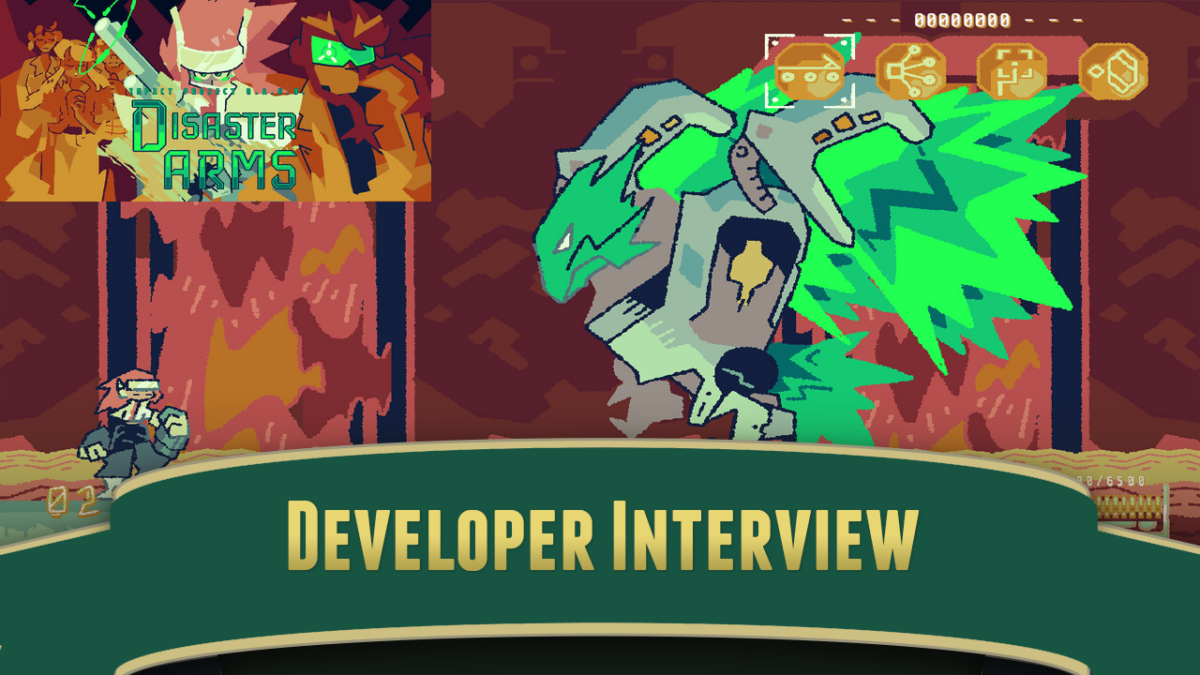
Modern Retro Design With Disaster Arms and David Peters Interview

For this interview, I (Josh Bycer) spoke with David Peters who is the designer of Disaster Arms and a lover of modern retro games to discuss the game, being inspired by Treasure, and what it’s like to make challenging action titles.

Christian Hammond Investigates Faxanadu Internals

Oh we here at Set Side B try to make all kinds of posts, but among my personal favorite kind are finding some deep dive into some aspect of a game’s inner workings and presenting it. These days, for multiple reasons (such as ease of monetization) many of these dives turn out to be Youtube videos, but not always.

Christian Hammond (Bluesky) has begun a series of text articles looking into the specifics of the implementation of Famicom/NES game Faxanadu.

To explain its name, Faxanadu’s name comes from Xanadu, an early JRPG from Japanese computer game maker Nihon Falcom. Falcom didn’t make Famicom games themselves, but they did sometimes license their games to other developers to make Famicom ports of them, or spinoffs. Faxanadu, developed by Hudson Soft, is such a spinoff. It has nothing to do with Xanadu other than being a non-scrolling exploratory platformer. Its name is a combination of “Famicom” and “Xanadu,” you see. While it’s not at all as popular as a Dragon Quest/Warrior, it’s well remembered by many.

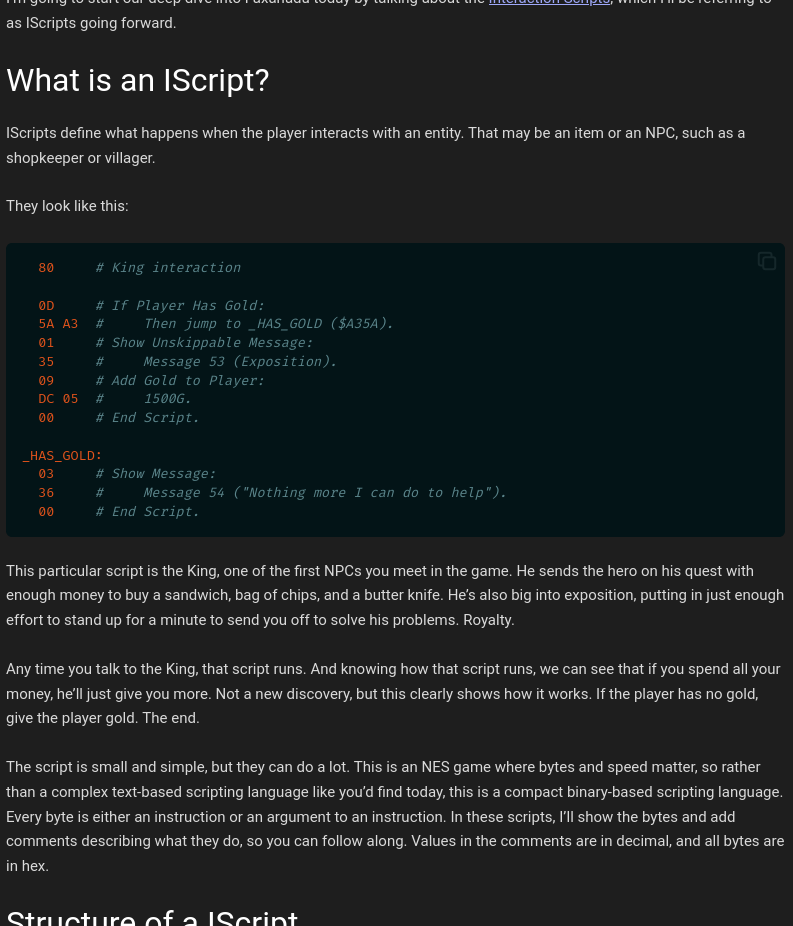
Christian disassembled the whole game, and found out that it has three separate binary scripting languages. His series to document and explain them so far has only Part 1, which is here, but the rest are forthcoming soon.

This first part explores what is possible using interaction scripts, or “IScripts,” which are run when the player runs into some object or speaks to an NPC. It’s quite easy to understand. If you have some interested in how these things are built and run, it’s worth it to take a look.

Basement Brothers Looks At PC-98 Brandish

Basement Brothers is a great Youtube channel that finds and runs classic PC-98 games on original hardware. The PC-98 is a computer platform that was only sold in Japan, and was a home platform for Nihon Falcom, the long-lived JRPG publisher. Here they talk about Brandish, a unique style of dungeon crawl created for the PC-98. (38 minutes)

The first Brandish game did get an English port, released in the US on the SNES, but in Japan it got three sequels. It used sort of mixture between first-person and overhead view, with a bit of roguelike mixed in. You viewed the action from above, but your character was fixed to the bottom center of the screen, and the view was behind his back. He could move or jump forward, or strafe to either side, but if he turned 90 degrees the screen would be suddenly redrawn to the new facing. Enemies would attack you in the field in real time, that is to say, combat was not modal but took place on the same screen as exploration.

It was a bit disorienting; you might think that the SNES’s Mode 7 effects could be used there, but no it kept the same quirk. Smoothly rotating the view wouldn’t happen until the PS Vita remake years later.

Basement Brothers digs up lots of classic Japanese computer games that are still barely known in the US. Please check them out some time!