From “Kin no Tori,” or “The Golden Bird,” an anime movie. This alchemist witch character and her cat-bat minions are so much fun!
It’s Halloween today! Boo! I don’t mean that in a bad way, I mean it enthusiastically! Boo, I say!
Growing up I was never a big fan of Halloween, other than the opportunity to get candy. I never wore a costume out. This has changed a bit in recent years, I still don’t dress up but I do try to observe the season. Today I’m running a video marathon of various things over on cytu.be. If you know me, you might know where to look to find it, if you’re interested in such things, but this isn’t really the place for it.
While waiting for trick or treaters, here’s a few vids to help you pass the time.
MrMatthews reviews all the Gameboy Castlevania titles (29m), a collection that rates from pretty good to abysmal. But that’s not what he says, he pretty much likes them all, even Adventure and Legends.
If your tastes run a bit more academic, Jeremy Parish has some dives into the Castlevania games: the original (16m) II: Simon’s Quest (15½m), Super IV (17m) and Circle of the Moon (23m). He hasn’t done III yet it seems. His old design discussions of the NES Castlevania games at anatomyofgames.com are still up, marred a bit by the fact that the site’s been hacked to host links to casino sites. Earlier this month Jeremy appeared on the Still Loading podcast to talk about the ‘Vainia, which you can listen to on the site, or on Youtube (1h33m). The embeds below are of the original and the podcast:
To finish off, an early Sundry item, TerminalMontage’s “Something About Castlevania” animation (4m). This is basically Simon Belmont’s whole personality: violence.
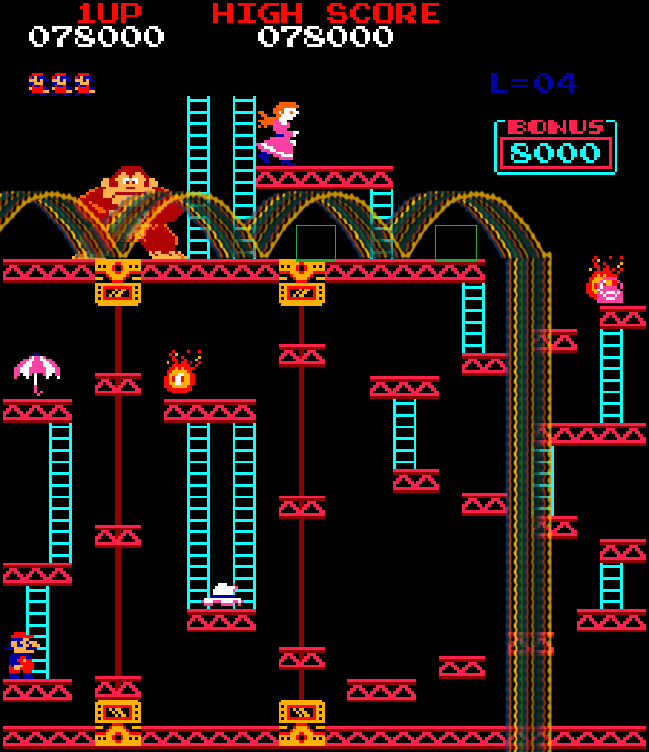
Another arcade classic strategy rundown, and again c0ncerning Donkey Kong. As the video rightly notes, the Springs board, a.k.a. Elevators, is most devoted players’ greatest barrier to playing to the kill screen, and even pros mess it up sometimes. I think it’s the worst part of the game, personally. Donkey Kong is great, says I, because it’s open to multiple strategies, while the later Elevators boards have to be finished a specific way, all because of those springs. That way is what this video (4m) is about.
Sadly the video has been made non-embedable, so it’s up to you to follow the link, if you care. The video encapsulates information on donkeykongforum.net (which it mislinks). That link is some hardcore geekery, of the kind beloved to Set Side B’s cadre of pixelated aliens, so please take a look.
Image from donkeykongforums.net.
Here’s the basics, in text form. Donkey Kong gets more difficult over the course of five “levels.” These are different from “boards,” a.k.a. “racks” or “screens.” In the corner of the screen there’s a notice, “L=X” where X is some number. That’s the Level. It goes up by one every time you finish a Rivets board.
The problem is, starting with Level 2, the spots at which the springs hit the ground is slightly randomized. The final climb up to Pauline’s platform is super dangerous, since Mario is vulnerable the whole way. Level 4 is the hardest difficulty for the springs on Elevators, and you have to handle it a very specific way: climb up to the first safe spot, wait for a spring that comes out bouncing at a specific location (near DK’s right foot) then running to another safe spot, then waiting for another specific spring speed to rush over and up the ladder.
So go forth and conquer the elevators, and as Coily the Sprite reminds us:
I’ll be honest, I got caught off-guard by the need to make today’s post, so it’s pretty simple today. But it’s still pretty cool.
There’s this Korean person who goes by Sanago on Youtube who used 3D pens to make models of various pop culture characters, and some of them are of video game characters. Here’s Sonic (11 minutes):
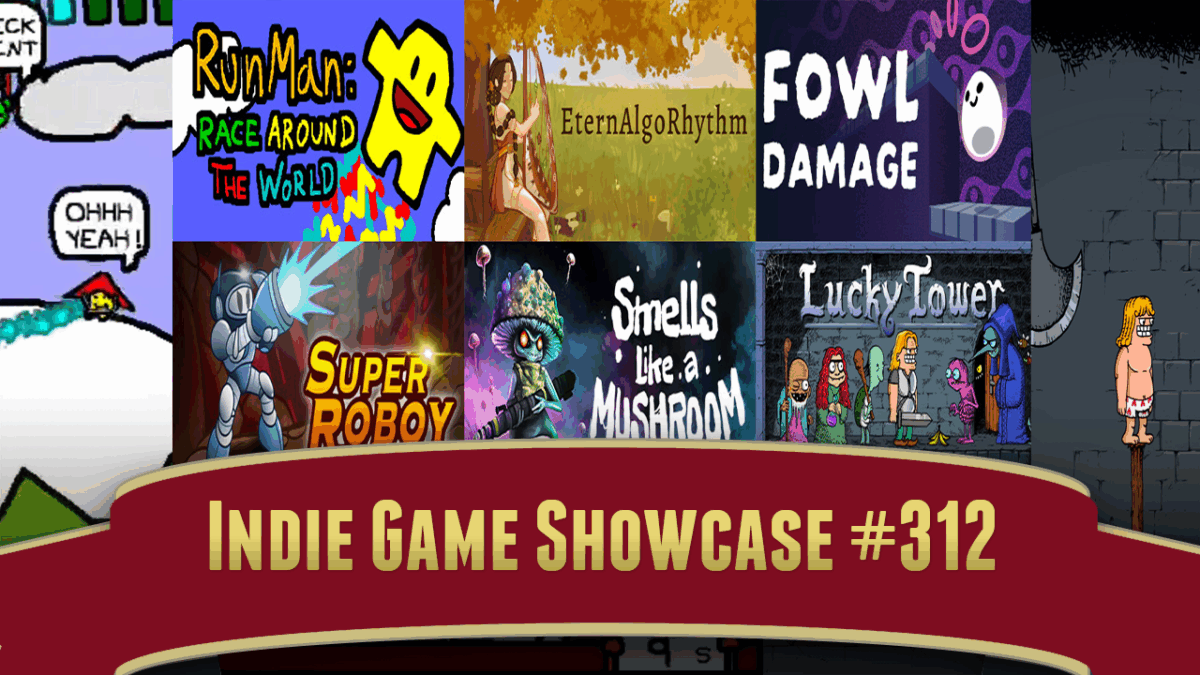
The indie showcases highlight the many games we check out each week on the channel. Games shown are either press keys, demos, or from my (Josh Bycer’s) own collection.
It’s been a couple of years, I believe since we reported on what we’re currently playing. This doesn’t fill in any blanks for the time since we last reported, but maybe it’ll be a useful snapshot for the current moment. Maybe we’ll return to doing these, maybe once a month?
rodneylives(John Harris): I’ve been playing a lot of Once Upon A Katamari, a new release as of this moment. Last night I played a bit of Shovel Knight for the first time, yes the very first. (I can’t play everything! And a bundle of the first game and all its DLC is currently on sale on the Switch shop.)
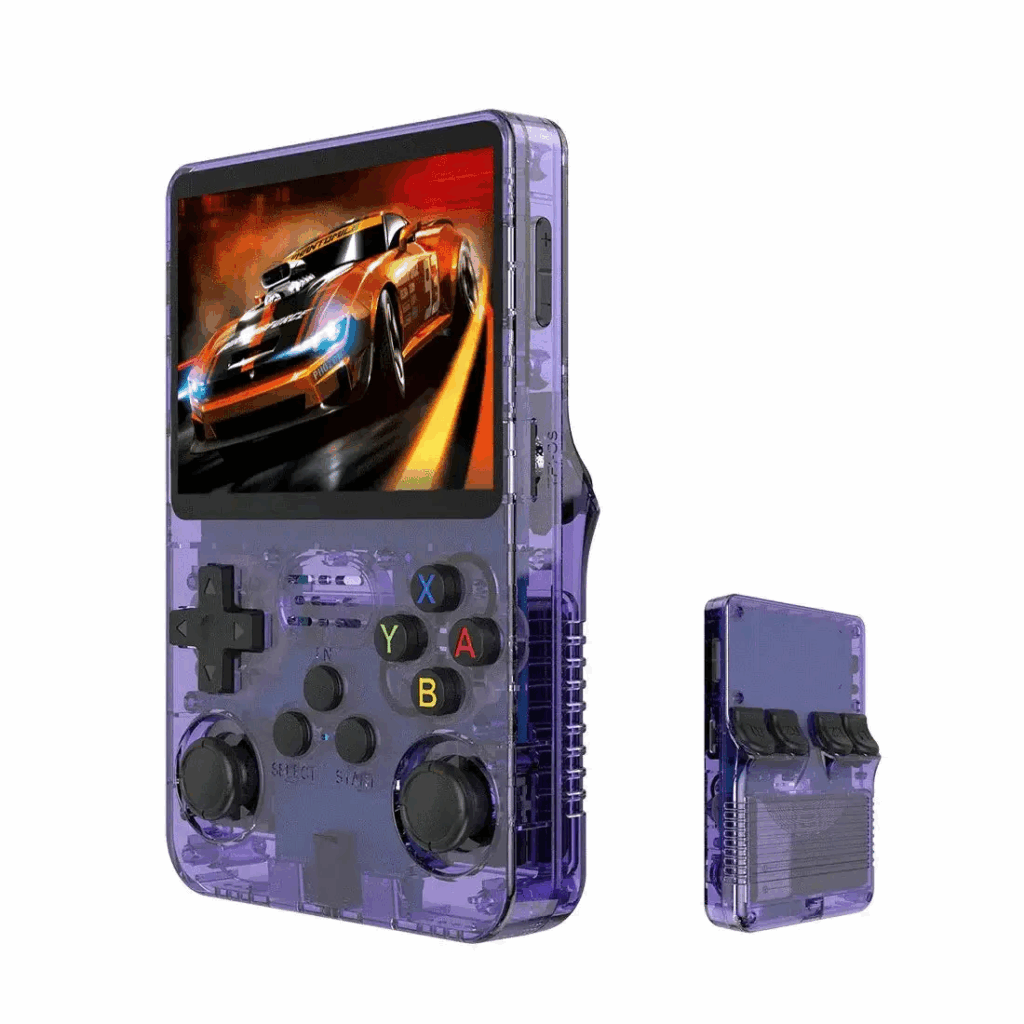
While mine’s not translucent purple, but white and with cool Apple II pixel art on it, the device pictures is similar to mine. I can vouch that it runs PSP games pretty well!
There’s also been some Final Fantasy VI and I, UFO 50 (Party House, Rakshasa, Mini & Max and Valbrace) and Power Wash Simulator (2nd playthrough). On Nintendo Switch Online, I’ve been playing Mr. Driller 2 for the GBA. Oh, and training amiibo players in Smash Bros. Ultimate. I also picked up a “Game Dad,” as Dan Fixes Coin-Ops calls them, at VCFMW 2025, specifically a R36S, and on it I’ve been playing a few favored things, particularly arcade games like Robotron 2084 and Cadash. What I’m really looking forward to, as you might guess from recent posts, is Kirby Air Riders on Switch 2, which isn’t here yet but is rapidly approaching.
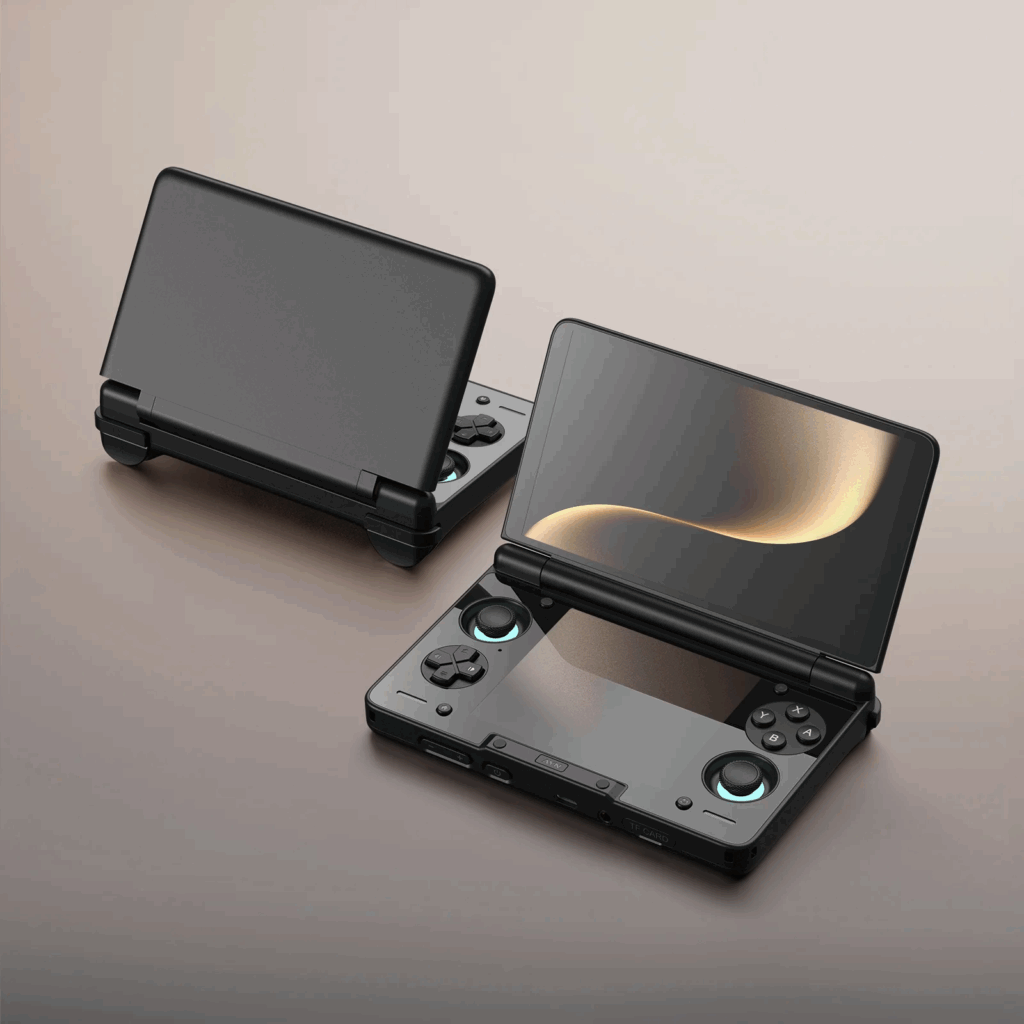
Keith Burgun: He recently ordered a much more capable device than mine, an AYN Thor, powerful enough, so he tells me, to run Switch games. It’s still on its way, so he’s been playing the PSP version of Final Fantasy Tactics on his Retroid Pocket 5. He’s enjoyed it, but deep into the game thinks he may be getting a bit bored with it.
An AYN Thor. While prices seem to be around $250, it’s a very capable device, with two screens in a DS-like form factor. The clamshell design helps protect the screens while in one’s pocket.
GWBycer (Josh “Game Wisdom” Bycer) plays lots of indie games for his Game Wisdom Youtube channel, and as contributor many of his videos end up linked from here, so you’ll see those roughly as they happen. He does mention that, for his own enjoyment, he’s been playing Silent Hill f. Apparently, the ‘f’ is officially lowercase.
Sundry Sunday is our weekly feature of fun gaming culture finds and videos, from across the years and even decades.
A few years ago, former long-time voice of Mario, Luigi and Wario, and current Nintendo “brand ambassador,” Charles Martinet posted some amusing videos on Instagram, of him playing around with some figures of the plumbers and improvising their voices during his vacation in Chile. At the time I found them charming! I don’t know about others? The posts have been preserved here (10 minutes), but they aren’t the point of this post.
SuperStaticPro made some Source Filmmaker animations that repurposed the audio into little vignettes. I also like them, and they are the point of this post.
NOTE: In another world, Roguelike Celebration is going on today! A lot of people worked hard to organize it, and more worked hard to present at it, including some of the coolest people in indie gamedev, IMO, just to apply a little timely peer pressure. As I write this it hasn’t happened yet, so not a lot to say that I haven’t already, but I’ll say more about this once the talks have actually occurred. In the meantime….
I overall really like the direction the news of Kirby Air Riders is going, even if I have a few mixed feelings about it. There’s a lot of cool and funny new elements, but it also feels like Sakurai might be leaning a bit too hard into the Smash Bros. style. So many of the new features are note-for-note similar to Super Smash Bros, which I can’t just abbreviate to “SSB,” because that’s the same initials as this blog.
Like the fully-voiced opening theme song. The feature of Smash Ultimate that I hated more than perhaps any other part was that stupid theme song. It’s not that it’s a bad song itself, but every time I started the game up I was greeted by a song about the most overused tropes, not just in gaming, but in current-day media altogether: light and darkness. Oh, if my griping might start a movement to take pop culture back from terrible good-slash-evil narratives I would be a pleased whatever-it-is-that-I-am. I got the Adventure Mode out of the way very early in my time with Ultimate, I didn’t need to be reminded it existed at every startup. Air Riders has one of these songs too. I’m sure it’s nicely sung and produced, but it’s the opposite of what makes Kirby music great: bright, cheery, impressively scored tunes with an incredibly quick tempo.
Other features in both games:
For starters, the interface, especially the menus, are extremely Smash-like.
Amiibo support, in the sense that both games store machine learning parameters onto the figure’s 2K of flash memory to support trainable characters. Yes, figure players are back, the feature only interesting to me and a handful of others. I wonder how the game will utilize the approximately ½K of flash storage available to game applications this time?
Uses a currency for unlocks, and a weird kind of fake economy. Smash Ultimate has gold and “SP.” Air Riders has “Miles,” which are essentially gold coins again. Is anyone annoyed that gold, a metal without a lot of industrial use, is still absurdly valuable mostly because of jewelry use and tradition?
A very similar visual style. When unlocks happen, words splash across the screen in your face in exactly the same way familiar to anyone who followed the Smash Ultimate updates eight years ago.
Sakurai says it’s different, but “Global Win Power” still looks a whole lot like “Global Smash Power.”
On top of it all it uses the Smash Announcer, who unless my ear is mistaken (it frequently is) has been with the series since Melee, at least in English.
Not that the requisite griping is over, there’s lots of really fun things unveiled too. Like the inclusion of loads more Kirby characters, some of them pretty deep cuts. My favorites have to be Lololo and Lalala, who are direct references to HAL Laboratory’s early MSX hit Eggerland, known in the US as The Adventures of Lolo. Other than an obscure Windows release many years ago now, Lolo and Lala basically live on Planet Popstar these days, with no forwarding address left to the King of Eggerland.
Do you have any blocks that need pushing? No? Well we’re just going to hang out in case you get some.
Í’m struck by the fact that, by having so many varied villains who all have become Kirby’s friends over the years, Kirby’s adorable little universe has become one of the largest and deepest in all of gaming. Among Kirby’s friends are a mischievous penguin, a mysterious knight with a battleship, a lady robot entrepreneur, a mouse thief, a spacefairing alien, a spider person, a tricky clown, and more. Most of these characters were created after Sakurai left HAL and Nintendo, but yet are fully embraced by Air Riders, and I love that.
And there are so many weird little unnecessary touches. There’s a full lobby-like “paddock” where characters can congregate between matches, and they gave everyone full walking and jumping animations just for interacting within it. Sakurai says it took a lot of effort to make them, and I believe him. Also, it seems to be fully catered. Chef Kawasaki’s been busy, I see.
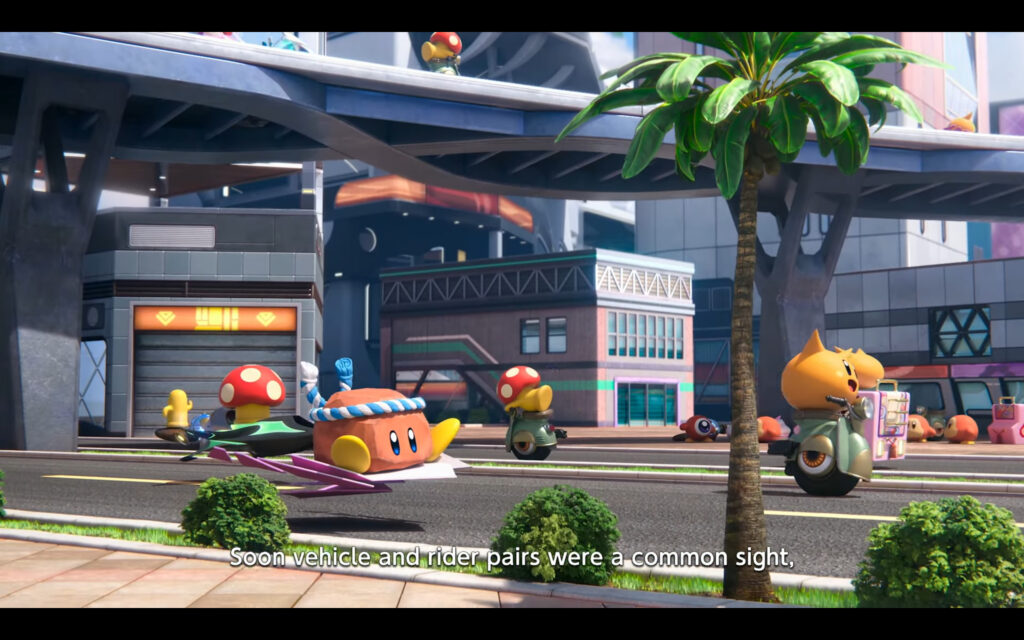
The best reveal was the new game mode, Road Trip. I’ve always liked Smash Bros’ weird side game modes, like Smash Run and Smash Board. There’s no one working in big gamedev who is as free with his thinking and design atoms as Masahiro Sakurai. He takes all these design elements and combines them in a way to create these little narrative engines. Road Trip fills the biggest gap of the original Kirby Air Ride, a game that, despite the greatness of City Trial, had absolutely no Story or Grand Prix mode, and so seemed a bit light. And indeed, there’s still no Grand Prix, or other structured racing-only mode.
Back to Road Trip, I especially like that it uses the patches from City Trial, so as you play you also create customized vehicles.
Kirby games don’t usually give you much of an indication of what day-to-day life in Dream Land is like, this is more than we’ve ever gotten.
All of the tracks from Air Ride are returning in Air Riders, although it seems the original City Trial City isn’t. Also returning is Top Ride, Sakurai’s weird homage to, of all things, Atari’s incredibly ancient Sprint series. He’s never mentioned Sprint in a Direct, but it’s so obviously a riff on Sprint. Even if he’s never heard of Sprint (given the breadth of his knowledge of the history of video games that seems really unlikely), it had to have been inspired by other games that were inspired by Sprint.
Another of Air Ride’s signature features, the Checklist, is back. To explain: each game mode has a grid of boxes, each with some feat or objective to perform. While you can unlock them in any order, you aren’t told what any of them are at first. But after you stumble upon your first unlock, the conditions of the squares surrounding that one are revealed to you, so it results in a kind of progression. Some of the squares unlock features when opened, and as you clear the board you’re eventually granted a handful of free checkmarks, to help clear out the hardest challenges.
In Air Ride, the Checklist was the only thing providing continuity between play sessions. That’s less the case with all the things there are to unlock in Air Riders, but what with Nintendo’s stubborn resistance to implementing Achievement features, as about the nearest thing to that Nintendo’s ever published, they’re welcome.
There’s a whole menu dedicated to making visual effects less jarring!
Here’s a flurry of little things I noticed:
A bespoke boss, a mecha version of our favorite emperor penguin*, called Robo Dedede. Say it quickly, it’s fun!
A special kind of collectable called gummis. They seem to have no purpose except to pile up onscreen in a physics engine and letting the player sift through them like a greedy candy miser.
A transforming vehicle, that transforms like a Transformer, metal bits shifting around into an alternate shape.
For the first time in any Kirby game, you can be nice to Whispy Woods, instead of making the old tree cry.
Some fun cameo characters revealed: Tortilding (from Forgotten Land), King Golem (from Amazing Mirror) and Computer Virus (Super Star), the funniest Kirby boss of all, where you fought it in a mocked-up JRPG-style battle.
A track only named “?” in the Direct, which uses music from the Nightmare fight from Kirby’s Adventure (the first “serious” opponent the pink blob creature ever fought), and features the Heart of Nova in the background.
For the first time really in a Nintendo game, it looks like they paid serious attention to accessibility! You can turn off screen-shake and move the camera so that motion isn’t so extreme. As time has passed I find myself more and more bothered by screen-shaking effects, though I’m not sure if that’s me, or just that they’re much more common nowadays than they were in the days of the NES.
Once of the license designs shown off uses iconography from the Japan-only Kirby Cafés.
I’d love to go to a Kirby Café some day!
* I think the official line is that King Dedede is some kind of eagle, but he’s never shown any hint of flying like a real bird, and the idea of Kirby’s first major antagonist being a penguin with royal pretensions is too much fun to reject.
While patiently waiting for Roguelike Celebration 2025 to start tomorrow, here’s something completely different, yet still somewhat random. The Youtube channel “Hidden Saves” points out two hard-to-reach item boxes in Mario Kart 64: the one hanging from the balloon in Luigi Raceway, and the one over the rock, only accessible from the huge ramp, in Koopa Troopa Beach. Along the way they break down the method the game uses to decide what item to give you from any box. Big surprise: it’s usually determined by what place you’re in.
Here’s the video (10 minutes) Or, since they spend over half of the video explaining the boxes and their methodology, you can click here to go right to the gist.
What did they find? Both of these boxes are rigged to give you a Blue Shell every time you hit it, even if you’re in first, where using it will cause it to circle the track and hit you who fired it. It’s not the result, due to the balloon’s weird timing, of naturally only getting the Raceway box while far behind, or of the spil you always take after getting the Koopa Troopa Beacn box knocking you back. That’s what they report anyway.
This year it’s happening between Saturday and Sunday, October 25-26. That’s the day after tomorrow! There’s an unusually good roster this year, and I don’t just say that because I helped find speakers for it this year.
We’ve already had a preview event with a couple of great talks, including a real star, Jon Perry, who created two of the best games in UFO 50, Mini & Max and Party House. While I spent a lot of time with Mini & Max uncovering its many secrets, it’s but a small fraction of the time I’ve played Party House. (If you want to hear Jon Perry’s talk, from September, you can find it here, as well as Ezra Stanton’s talk on Synergy Networks in roguelikes, and Alexei Pepers’ Designing for System Suspense.)
Mixing Hand-Crafted Content with Procgen to Achieve Quality
1:30 PM 10:30 AM 7:30 PM
Max Sahin
Stuff: The Behavioral Science of Inventory
1:45 PM 10:45 AM 7:45 PM
Florence Smith Nicholls
Roll for Reminiscence: Procedural Keepsake Games
2:30 PM 11:30 AM 8:30 PM
Alexander Birke and Sofie Kjær Schmidt
Hoist the Colours! Art Direction and Tech Art in Sea Of Rifts, A Naval Story Generation RPG
3 PM Noon 9 PM
bleeptrack
From Code to Craft: Procedural Generation for the Physical World
3:30 PM 12:30 PM 9:30 PM
Zeno Rogue
The Best Genre for a Non-Euclidean game
4:30 PM 1:30 PM 10:30 PM
Cole Wehrle
Play as Procedural Generation: Oath as a Roguelike Strategy Game
5 PM 2 PM 11 PM
Jeff Lait
Teaching Long Term Consequences in Games
6 PM 3 PM Midnight
Ray
A Mythopoetic Interface Reading of Caves of Qud
6:15 PM 3:15 PM 12:15 AM
Johnathan Pagnutti
Wait, No, Hear Me Out: Simulating Encounter AI in Slay the Spire with SQL
6:30 PM 3:30 PM 12:30 AM
Jamie Brew
Robot Karaoke Goes Electric
7:30 PM 4:30 PM 1:30 AM
Stephen G. Ware
Planning and Replanning Structured Adaptive Stories: 25 Years of History
8 PM 5 PM 2 AM
Tyriq Plummer
Scrubbin’ Trubble: The Journey to Multiplayer Roguelikery
8:15 PM 5:15 PM 2:15 AM
Andrew Doull
Roguelike Radio 2011-Present
Sunday, October 26th
Time
Speaker
Talk
12:45 PM 9:45 AM 6:45 PM
Ada Null
Dyke Sex and Ennui: Generating Unending Narrative in “Kiss Garden”
1 PM 10 AM 7 PM
Younès Rabii
We Are Maxwell’s Demons: The Thermodynamics of Procedural Generators
1:30 PM 10:30 AM 7:30 PM
Dennis Greger
The Procedurality of Reality TV Design – An Overview
4:15 PM 1:15 PM 10:15 PM
Paul Dean
Picking up the Pieces: Building Story in a Roguelike World
4:45 PM 1:45 PM 10:45 PM
Patrick Belanger and Jackson Wagner
Hand-Crafted Randomness: Storytelling in Wildermyth’s Proc-Gen World
5:15 PM 2:15 PM 11:15 PM
Nifflas
Music algorithm showcase
6:15 PM 3:15 PM 12:15 AM
Seth Cooper
Building a Roguelike with a Tile Rewrite Language
6:30 PM 3:30 PM 12:30 AM
Quinten Konyn
Anatomy of a Morgue File
6:45 PM 3:45 PM 12:45 AM
Alexander King
Don’t Pick Just One: Set-Based Card Mechanics in Roguelike-Deckbuilders
7 PM 4 PM 1 AM
Brian Cronin
Playtesting Process for Ultra Small Teams
8 PM 5 PM 2 AM
Mark Gritter
Sol LeWitt, Combinatorial Enumeration, and Rogue
8:15 PM 5:15 PM 2:15 AM
Dan DiIorio
Luck be a Landlord – 10 Lessons Learned
8:45 PM 5:45 PM 2:45 AM
Liza Knipscher
The Form and Function of Weird Li’l Guys: Procedural Organism Generation in a Simulated Ecosystem
If some of these talks seem like they’re spaced closely together, some of them are “lightning talks,” very short. Those have their titles in italics in the above list.
If you follow indie gaming circles, there are a fair number of exciting speakers among the talks! Jeff Lait (homepage) has made twenty highly interesting roguelikes, many as 7DRLs. Nifflas of course is the creator of Within a Deep Forest, the Knytt games, Affordable Space Adventures and others. Dan DiIorio is the creator of the oft-mentioned (at least in my hearing) Luck be a Landlord, and Zeno Rogue makes the long-lived, and brain-bending, HyperRogue.
And make sure to have a look at the Redbubble and Steam links too! In this year’s Steam selection, MidBoss and Shattered Pixel Dungeon are already on sale.
It’s your annual reminder that adamgryu’s Ghost Town Pumpkin Festival is online and live again, through and a couple of weeks beyond Halloween.
Log in, carve up a gourd with the easy mouse-based controls, and submit your new orange child to reside on the shelves for people to gawk at and wonder over.
My contribution for 2025
And some of the pumpkins that were up when I logged in this year:
We love it when we find weird and unique indie games to tell you all about! Our alien friends to the left herald these occasions.
I was recently reminded of one of my favorite works of interactive fiction, the text adventure Lost Pig (And Place Under Ground), which can be played here.
It’s a comedy game where you play Grunk the Orc, a good-natured green person who works at a farm, but unfortunately let the pig out, and he’ll lose his job if he doesn’t bring it back. This rather minor quest is complicated by the fact that the pig isn’t so easily caught, and both Grunk and the pig fall into a small set of underground rooms at the start. The chambers are the home of a friendly gnome, who at the time was recognized as one of the most conversational characters in all of IF, capable of talking about dozens of topics. The game even has an optional feature that suggests things you can talk to the gnome about!
Example of play, from start
But the highlight of Lost Pig is Grunk himself, who talk caveman speak like this, no article and refer self in third person. As Grunk describe himself: Grunk orc. Big and green and wearing pants. You can have Grunk take his pants off, to the embarrassment of everyone but Grunk (that includes the pig). Grunk may seem a bit stupid at first, but Grunk’s smarter than he sounds. Unfortunately, your formidable adversary, the pig, is pretty smart too.
A lot of IF can be a bit imposing. Difficult puzzles! Lots of ways to die! Saving often! Long play times! While the puzzles in Lost Pig are challenging, there’s not many ways to actually lose (unless you do some obviously bad things, like burning down the forest at the start). You don’t have to worry about making the game unsolvable, which frees up brain space to focus on solving puzzles. It is a very pleasant little game that won multiple awards at XYZZY 2007. As it turns out, the game is a sequel to Grunk’s LiveJournal, which tells about his previous adventures in the army. (2002-2007)