I’ve banged this drum a lot lately it feels like, but I have to reemphasize that the internet is not forever, and as Ryan North has told us lately, even the most popular website in the world is one missed bill from disappearing, probably forever. As this happens more and more often, big and well-funded content hosts like Fandom and Github persist, while smaller, independent information sources tend to fall away, which results in a rich-get-richer feedback loop. Independent sources of accurate information are so important, no matter the subject. It is difficult to fault anyone unwilling to keep content up and updated for a large portion of their lives, but whenever it happens, I appreciate it.
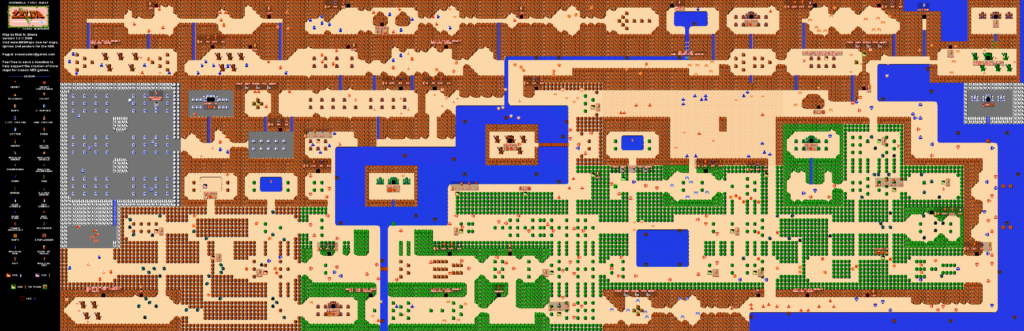
Before the death of Flash, their Zelda map used it to provide an interactive browsing experience that is sadly defunct now. This PNG version is still great, though.
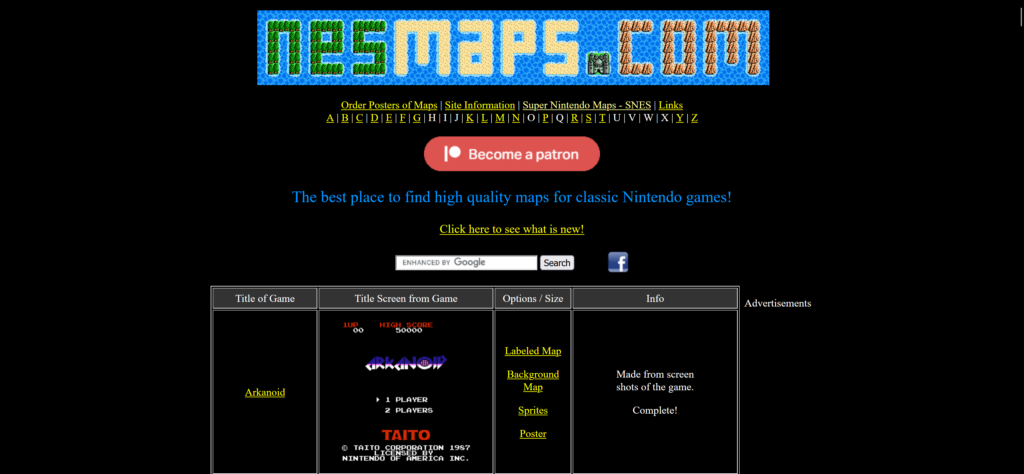
So I’ve been trying to celebrate the best, most long-lived websites out there, and NES Maps, and its sister site SNES Maps, qualifies, going back to around 2006. That’s 17 years! And it’s still there, quietly providing maps of just about any NES game you might want to find information on.
It’s not perfect. Their labeled maps of Castlevania III, I discovered just now, are incomplete, cutting off after Block 5, promising that more is coming soon for who knows how many years. But most other games have complete maps, including a number of Japanese-only title. It’s truly a great resource, and I hope they can figure out a way to keep it going for the long term.
The ending of Power Wash Simulator is too adorable to miss. It does count as a spoiler technically, but it doesn’t really give much way. It does contain that most important of elements to any current-era web content: KITTIES.
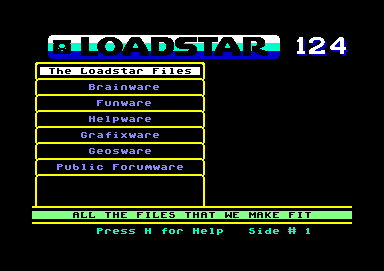
Aah that’s a screen I haven’t seen in a long long time.
1982 saw the founding of the Apple II computer magazine-on-disk Softdisk. Soon after Softdisk Publishing produced disks for other home computers too. One of them, Big Blue Disk, has gone down in history as previous employer of some of the original principals of id Software, especially John Carmack and John Romero. But another of Softdisk’s legacies was their Commodore 64 product, Loadstar, probably the longest-lived Commodore 64 software publisher. They published C64 software from 1984 to 2007. And most, if not all, of it is available online!
Loadstar is yet another of those computer gaming stories that must be told, and I’m in a pretty good place to tell some of it, because I beta tested for them for many of those years, and sold programs to them as well. Yes, several of their releases bear the programmer name John “The Mad Gamer” Harris. You have to understand, this was long before the word gamer reached common usage. In fact, as someone who may have primacy over the use of the term, I hereby forbid its use by anyone with misogynistic, anti-trans or racist intent. It is so decreed, hey-nonny-nonny!
Loadstar was lots of fun. Every month they’d send you two disks in the mail with several new pieces of Commodore 64 software on it. Under the watchful eyes of Fender Tucker and Jeff Jones, and later on Dave Moorman, it’s not that they grew an empire of Commodore programs, but they did manage to sustain that platform for a small but avid userbase for far longer than you’d have thought possible.
I plan to start doing Loadstar reviews eventually, but in the meantime, you can try out some of the later issues of this important piece of computing history at the site linked below. Note that you’ll have to have a means of running C64 software to use them, of course. The emulator VICE is known to work well. And if you want to hear the words of Fender, Jeff or Dave yourself, all three are on Facebook.
On Romhack Thursdays, we bring you interesting finds from the world of game modifications.
There was a period during the 8-bit era where games best known for being on the NES could get ports to other machines. Most of the ports we got in the US and Europe were not that great. There were a fair number of classic NES games with lackluster home computer adaptions. Even the best of these, like Mighty Bomb Jack, Castlevania and Life Force for the Commodore 64, usually paled compared to their NES counterparts.
I put the blame for this on the cartridge format. While a much more expensive media for releasing software than disks or tapes, it had the great advantage of being enormously flexible. The whole phenomena of mapper chips and other in-cart add-on hardware on the NES had no counterpart on the C64 during its heyday, even though there was really no reason the ’64 couldn’t use the same kinds of chips that the NES used.
Things were a little different in Japan on their native microcomputer platforms. While anemic ports were certainly possible there (like the infamous Super Mario Bros. Special) a fair number of console games got pretty good computer ports. Many of the best of these were for the Sharp X68000, a system I really must cover in detail soon, but the MSX platform got a fair number, many due to the efforts of Konami.
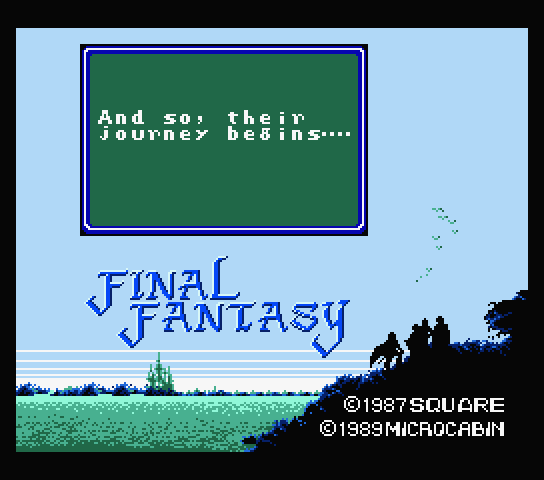
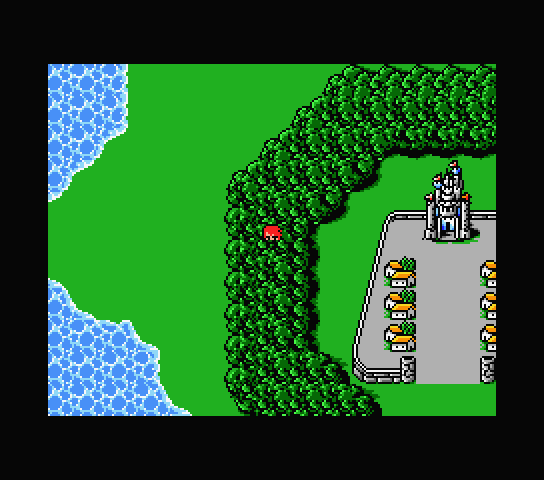
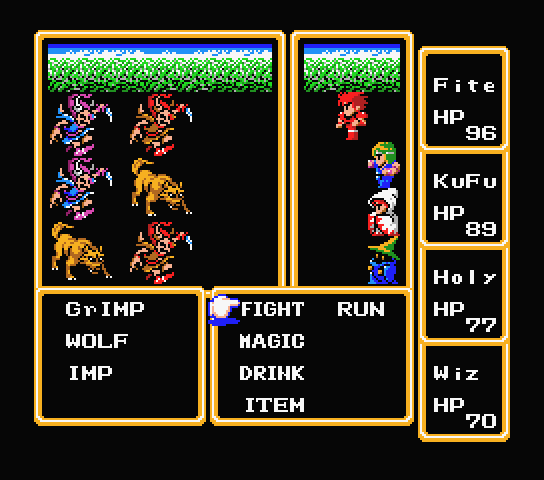
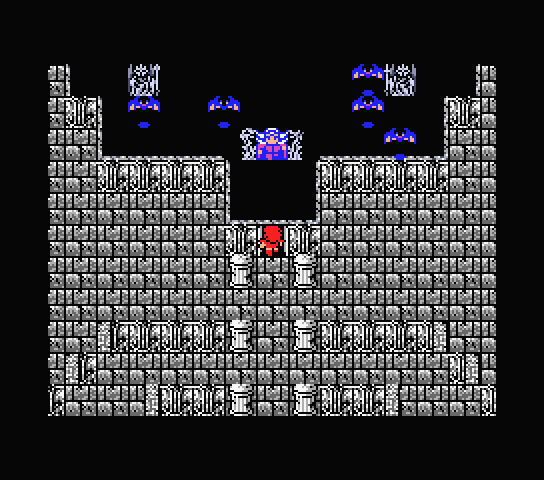
Both Dragon Quest and Final Fantasy for MSX ports with their own unique properties. Today’s post is about Final Fantasy, which recently got an English translation, and which in play and structure resembles its NES original to a large degree. It’s even a slight upgrade, with more colors in its characters and able to make use of an MSX sound expansion cartridge for improved music.
The game was reimplemented from the ground up, so it’s even missing many of the bugs that the Famicom original, forged out of raw bytecode as it was by consummate hacker Nasir Gebelli, is known to have. It would probably be the definitive early version of Final Fantasy if it didn’t play painfully slowly. You can’t see it in these screenshots, but instead of the world sliding smoothly across the screen as on the NES the terrain snaps by in eight pixel steps, and your party also walks more slowly than on Nintendo’s machine. And while it’s not as bad as loading times in the Playstation 1 Final Fantasy games, the game still lingers on a blank screen for several seconds when fights begin and end, which will drive you nuts before long.
The English translation patch that FCandChill put together basically just uses the NES game’s script, so no surprises there. These days games in the style of those early JRPGs are quite out of style, but if you still have a hankering to play a game that basically demands that you grind out levels to have a chance and where you will almost certainly total party wipe at least once during your run, you could do worse.
Thanks for reading Set Side B! This year we’ve talked about roguelikes and classic arcade games and romhacks and silly game videos and even some more esoteric subjects, like Wordle clones and crossword puzzles, and all kinds of other things. We intend to bring you lots more, over the next year, from the Flipside of Gaming.
Might I suggest taking a moment to investigate some of our finely-sifted tags? There’s @Play, the continuation of my old GameSetWatch roguelike column, Arcade for Arcade Mermaid and other arcade gaming posts, Sundry Sunday for fun gaming memes and videos, and Romhack for Romhack Thursday and similar posts.
PannenKoel2012 is the Super Mario 64 enthusiast (that’s the only word I can think of that matches) who has been working on reducing the number of A button presses needed to finish the game. They haven’t gotten it down to zero yet, and likely never will, but by resorting to increasingly extreme measures they continue to figure out ways to get it down. I think they’ve been working at this project for over 12 years; the oldest video on their Youtube account is that old.
Of arguably more interest than their quest, though, is its interesting byproducts, which is a series of Youtube videos, on both their main channel and alternate channel UncommentatedPannen, which not only explain how their many subtle and effective stratagems work, but also a number of aspects of how Super Mario 64’s engine works, and even basic principles of computer science. These videos are so in-depth that they have their own wiki to track the concepts they use, to explain turns like Parallel Universe (PU) and Pedro Spot.
When I say they return, it’s not that they ever left, but it’d been a while since they had a solid explainer. Now they have one, it has spoken narration instead of the text that marks many of the best videos, and the production values have even increased a bit:
In this video, a clever way to manipulate the pendulums in Tick Tock Clock to crash the game after 39 1/2 days of playing also takes into its sweep an excellent explanation of many of the systems compilers use to represent numbers and their limitations.
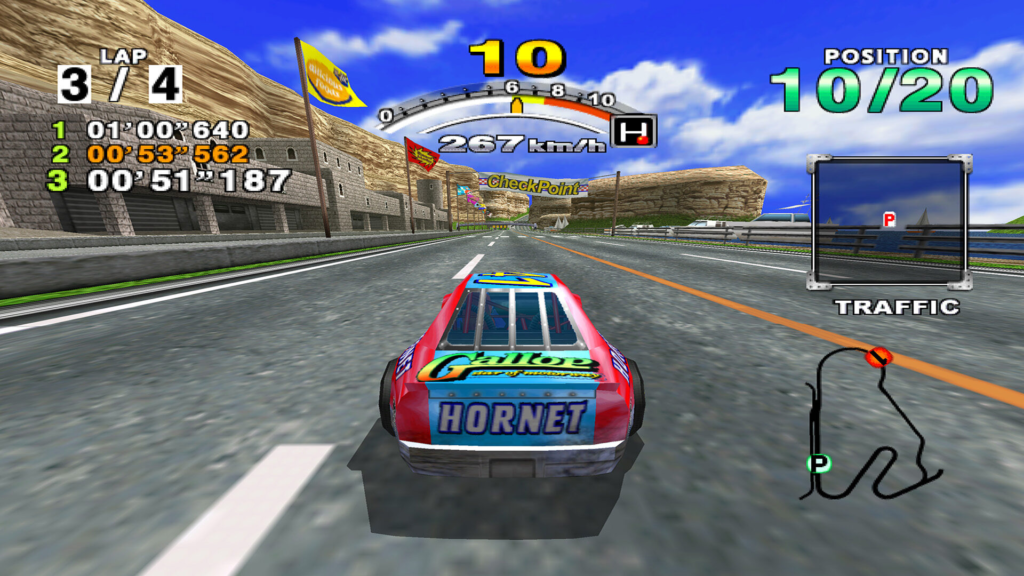
Some exciting news for people who have set up their Dreamcasts for online play. While official servers for Dreamcast games have all been taken down long ago, fans have worked towards making their own fan-run versions, and word from Dreamcast Junkyard is that they’re close to getting one working for Daytona USA 2001! While the game was released with online play, the servers for that game went down very quickly, staying up for just 18 months. Dreamcast Junkyard has an interview with ioncannon, the person responsible for this wondrous event.
Images from the article, ultimately from ioncannon
If you have a Dreamcast and the game, you won’t have to edit anything to get it working, but the Dreamcast Broadband Adapter does not work with it. You’ll have to use the built-in Dreamcast Modem in conjunction with DreamPi, a method for using a Raspberry Pi to connect a Dreamcast to the internet.
All the details are in the interview, so if you’re interested in trying this or just want to learn more, there the info be.
Posted yesterday to Youtube by Michael Taranto, creator of the webcomic Brawl in the Family. It ends with a promise of more videos to come, which is great news!
I’m thrilled to announce that today marks the beginning of big news for Set Side B. We’re switching our theme! We’re no longer providing the most eclectic and interesting of retro, indie and niche gaming information. No, starting on this auspicious day we’re going to all old websites and ancient meme videos!
Remember Slashdot? Remember Digg? I mean the Digg after the Digg that succeeded Digg! Have you been to Fark lately? How about MetaFilter? For some reason I’m still there! The twin fonts of news, Salon and Slate! Liberal infozones Dailykos and Talking Points Memo, they still exist, thumbing their noses at ennui and entropy!
Project Gutenberg is still gamely trying to give away a trillion ebooks! Snopes debunks all the worst misinformation out there, and Cecil Adams’ The Straight Dope column stopped running, but seems to be now running again, and new columns debut on their message boards! And the Internet Archive, in particular their Wayback Machine, is an essential tool for any thinking netizen, and I hear they could really use your support!
McSweeney’s Internet Tendency still brings a droll sort of funny. The IMDB may be owned by Amazon now, but you can still get a ton of information on nearly every form of visual media there. Rotten Tomatoes still aggregates movie reviews from critics and viewers alike.
Game stuff? GameFAQs, although owned by Gamespot, is still around, and StrategyWiki is the good version of what Fandom ruthlessly exploits. The Cutting Room Floor provides info and esoterica on hundreds of games!
We hope you’ve enjoyed this April Fool’s Day post! Happy thoughts! It’s intended as a real and useful post and certainly isn’t just an excuse to write whatever I wanted today!
But pleaase remember: the internet isn’t forever. The sites you love now won’t always be around. Ask me about Suck.com, Plastic, or the Brunching Shuttlecocks someday. But not today, I’ve got this terrible pain in all the diodes down my left side.
Have a few ancient Youtube videos from our voluminous files! (Yes, we keep files of cool Youtube videos. We’re awesome that way.)
That should be enough for now. Gotta keep some of it in reserve. For later….
Does it seem to you like there’s been a lot of Youtube videos here lately? It’s an unfortunate fact that a lot of the information and articles that once would have been in informative and quick-reading blog posts are now presented to the internet in a format that requires video editing software to create and 15+ minutes of your time to watch.
However, with Chrontendo it’s worth it. Dr. Sparkle’s epic-length tour through the entire run of the Famicom’s and NES’s libraries. Most episodes are an hour or longer, but you definitely get your time’s worth by watching them. And like U Can Beat Video Games, it’s nice just to have running in the background while you do other things.
We linked to Chrontendo #60 last June, titled “The Most Perverted Episode.” Sadly Chrontendo #61 doesn’t come with any titillation factor; it’s title is “Not really worth the wait.” It’s a series of games ranging from pretty bland to outright terrible. Covered are the months of May and June 1990, plus one game that’s a holdover from April. Within the video is footage and commentary on:
Castle Quest, which is not the same game as Castlequest in the U.S., which was a renamed localization of a game called Castle Excellent in Japan. It’s a turn-based strategy game that’s like Chess against a computer opponent, but with a random factor.
Snake’s Revenge, the disowned sequel to Metal Gear that Hideo Kojima didn’t work on, a game that some people like but Dr. Sparkle doesn’t. I’ll say it’s more polished than NES Metal Gear, at least.
Remote Control, a video version of a nearly forgotten MTV game show that couldn’t use any of the celebrity likenesses from the show.
Chip ‘n Dale: Rescue Rangers, another of the Disney Afternoon tie-in games. Dr. Sparkle admits it’s not bad, and it’s probably the best game of the episode, but is only really interesting when played co-op with two players. There’s a fairly scandalous piece of Gadget fanart here, scavenged from the aptly-named halls of DeviantArt.
Rally Bike, a port of a Taito arcade motorcycle game with much less polish than the original. I note that this game was ported by one of my un-favorite developers, Visco.
Battle Fleet, another turn-based strategy game, with a naval theme.